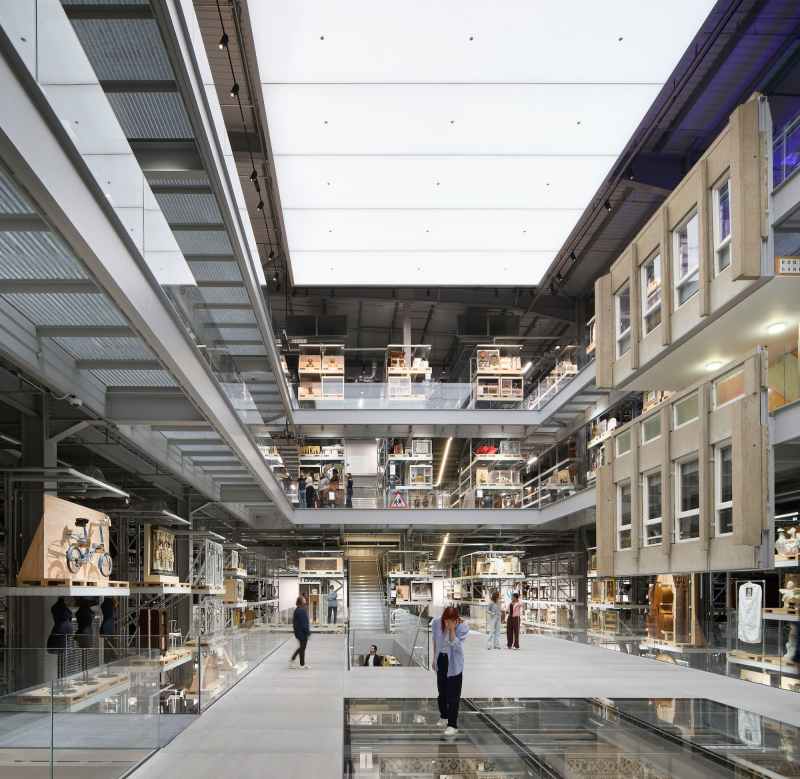
As the success of the Victoria & Albert Museum’s new open storage facility in East London shows, open storage is becoming the new “white cube.”
Overwhelming your audience with the sheer volume of stuff that you hold and making them believe that they are having a privileged look into your treasure house has turned out to be a way to bring in the masses and delight them, while also solving the problem to do with all that art –of which you exhibit, if you are your average museum, only a small fraction against those soothing walls, in isolation, preferably bathed by soft light.
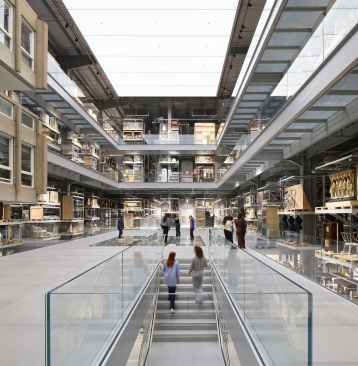
Photo: Hufton Crow.
The V&A Storehouse, as it is officially called, is by far the largest such facilities to open to the public: over a quarter of a million objects, even more books, a thousand archives, and whole rooms and pieces of building displayed in a space that was originally designed by local firm Hawkins/Brown to house the Olympics Media Center and that, as the V&A says, is “bigger than 30 basketball courts.”
Ossip van Duivenbode courtesy MRVDV
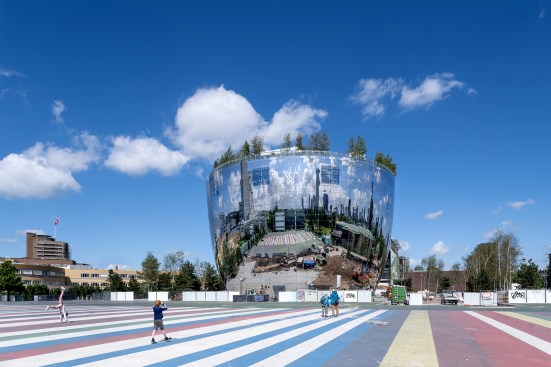
The Depot—a new art storage facility for the Museum Boijmans Van Beuningen in Rotterdam—by MVRDV.
The Storehouse joins the much smaller, but in some ways more spectacular, MVRDV-designed Depot of the Boijmans van Beuningen Museum in Rotterdam and many others efforts around the world (as Director of the Netherlands Architecture Institute I managed the conversion of another space in Rotterdam into open storage in 2005, and made a similar display central to renovations I oversaw at the Cincinnati Art Museum in 2012).
What sets the Storehouse apart, other than its sheer scale, is the simplicity of its design. Diller Scofidio + Renfro, who directed that work with local firm Austin-Smith:Lord, did not have to worry about the outside, but also did not have a chance to fix the rather confused nature of the more than a thousand foot long shed in which the facility is placed.
In terms of the usual kind of public space where architects get their jollies, they only had the opportunity to make a tiny and perfunctory lobby with the requisite spaces for merch, coffee, and education, and then take you up to the actual facility.
That is where the awe sets in. Following MVRDV’s lead, the architects bring you into the center of a four-story, top-lit atrium with a grated metal and glass floor, allowing the racks of ceramics, furniture, flat files, paintings, building fragments, and other bits and pieces of human artifice from around the globe and from all times to envelop you.
There is very little to distract you from that end-of-Raiders-of-the-Last-Ark onslaught, as the architects used a super-reduced aesthetic of metal pieces with as little articulation as possible to frame the accumulation.
The curators, meanwhile, arranged the material according to the logic of their cataloging system, although what that organization is does not become clear just from looking at the material. It turns out to have more to do with sequence of acquisition, size, and a complex set of factors that turn almost all art museum storage spaces into assemblages rather than a visual order resembling a library organized according to the Dewey Decimal system.
The decision not to make the material appear in an understandable manner only increases the joy of discovery as you treasure hunt your way up and down and through the racks, stopping to admire (without touching, of course) a medieval chest, a midcentury modern chair, or a still life by somebody you have never heard of.
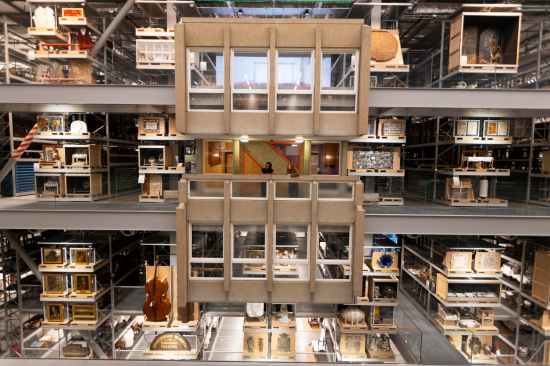
View of a section of the Robin Hood Gardens, a former residential estate in east London. Photo David Parry.
Interspersed with the racks are moments of grandeur. A whole section of Robin Hood Gardens, the Alison and Peter Smithson-designed housing project that was torn down a few years ago, faces the atrium, and nearby, in a rare moment of traditional exhibition logic, other artifacts saved from that project, along with a film and drawings, explain the importance of the big façade fragment.
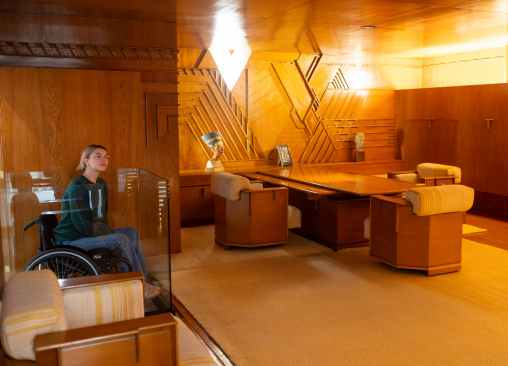
Frank Lloyd Wright's 1930s Kaufmann Office. Photo: Kemka Ajoku for VA.
On the top floor there is a recreation of the Frankfurt Kitchen, the idealized home food production space designed by 1927 by Margarete Schütte-Lihotzky, and nearby you can find the office Frank Lloyd Wright designed for Edgar Kaufman, the client for Fallingwater, in Pittsburgh.
Here the V&A has recourse to another tradition that is now having a bit of a revival, namely the display of artifacts in a kind of period room that gives you a sense of the relationship they had to each when they were made.
You can also view into a large conservation lab that would be the envy of most art museums I know, and there are somewhat bare-boned spaces for education and lectures.
The Storehouse’s most popular element is the David Bowie archive, a large room that contains paraphernalia and ephemera from that artists career. I dutifully stood in line to enter the two-story gallery, but the remains of music performances and recordings, such as costumes, concert photographs, lyric notes, or album covers, did little for me. Once the music stops, the art goes out of most such things.
More thrilling to me was the peeks into the space beyond the stacks, where empty racks and just open space await future accumulation and crates marooned under fluorescent lights suggest imminent shipment. It gives you the sense that the museum is a living, growing, working entity, while also making its scale seem even more awe-inspiring.
Diller Scofidio + Renfro only show their hands as high-end architects in a few ways, from the directness and theatricality of the entrance to the folded pleats of the stair rails, but that is more than enough. This is truly a less-is-more situation, with the less being the architecture and the more being the collections.
When I visited, almost a year after the opening, on a rainy Saturday afternoon, there was a line to get into this huge building. To me this was even more remarkable because it takes close to an hour to get to the former Olympics site from the center of London.
It just goes to show that neither of the three elements we (and I am speaking here as former museum person) used to think were central to the success of an art museum, namely location, a beautiful building, and curation, are necessary.
That is itself a reflection of how we no scan and surf imagery and assemble our lives in fragments in both real and zoom time, so perhaps the Storehouse is only the beginning of a wave.
This is a museum that makes the vast storage that we take for granted on our digital devices and service farms visible. It made me wonder: will we soon see museums expand and scatter into exploded and imploded versions of themselves? Or will the monumental center hold as the anchor machine for bringing people and art together?
Given the fact that many art museums have not recovered the visitor numbers they had before COVID, I would think that the V&A Storehouse might be a big part of the answer.
The views and conclusions from this author are not necessarily those of ARCHITECT magazine.
Read more: The latest from columnist Aaron Betsky includes reviews of: New Museum & The Studio Museum in Harlem | The Modern Museum | Monuments | Infrastructure | Interior Design | Viollet-le-Duc | Malibu High School | Architecture without Architects | Louis Kahn’s Fisher House | Meow Wolf | Generative AI | Frank Gerhy | Robert A.M. Stern | Lars Lerup | Princeton Art Museum | Victor Legorreta | Mexico City Underwater | On Vitruvius | On Olive Development | Calder Gardens | White House and Classical Architecture | Louis Kahn’s Esherick House | Ma Yansong’s Fenix Museum | The Cult of Emptiness | An Icon in Waiting | Osaka Expo | Teamlab | the Venice Biennale of Architecture | On Michael Graves | On Censorship or Caution? | Uniformity in Architecture | Book on Frank Israel | Legacy of Ric Scofidio| Fredrik Jonsson and Liam Young | DSR’s New Book | the Stupinigi Palace | Living in a Diagram | Bruce Goff | Biopartners 5 |Handshake Urbanism | the MONA | Elon Musk’s Space X | AMAA | DIGSAU | Art Biennales | B+ | William Morris’s Red House | Dhaka | Marlon Blackwell’s new mixed-use development | Eric Höweler’s social media posts,| Peter Braithwaite’s architecture in Nova Scotia,| Powerhouse Arts, | the Mercer Museum, | and MoMA’s Ed Ruscha exhibition.
Keep the conversation going—sign up to our newsletter for exclusive content and updates. Sign up for free.