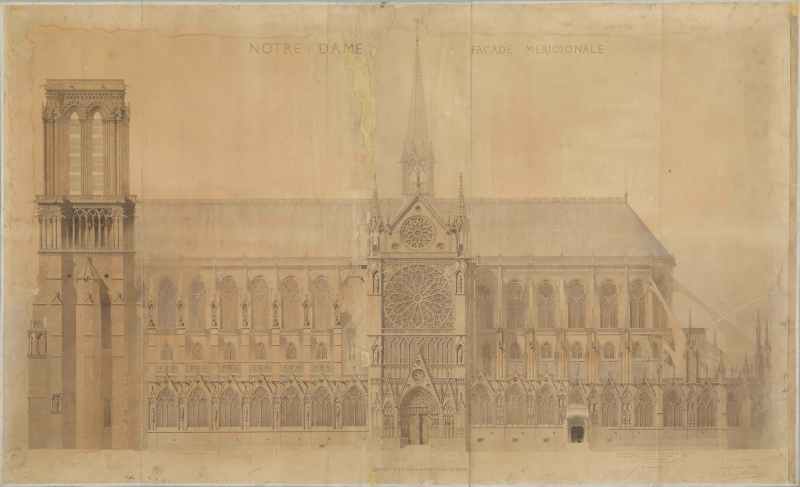
“Drawing is a relentless activity of restoration, as if the world must constantly be made anew.” That sentence, written by the architect and historian Martin Bressani, is a welcome reminder of how the act of representation, in whatever medium, precedes and goes beyond the act of building.
It does so to let us a imagine and project a world that might have and could be. Bressani is, however, actually describing the activity central to the work of Eugene-Emmanuel Viollet-le-Duc, the 19th century French architect, restoration specialist, artist and so much more that is the subject of a comprehensive exhibition (with a catalog from which the quote above was taken) currently on display at the Bard Graduate Center in New York (through May 26th).
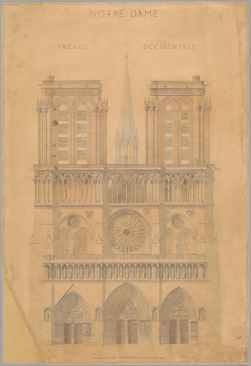
Eugène-Emmanuel Viollet-le-Duc (French, 1814–79); Jean-Baptiste-Antoine Lassus (French, 1807–57), west elevation of Notre- Dame de Paris, competition drawing, January 28, 1843. Watercolor. Médiathèque du patrimoine et de la photographie, Charenton- le-Pont, F/1996/83/189-4358.
We remember Viollet-le-Duc today mainly for his activity as a creative restorer: he was the man who gave Paris a version of Notre Dame that could or should have been (and that has now been painstakingly recreated after the fire a few years ago), who turned the ruined town of Carcassonne into an rebuilt emblem of France’s medieval emergence, and who let Napoleon III inhabit the crumbling remains at Pierrefonds by restoring it to partially imagined splendor and outfitting it with all modern conveniences.
The curators of this exhibition, Bressani and Columbia’s Barry Bergdoll, show how the architect’s lifelong practice of drawing as a form of investigative documentation and imaginative recreation enabled that practice, but was also part of a larger set of interlocking projects in history painting, cataloging and indexing historic elements and styles, geological research and racist propaganda.
Though he was of “good family” and related to artists, growing up for part of his youth in the Palace of the Tuileries and learning from an uncle, Étienne-Jean Delécluze, who was an established painter, Viollet-le-Duc refused to usual route of attending the central finishing school of the École des Beaux-Arts, training himself instead both through apprenticeship and, as the curators show, through the relentless act of drawing.
As those astute observers point out, Viollet-le-Duc drew first as a discipline of observation, noting everything around him in his environment and traveling to widen what he could see. He then interpreted and recreated, focusing on details of walls, ornaments, and flowers, adding people in costumes they might have worn at the time the buildings where constructed and eventually gargoyles and whole building elements that might have been carved by the artisans working on those structures.
He zoomed out to make history paintings and showed what such structures as the church at Vézèlay, his first restoration project, could look like if it was restored not to what Viollet-le-Duc found on site when he started, but what it might have been. That supposition was based not just on the remaining ruins, but on what his study and drawing of similar structures showed him the architects might have had in mind.
By the middle of the 19th century, Viollet-le-Duc had become the leader of a movement to rebuild medieval structures in France and beyond. Having directed the restoration of some of the State’s central monuments, he continued his work as teacher and author, publishing an interpretative dictionary of French architecture and a history of how the discipline had emerged. All that work was based, as Bergdoll puts in, on a “graphic language of pedantic clarity.” He saw himself as a teacher not only of, but through drawing.
The signature Viollet-le-Duc technique was the exploded perspective section, homing in on a fragment of a building where wall, window, structure, and ornament came together. Based on what he observed in the remains, but also on what he had seen and delineated in his thousands of other drawings (and the curators point out, only the German architect Schinkel and the English Soane left archives as voluminous as his), he then drew out possibilities that could be constructed or that could serve as examples to be taken up by the countless readers of his compendiums.
The weakness of his method was that it concentrated so much on what made the buildings that it left little space, quite literally, for other possibilities. Charles Garnier, the former student who defeated him in the competition for the Paris Opera, sneeringly pointed out that he was not a “composer,” which is to say he did not know how to make and sequence spaces.
That may be why he received almost no commissions for new buildings. The one example on display at the end of this exhibition is the house he built for himself near Lausanne (a VR recreation of the central room is included) that, if the material exhibited is any evidence, shows that Garnier might have been right.
Instead, Viollet-le-Duc was, as his uncle pointed out when the architect was still young, a “machine a déssiner:” a drawing machine. Over 20,000 drawings remain in the central repository of his work in the state archives in Charenton-le-Pont alone, and the exquisite examples on all four floors of the Bard’s Manhattan townhome are not only well-chosen, but hint at the fact that the curators could probably have filled a much larger space as well.
Viollet-le-Duc was not a neutral observer or designer, however. He continued his family’s tradition of working for the French state and he was an enthusiastic supporter first of all of the so-called “July Monarchy” that ruled the country when he was making his career and thereafter of Napoleon III, the self-styled emperor who tried to make France great again before he was defeated by the Germans in 1870.
As a result, he pivoted from building to writing and, of course, more drawings, in the last few decades of his life. His final obsession was with the forms of the Alps. He thought he discerned a huge crystal in the geology of the massif of the Mont Blanc and tried to show the hidden forms and forces that had shaped the mountains just as he evoked the life and craft out of which medieval and ancient buildings had arisen.
The structures he loved were, he believed, the products of an Aryan race that had evolved in mountains and come down into the plains to form the basis of what he saw as civilization. Profoundly racist, Viollet-le-Duc followed the theories of Arthur de Gobineau and made drawings of figures that claimed to trace racial characteristics.
The exhibition shies away from none of this. One of its messages is that drawing is not neutral. It is a way of interpreting what one sees selectively and then communicating what one thinks are the salient characteristics of that supposed reality.
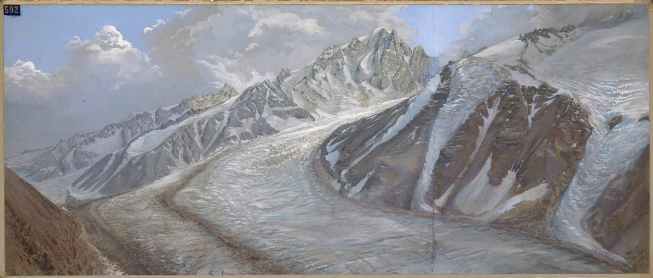
Eugène-Emmanuel Viollet-le-Duc (French, 1814–79), Glacier du Bois from above Chamonix, with the Aiguilles du Dru and Verte above. Restored to the ice age, August 1874. Pencil, ink, watercolor and gouache on paper. Médiathèque du patrimoine et de la photographie,Charenton-le-Pont, I/2024/12- 40127.
In Viollet-le-Duc’s case, the act moves from there with no transition to biased recreation of what one thinks should have been and then to proposals for what should be. Architecture draws out what the architect believes is world as it is right.
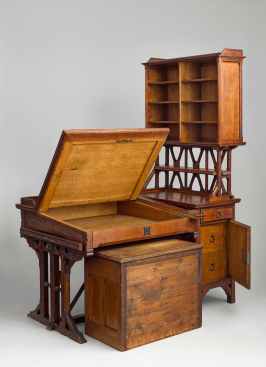
Desk from the office of Eugène-Emmanuel Viollet-le-Duc on rue Condorcet, Paris, after 1862. Oak. Médiathèque du patrimoine et de la photographie, Charenton-le-Pont, I/2012/24/M-1.
You might not agree with Viollet-le-Duc’s interpretations, and certainly I do not, and still be awed by the quality of his work as a draftsman, artist, restorer, architect, and writer. In that sense he was a thoroughly 19th century figure: someone who synthesized the knowledge then becoming available with the tools of the nascent industrial revolution to imagine something familiar, or at least half-remembered, as a way of making sense of the rapidly evolving environment around him.
That some people pretend that we can still do so in a world that is so much more diverse, both in a cultural and a spatial sense, is sad. Let us instead revel in that moment of vision, powered by scrumptious drawings, that produced a handful of beautiful, imaginative restorations.
Or let us just enjoy Viollet-le-Duc’s drawings in and for themselves, and learn from that the simple act of contemplative, interpretive, and exploratory looking can open whole worlds in what remains around us. If architects stuck to that, using pen, pencil, LIDAR or Midjourney, they might often do better, I believe, than trying to translate that work into compromised buildings.
The views and conclusions from this author are not necessarily those of ARCHITECT magazine.
Read more: The latest from columnist Aaron Betsky includes reviews of: Malibu High School | Architecture without Architects | Louis Kahn’s Fisher House | Meow Wolf | Generative AI | Frank Gerhy | Robert A.M. Stern | Lars Lerup | Princeton Art Museum | Victor Legorreta | Mexico City Underwater | On Vitruvius | On Olive Development | Calder Gardens | White House and Classical Architecture | Louis Kahn’s Esherick House | Ma Yansong’s Fenix Museum | The Cult of Emptiness | An Icon in Waiting | Osaka Expo | Teamlab | the Venice Biennale of Architecture | On Michael Graves | On Censorship or Caution? | Uniformity in Architecture | Book on Frank Israel | Legacy of Ric Scofidio| Fredrik Jonsson and Liam Young | DSR’s New Book | the Stupinigi Palace | Living in a Diagram | Bruce Goff | Biopartners 5 |Handshake Urbanism | the MONA | Elon Musk’s Space X | AMAA | DIGSAU | Art Biennales | B+ | William Morris’s Red House | Dhaka | Marlon Blackwell’s new mixed-use development | Eric Höweler’s social media posts,| Peter Braithwaite’s architecture in Nova Scotia,| Powerhouse Arts, | the Mercer Museum, | and MoMA’s Ed Ruscha exhibition.
Keep the conversation going—sign up to our newsletter for exclusive content and updates. Sign up for free.