One of the pleasures of living in Philadelphia is that I have access to so much work by Louis Kahn. As a longtime fanboy of that enigmatic, tragic, and not exactly morally pure architect, I have tried to visit just about every major building he designed —several many times—and am now missing only the work in India and the theater in Ft. Wayne, Indiana on my archi-safari.
Last fall, I was able to see the Esherick House, less than a mile from my house, and a few weeks ago, thanks to the hospitality of the owners and the University of Pennsylvania, I was able to join a tour of the Fisher House in Hatboro, about ten miles in the other direction.
Next up, I hope, is the expansive estate of the Korman House.
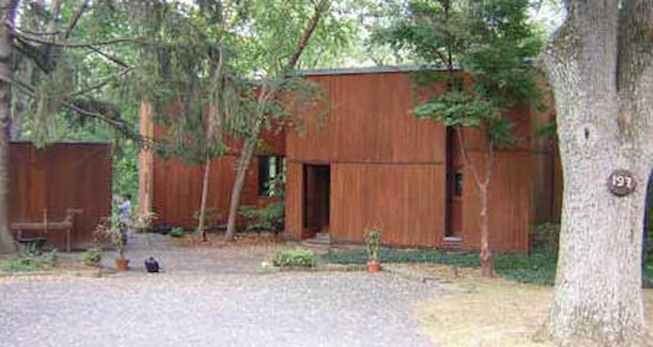
The Norman and Doris Fisher House is textbook Kahn, from its materiality and form to its geometry and spatial planning. You might even say that it crystalizes many of the architect’s moves into a coherent and clear form that, way back when I was a student that Kahn-drenched Yale, was easy to comprehend –although, despite the seduction, devilishly difficult to copy.
What I have loved most about the house since those days pouring over Louis Kahn monographs was the “kissing corner:” the way in which the building’s two main components, one social and one private, touch each other at an angle. That gesture of connection, so redolent of affection and individual identity as to scream for anthropomorphic interpretation, also creates a composition in that evokes a whole century of off-kilter connections in art, while also, through the massing that results, making the building one of the late-twentieth century attempts to recapture a sense of place and monumentality (and thus time).
The little Fisher House –it comprises a grand total of less than two thousand square feet—thus embodies so much architecture as to have always made my head spin, and that was before I saw the actual structure.
So, does it live up to its representation? Yes, but it a manner that brings in time less in the grand manner of the Corbusian “the play of pure forms in light” and more in the gentle wearing of the cedar siding and the use of the local stone that was the default Philadelphia building block for almost three centuries, while that splay turns out to have more to do with privacy and the site than with abstract ideas about composition.
Commissioned by a doctor and his wife in 1960 when Dr. Fisher moved his practice to the area from Elkins Park, the house fronts a residential street that was already mostly built up at the time, while the complex faces a creek and open wetlands to the rear.
During the design process, the Fishers bought the lot next door, giving them more outdoor space, including room for a pool. Working with Kahn, they sought to have a house that would look mainly to the woods and water to the lot’s rear. Hence the skew, which fronts and opens at the same time.
As a result, the structure presents itself as two blocks clad in vertical wood siding. Kahn meant for the soft material he chose to fade and age, though a little over a decade ago that process had reached the point of the wood deteriorating to a dangerous degree.
Upon Norman Fisher’s death in 2007, he deeded the house to the National Trust for Historic Preservation, according to daughter Nina Fisher. Sold in 2012 to Charles Firmin-Didot and Bianca Sforni.
The owners who then bought the house from the heirs worked with preservation experts to treat the house in a manner that eschews a shiny shellack and yet protects the façade from too much further fading. The result that the weathering is very much evident but does not appear as a mark of decay.
Narrow slots leading to windows in the house indicate the inhabitation behind and lighten the massing. These openings become larger and come to the front as you move around the sides, until they are joined by large panes of square glass to the rear.
On the block that houses the living areas, these transparent planes group together in the corner jutting out towards the creek, dissolving the mass in a manner that recalls the ways villas would open behind a closed front to their private park views.
Everywhere Kahn’s mastery of detailing is evident. The push and pull between what is on the main plane and what is set back, the rhythm of the windows themselves, and the use of stringcourses that become lintels between windows, all balancing on a stone base that contains the service areas, gives the Fisher House the appearance of having different modes of being: open and closed; continuous and fragmented; contained and expanding. Hints of the local mode of composing houses in wood and stone mix are abstracted into a celebration of a new sense of openness and shelter.
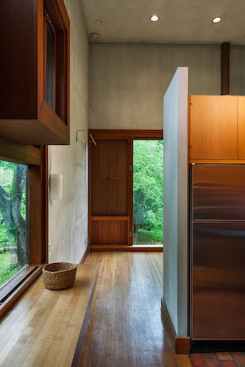
You enter the house (after passing by a small garage and utility pavilion) somewhat paradoxically through the private block, moving from a sheltered portico down a long corridor that ends, again in reference to the villa tradition, in a window overlooking the natural setting to the rear.
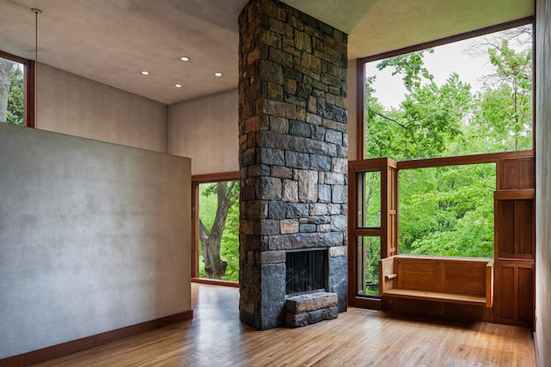
Two-thirds of the way down the hall, the space opens at the kissing moment to the two-story living room, which stands in for the great hall or grand salon in country home structures. Kahn did not leave this space empty, however. Instead, he populated it with domestic fragments: a kitchen and pantry hiding behind a stucco wall, a round, stone-clad fireplace that is a piece of the rustic base pushing up through the floor, and a seating nook that occupies that corner window where the block tends towards dissolution.
The tactic suggests to me the depictions of St. Jerome in his study that were a trope of Western painting throughout the Middle Ages and Renaissance (the version by Antonella da Messina of 1475 is the most famous one). A domestic scene, comprising the elements that connect you both to the body and the wider world (books, scholarly devises) inhabits a much a larger space that usually fades off into abstraction. The house becomes a generic container in which the family can enact the rituals and activities that bring them together as part of a wider society and culture.
The composition of the corner seating nook is the most evident marvel in the house. Comprising a concatenation of windows of different sizes interspersed with wood slats and planes, it works at the level of the individual reader cozying up the house’s structure and the window’s light, while also letting that light and views in beyond the scale of the moment of concentration.
In the second volume, Kahn stacked the four bedrooms, along with bathrooms and service spaces, in a tight packaging that leaves little room for the spatial plays in the public spaces –although here as well, the hand of an architect who is able to control every detail of every molding and the scale of every window and door to contribute to the sense of domesticity is evident.
In the Fisher House, Kahn condensed and clarified what it means to live in a freestanding house as a nuclear family in the middle of the century in the United States. I know of no other buildings that embodies that so canonical social condition as well as this modest structure.
None of the tensions between modernity and tradition that animate most other pieces of residential architecture of the time are evident. Of course, none of the economic privileges are put on display in a manner that evidences the contrasts on which they floated. Instead, the Fisher House is rooted and clear to the degree that only Louis Kahn was able to make his buildings.
Many of the elements Kahn experimented with in this design became a part of his larger, more public buildings: the kissing corner shows up in his design for a monastery, among other ventures, and composition of windows and wood walls leads to such buildings as the Salk Institute. At the Fisher House, the pieces are all there, assembled into a perfect home.
Read more: The latest from columnist Aaron Betsky includes reviews of: Meow Wolf | Generative AI | Frank Gerhy | Robert A.M. Stern | Lars Lerup | Princeton Art Museum | Victor Legorreta | Mexico City Underwater | On Vitruvius | On Olive Development | Calder Gardens | White House and Classical Architecture | Louis Kahn’s Esherick House | Ma Yansong’s Fenix Museum | The Cult of Emptiness | An Icon in Waiting | Osaka Expo | Teamlab | the Venice Biennale of Architecture | On Michael Graves | On Censorship or Caution? | Uniformity in Architecture | Book on Frank Israel | Legacy of Ric Scofidio| Fredrik Jonsson and Liam Young | DSR’s New Book | the Stupinigi Palace | Living in a Diagram | Bruce Goff | Biopartners 5 |Handshake Urbanism | the MONA | Elon Musk’s Space X | AMAA | DIGSAU | Art Biennales | B+ | William Morris’s Red House | Dhaka | Marlon Blackwell’s new mixed-use development | Eric Höweler’s social media posts,| Peter Braithwaite’s architecture in Nova Scotia,| Powerhouse Arts, | the Mercer Museum, | and MoMA’s Ed Ruscha exhibition.
Keep the conversation going—sign up to our newsletter for exclusive content and updates. Sign up for free.