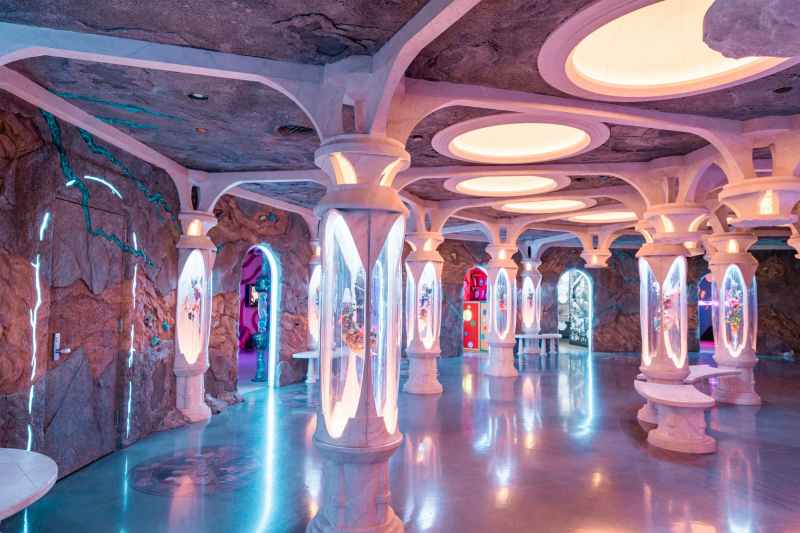
The spread of the Meow Wolf pack of “kaleidoscopic immersive experience” venues across the country is the result of a peculiar convergence of at least three different phenomena in American culture: the rise of immersive art experiences, pioneered by the California “light and space” artist such as James Turrell and Robert Irwin; the spread of DIY cooperative arts and crafts communities whose products occupy the spaces between coffee shop and home decoration, using traditional craft products such as decorative woodwork and stained glass; and the lasting influence of “imagineered” environments pioneered by Walt Disney at Disneyland and now extending both into the creation of vast domes containing alternate realities (the Sphere in Las Vegas) and the realm of virtual and simulated reality.
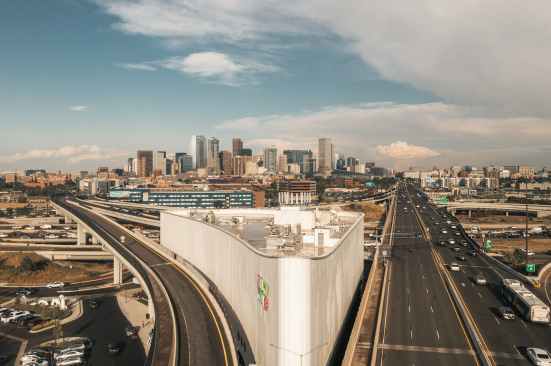
Meow Wolf's Convergence Station in Denver, a massive immersive art experience, was designed by SAR+ Architects, integrating unique architectural features with four converged worlds and interactive art installations.
To see how well the Meow Wolf company, which started as an artists’ collective in Santa Fe in 2016, is able to turn that hybrid into a successful space, I took advantage of a recent trip to see the Green Bay Packers play the Denver Broncos (they lost, I am afraid) to see the adjacent outpost in that city. I can report that Meow Wolf Converge Station, as this site is called, is successful, both financially and in its ability to create a labyrinth of exciting, complete, and wonderfully weird worlds. Whether or not in means anything, and whether it stands much repeat inquiry, is another question.
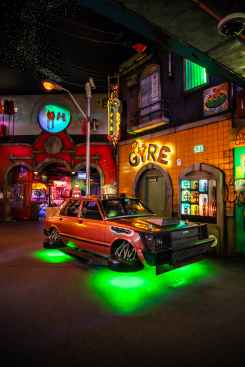
Meow Wolf Convergence Station, C Street, Courtesy Kennedy Cottrell.
The Denver outpost is wedged into a triangle of space between highway overpasses with a design, by local firm Shears Adkins Rockmore, that makes it seem enigmatic. From afar, it looks like it could be a warehouse, a data center, or a highway maintenance site. Only the slow arches that indicate where the entrance is and which unfortunately leach the slick, metal skin into something thinner and more familiar, break that wonderful sense enigma.
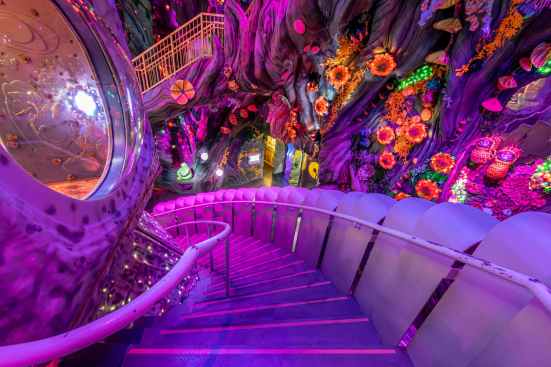
Meow Wolf Convergence Station, Cosmohedron. Courtesy Jess Gallo.
Meow Wolf’s appeal stems in equal part its ability to create a sense of awe with its environments and its hokiness. Those two meet in what to me are the most fun environments, where junker cars have been kluged to resemble something you might have seen in those sci-fi movies, such as either the Back to the Future or Guardians of the Galaxy franchises, that delight in the nostalgia built into visions of the future based, paradoxically, in the past. The aesthetic is one of cyberpunk, steampunk, or just well-worn junker tech, with tubes and tentacles snaking around both objects and the spaces’ walls and ceilings, vending machines selling versions of sports drinks and mementoes, and the general sense that various worlds and time periods have become all entangled around you.
Here it does not matter that the seams sometimes show, with exit signs and bathrooms taking their place in the assemblage of entertainment. Similarly, the selling of merch and the incorporation of environments you can only peer into through windows all seem to be part of a taking you to limbo land. You don’t have to worry about whether something works, is well-designed, or even convinces you that it is what it claims to be. You just get yourself lost in the mess, delighting in the wood veneer and payphones from the 1960s, an old bus that used to run to Sun Valley, Utah, and electric conduit that has spread into a version of Gaudi-esque decoration around walls and ceilings.
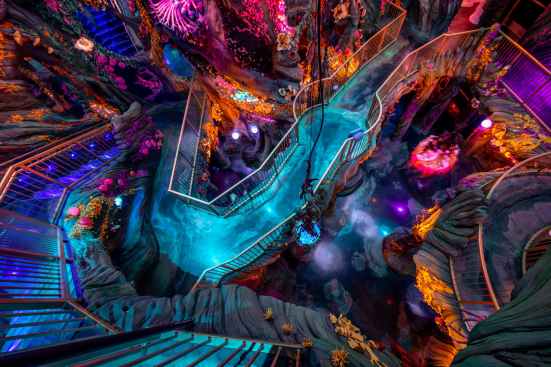
Numina. Courtesy Jess Bernstein.
Against this sense of being lost exactly because you can never quite pull yourself away from recognizing elements whose origins and time and place contradict each other, are the grander environments. These try to take you away to fully conceived other places, more in the sense of either the Lord of the Rings or Avatar cycles. In one of these worlds, a “tree of life” sends branches and vines snaking throughout the space, where they mingle with oversized glass baubles and colored lights to evoke a world of faeries and animate beings. In another, you can place yourself inside a control room for what appears to be a fairy castle glowing all around you.

Ossuary Blue Sound Spa, Courtesy Nikki A. Rae.
These environments are to me less convincing, exactly because they depend on being complete. Even though several imagineers, as Disney calls those responsible for creating their themed environments, apparently work at Meow Wolf, they somehow (perhaps because of a different scale of budget) cannot achieve the sense of being surrounded in a seamless other world that the entertainment behemoth can create. From another perspective, though, that is part of the charm. I was reminded of some of the spaces hippie craftspeople built in regions such as Big Sur (Nepenthe Restaurant, for instance) or Santa Fe (Meow Wolf’s original home), where the earnestness of both the craft and the desire to create a world more in tune with one’s Shakras mellows the vibe all around you.
If you look hard enough, you can also find the examples of individual art works that Meow Wolf commissions from local artists. Though I appreciate that idea, I am too much of a recovering art museum professional and thus snob, however, to really appreciate what to me seemed mostly like trite, derivative, and not particularly well-crafted pieces.
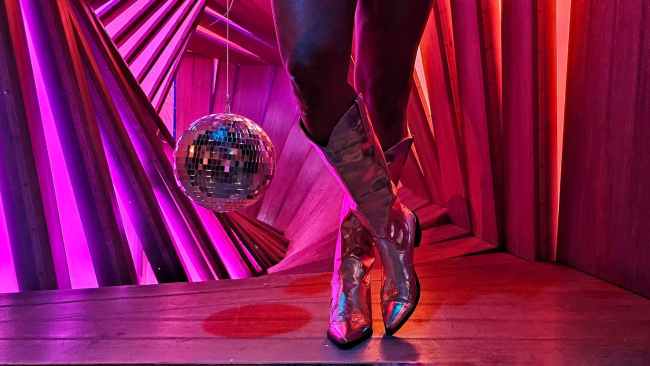
Meow Wolf Convergence Station.
What Meow Wolf has resolutely not done is go the digital route in the manner of their biggest competitor in the immersive art environment space, Tokyo’s Teamlab. That somehow also makes the work more American. Its honkytonk quality reminds me of how Thom Mayne once compared his (early) work to that of the British high-tech Lords: “They’re the guys in white lab coats, where we’re the ones in dirty overalls working in the garage.” All the Santa Fe firm’s outposts have, until now, been in the American West, including ones in Houston, Grapevine, and Las Vegas, although new ones in Los Angeles and New York are in the work.
What they are ultimately selling, it seems to me, is the underbelly to our government’s desire to go back to an amorphous time and place sometime between the Gilded Age and the Eisenhower Era. Instead of making us at home in those eras, they make the sleaziness, contradictions and just plain lack of a sense of efficiency, logic, and accessibility that governed those worlds evident. They don’t quite celebrate that lack of sophistication, but they do let us enjoy it.
The Meow Wolf experience works exactly because it makes us feel smarter than all that. It lets us see and explore the seams, make us sense that all of us, both our contemporaries and our grandparents and grandchildren, are, have been, or will be, trying to figure out where and who we are and how to make that environment better –or at least livable.
Meow Wolf Denver’s visitor counts have been strong, dropping from a million in its first year since it opened in 2022 to what appears to be a steady stream of about half that, with several million visiting all the locations. Apparently, there is enough at the Convergence to bring people back to figure out where, when, or what they are. Plus, there is a great cocktail lounge that hovers between a 1960s bowling alley and an intergalactic whorehouse. And the stadium is just a few steps away.
Read more: The latest from columnist Aaron Betsky includes reviews of: Generative AI | Frank Gerhy | Robert A.M. Stern | Lars Lerup | Princeton Art Museum | Victor Legorreta | Mexico City Underwater | On Vitruvius | On Olive Development | Calder Gardens | White House and Classical Architecture | Louis Kahn’s Esherick House | Ma Yansong’s Fenix Museum | The Cult of Emptiness | An Icon in Waiting | Osaka Expo | Teamlab | the Venice Biennale of Architecture | On Michael Graves | On Censorship or Caution? | Uniformity in Architecture | Book on Frank Israel | Legacy of Ric Scofidio| Fredrik Jonsson and Liam Young | DSR’s New Book | the Stupinigi Palace | Living in a Diagram | Bruce Goff | Biopartners 5 |Handshake Urbanism | the MONA | Elon Musk’s Space X | AMAA | DIGSAU | Art Biennales | B+ | William Morris’s Red House | Dhaka | Marlon Blackwell’s new mixed-use development | Eric Höweler’s social media posts,| Peter Braithwaite’s architecture in Nova Scotia,| Powerhouse Arts, | the Mercer Museum, | and MoMA’s Ed Ruscha exhibition.
Keep the conversation going—sign up to our newsletter for exclusive content and updates. Sign up for free.