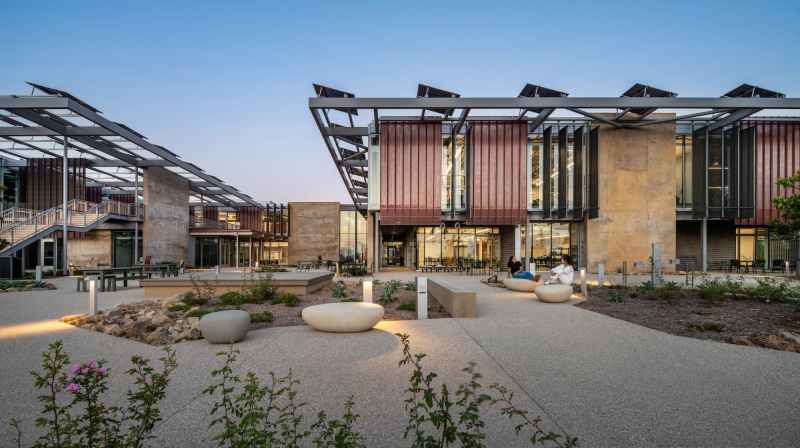
Surf High: it is part of Southern California’s lore and now it has a new home. Yes, this Malibu High School has a rack where students can store their boards after they come in from their morning rides. It is also a serious piece of architecture that stands out in a complex of mediocrity that includes other parts of the Santa Monica-Malibu public school system, utility structures, and McMansions for the rich and famous that infest this (unburnt, for now) part of Southern California coastline.
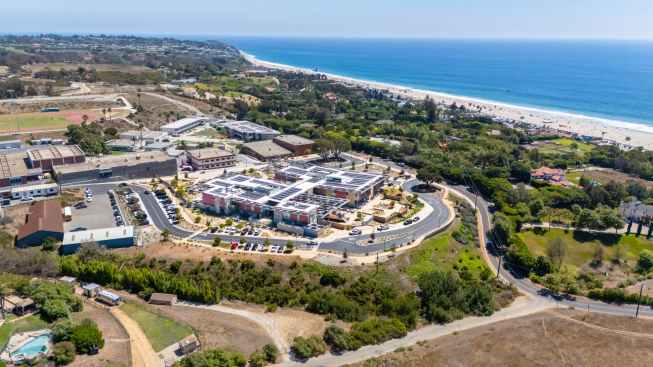
The high school was designed by Santa Monica firm Koning Eizenberg and Los Angeles firm NAC Architecture (full disclosure: I was the guest of Hank Koning, FAIA, and Julie Eizenberg, FAIA, on my most recent trip to the area, when they took me to see the structure) on a plateau the school system carved out above, but with a view of the beach.
The Malibu High School project was a collaboration led by Nathan Bishop, AIA, partner and lead designer, KoningEizenberg Architecture, and Michael Pinto, FAIA, partner and educational designer, NAC Architecture.
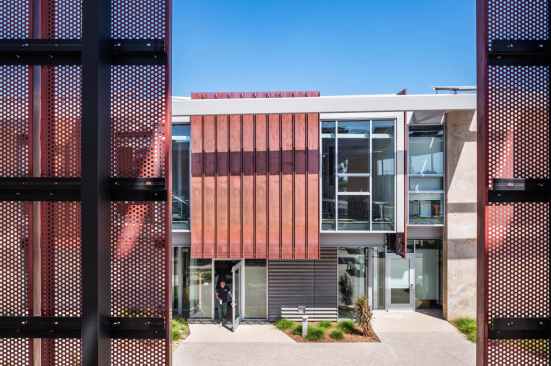
That alone makes for a rather idyllic situation. Imagine your mind wandering off from a math question to stare out at the Pacific through the large windows and perforated screens draping the building.
This is, then, not your average public high school. The budget was, relatively speaking, generous: $100 million for 70,000 square feet of space. The administration was progressive and specified an organization based on project-based learning that would let students cluster around different avenues of study rather than sitting in rows of classrooms.
And, of course, the building had to meet California’s wonderfully stringent sustainability requirements –even if I wish, as always, that the school system would have found an existing structure to reuse rather than building a whole new building. Finally, the school was lucky enough to be far enough north to escape the fires that have turned much of the area into a surreal landscape of charred remains dotted by surviving buildings and new growth. This allowed construction to be done on time and budget at the beginning of this school year.
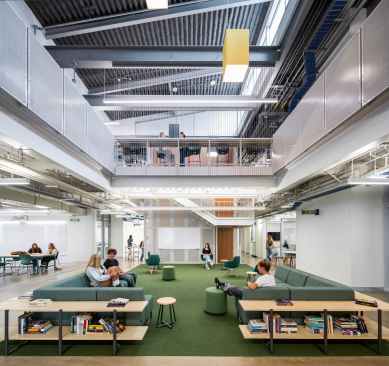
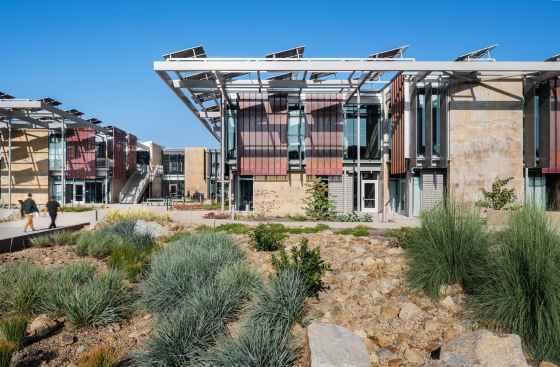
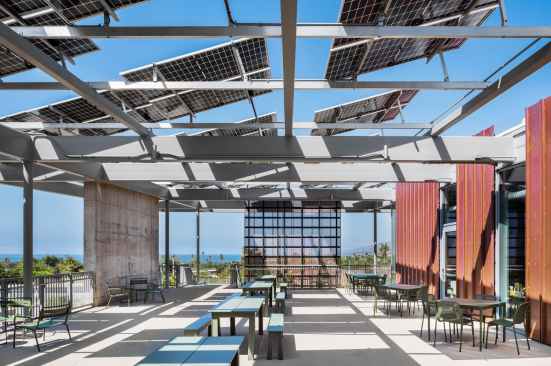
Koning Eizenberg’s approach to the project was to create a cluster of blocks within a steel superstructure supporting an array of solar panels that also serves as a shading canopy. Set at angle to the surrounding blocks so as to respond to the existing topography, minimize retaining walls, fully utilize its 5.7-acre site, and align with the sun and views, the complex falls apart (more or less, given the fluidity of forms) into three clusters that group around shared, two-story public spaces serving as places to both meet and study.
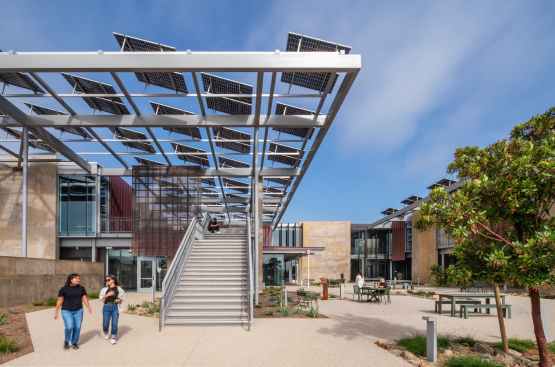
The skeleton gives Malibu High a scale appropriate to the sweep of the landscape and to a civic educational building, but it is light enough not to overwhelm the people using the spaces. It swoops itself, curving upward to meet the mountains behind and sign its presence. Concrete walls, pigmented to match the yellowish hues of the usually bare hills around the site, form the main spatial anchors. Between them stretch walls of glass and metal, with red-colored perforated metal panels providing shade where necessary.
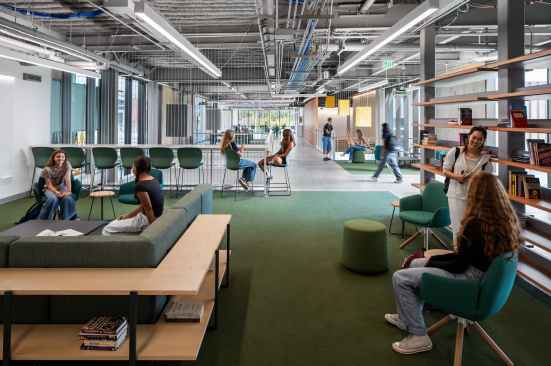
As the overhead grid extends beyond the clusters, it provides places for covered patios and terraces that further extend the social and learning opportunities the indoor spaces provide to the outside. Inside, the spaces are as open as the architects could make them, pulsing from corridors into study spaces and then the atria, which are lit by clerestories. Raw and rambling, but oriented towards light and modulated to provide different scales of learning and gathering, they create a continues collage of learning places.
As in most of Koning Eizenberg’s work, this is a building that exemplifies a loose fit in a highly tuned structure. The integration of the mechanical, shading, and solar systems gives it a hint of high-tech bravura while also exposing those essential bits and pieces, so that the building itself becomes a learning opportunity.
That didactic exposure continues in the detailing, which both exposes the meeting place of materials in a forthright manner and turns those moments into assemblies of great beauty. Everywhere you look, you can trace how the building is made, how it encloses and opens, and how it hangs together. You can see its elegance built in.
For a long time, I have been interested in Southern California architecture as meeting of two traditions. The first is the creation of open and flexible webs that tune the climate and landscape, generally forgiving and expansive, just enough to allow for human habitation. The second is the construction of walls, ideally made from the material of the site, that provide defensible and private shelter within those spaces.
The first comes out of both the stick construction techniques Anglos brought to the area and native American ways of living there, while the second came in with the Spanish and their missions, but also picked up on local adobe architecture. The two came together most notably in Rudolf Schindler’s King’s Road house for himself and the Chase family.
Koning Eizenberg and several generations of architects have in recent years used technology and mass-produced elements to expand that tradition to a large scale and turn it into social housing as well as commercial and civic structures. Here, they have also added a beach shack ramble to the mix, giving Malibu High a freedom of form and space that expands beyond what they usually provide in their structures.
Over time, or so I hope, the people populating this seaside educational facility will turn it more into Surf High. I imagine sand dragged into the classrooms, scuffs from the surfboards, and temporary structures built by the students (or faculty and staff).
That might be a romantic dream, but I trust the local culture will be strong enough to overcome the institution’s strictures. Even without those additions, Malibu High School will join the by now long tradition of elementary, middle, and high school buildings across the United States that are or have been paradigms of the optimism, freedom, clarity, and sense of possibility modernism provides. In our present day, we need such a concrete embodiment of what we should learn our culture to be.
The views and conclusions from this author are not necessarily those of ARCHITECT magazine.
Read more: The latest from columnist Aaron Betsky includes reviews of: Architecture without Architects | Louis Kahn’s Fisher House | Meow Wolf | Generative AI | Frank Gerhy | Robert A.M. Stern | Lars Lerup | Princeton Art Museum | Victor Legorreta | Mexico City Underwater | On Vitruvius | On Olive Development | Calder Gardens | White House and Classical Architecture | Louis Kahn’s Esherick House | Ma Yansong’s Fenix Museum | The Cult of Emptiness | An Icon in Waiting | Osaka Expo | Teamlab | the Venice Biennale of Architecture | On Michael Graves | On Censorship or Caution? | Uniformity in Architecture | Book on Frank Israel | Legacy of Ric Scofidio| Fredrik Jonsson and Liam Young | DSR’s New Book | the Stupinigi Palace | Living in a Diagram | Bruce Goff | Biopartners 5 |Handshake Urbanism | the MONA | Elon Musk’s Space X | AMAA | DIGSAU | Art Biennales | B+ | William Morris’s Red House | Dhaka | Marlon Blackwell’s new mixed-use development | Eric Höweler’s social media posts,| Peter Braithwaite’s architecture in Nova Scotia,| Powerhouse Arts, | the Mercer Museum, | and MoMA’s Ed Ruscha exhibition.
Keep the conversation going—sign up to our newsletter for exclusive content and updates. Sign up for free.