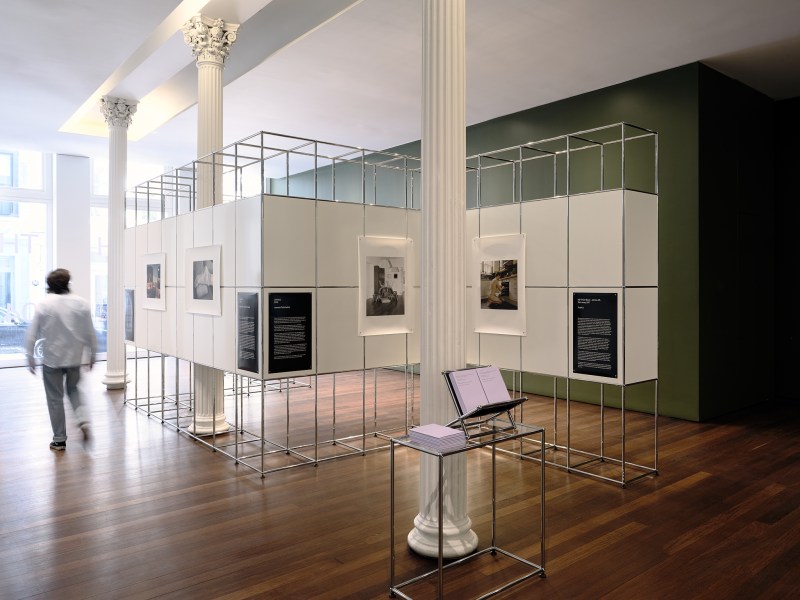
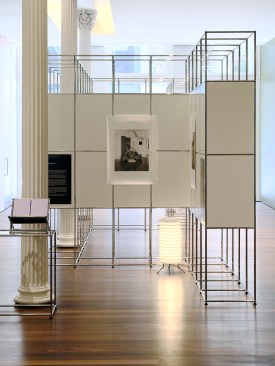
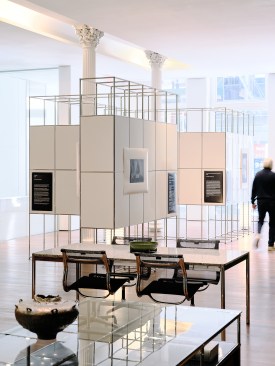
A foot in an athletic sock, resting upside down on a sofa. A stack of Eames chairs creating a symmetrical kid’s fort. A closeup of an oriental rug with white waves swirling across its patterns. A naked man crouched in front of an open oven, cutting into a meal of some sort with scissors. These and eight other photographs make up a tiny exhibition at the USM Modular Furniture’s flagship store in New York’s Soho.
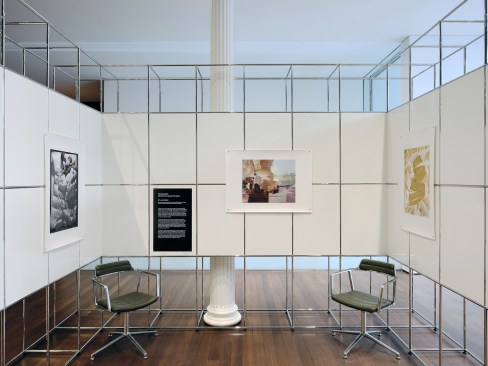
Assembled by the “Los Angeles-based Substack and print publication focused on the supreme potential of interiors,” For Scale, and curated by former Wallpaper photo editor Holly Hay, the small collection has big ambitions. It seeks to show, as an accompanying booklet explains, how “the world of décor absolutely mimics our interior world (i.e., our psyches) in that: it must accommodate MISCHIEF, HUMOR, EXHAUSTION, AROUSAL, CHAOS, et.cetera.”
That is a lot to ask of a dozen images, but, even without the Trumpian use of caps and punctuation, as well as grandiose the claims, the exhibition actually accomplishes its questioning of the relation between interior design and its inhabitation to a surprising degree.
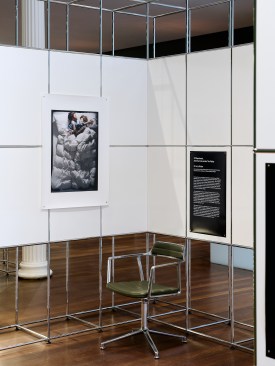
The key is For Scale’s notion of décor as what the French would call “mise-en-scene:” the directing of set, lighting, actors, and story to make something more out of all those elements. That assembly works here because these photographs all have the peculiar power to evoke what is not quite there.
In that, they build on the work of such artists as Gregory Crewdsen and especially Jeff Wall, who combine the hyperrealism of which the art form is possible with a storytelling akin to seeing a news reportage without a proper caption. The photographers manage to document slices of our environment and give a sense that there are lives present without telling you exactly what you are seeing or what to think of it. It is a bit like good decoration.
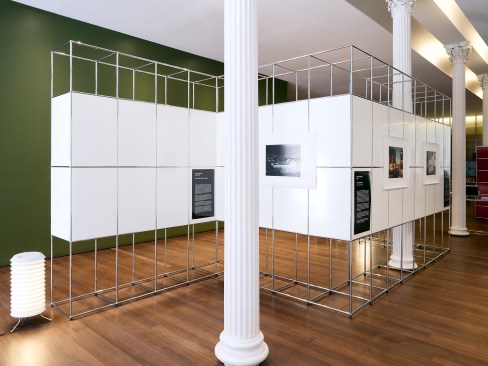
In the case of the foot, by Alessandro Furchino Capria, the curators claim that this is an illustration of “TO PUT YOUR FEET UP,’ but then why is foot upside down? Rather, it seems to me, the photographer has found a body lying head-down on a sofa. We get just a hint of skin, and then the foot, outlined in the grayish sock that is slightly bunched together. The way the light hits that piece of an unknown body, together with the pedestal of the sofa cushion, recalls classical marble sculpture, while letting you sense an apartment, slightly smelly from sweat, where the athlete has crashed after a workout.
The fort of plastic chairs piled both right-side and upside down to create an enclosure like a spikey tent over another cushion is by Joanna Piotrowska. The child (?) who made this construction has further enclosed themselves with wood slats. Presented in black and white, the image is much less composed than the other works of art in the show, instead making sure to give you an angled view of the whole structure.
This is a work of documentation, although of something usually not deemed worthy of such attention. You expect a caption either about the designer’s careful balancing of both structure and angular and curved forms, or just about reuse.
The image of the man kneeling by the stove, by Yushi Li, claims to have a more complex story to tell. Entitled “My Tinder Boys –James, 28, 3KM Away, 2017,” it is part of a series in which this East Asian woman artist seeks to turn the objectifying gaze usually focused on people like her on white men she met through the hook-up app.
But, as the curators here point out, the image makes you wonder “Who exactly is “EROTIC” in the domestic space? And what are their TOOLS OF SEDUCTION?” They also point out that the kitchen is not the usual site for portraits in general. Here the light caresses the hard, human-made surfaces that make up this (IKEA?) kitchen so that they contrast with the man’s skin. His submissive pose and attention to the food he is preparing –but why cutting it with scissors? — and the fact that Li is, to judge from the angle, right there on the floor with him, looking up at the surroundings, confuse all the signals.
I am not sure I see eroticism here, but certainly the space of domesticity, which is still so gendered, is disturbed, although very gently, by the composition, the lighting, and the occupation of this scene.
Other images are more standard in what they show but deviate in how they frame and exhibit what is on display. There is the extreme close-up of the rug, which is apparently being cleaned of a stain (“The Rug, Whiff #6,” by the artist couple Scheltens & Abbenes).
There is a man who is just lying in a bed reading, but Alec Soth photographed him behind reflections of a nighttime urban constellation of lights. It is, according to the description, a self-portrait of the artist in the Park Hyatt Hotel, Tokyo, a modernist aerie famous from film and video. Soth constructed this scene so that the man, whomever he is, is floating in 21st version of one of Little Nemo’s dreams.
A similar game of floating worlds is at work in Larry Sultan’s “Off Sepulveda, 2001.” You are looking into a suburban living room. A woman might be performing a sexual act on a man who has his back turned to us, or she might just be fixing his pants.
Another man watches from the foreground and Sultan, his outline in the glass through which he is shooting clearly visible around the three, takes the triad in. More than half of image, though, consists of the hills, other houses, and palm trees –a condensation of Southern California living– reflected along with him in windows.
Each of these images has a narrative, but none of these is spelled out. Each is a photographic record, but none of them are stable enough to figure out exactly what you are seeing. Space, texture, scale, and the sheer reality of what is presented is up in the air even as it shows up with great accuracy. The inhabitants, and there are actors in all but three of the images, are both lost and framed by the décor around them.
That is the work For Scale claims to do with all its articles, posts, blogs, and exhibitions. It wants us to look at, and really see, interiors so as to figure out what they are trying to contain, arrange, place, and organize.
It does so exactly by highlighting when the décor that is supposed to make sense of this interior design does not exactly work, or when desire or alienation enter in through the frame of either the building or the photograph and destabilize the scene. Look again. This is design but seen differently.
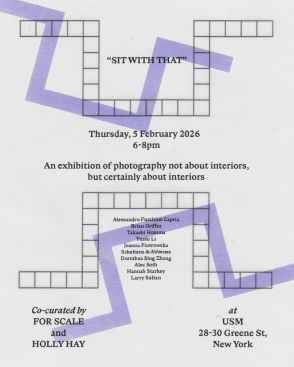
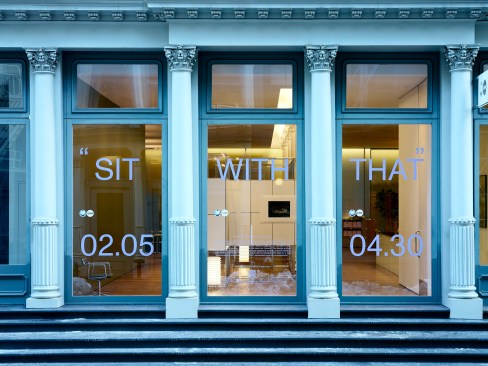
“Sit With That” is on exhibit at USM Modular Furniture, 28-30 Greene St., New York, until April 30.
The views and conclusions from this author are not necessarily those of ARCHITECT magazine.
Read more: The latest from columnist Aaron Betsky includes reviews of: Viollet-le-Duc | Malibu High School | Architecture without Architects | Louis Kahn’s Fisher House | Meow Wolf | Generative AI | Frank Gerhy | Robert A.M. Stern | Lars Lerup | Princeton Art Museum | Victor Legorreta | Mexico City Underwater | On Vitruvius | On Olive Development | Calder Gardens | White House and Classical Architecture | Louis Kahn’s Esherick House | Ma Yansong’s Fenix Museum | The Cult of Emptiness | An Icon in Waiting | Osaka Expo | Teamlab | the Venice Biennale of Architecture | On Michael Graves | On Censorship or Caution? | Uniformity in Architecture | Book on Frank Israel | Legacy of Ric Scofidio| Fredrik Jonsson and Liam Young | DSR’s New Book | the Stupinigi Palace | Living in a Diagram | Bruce Goff | Biopartners 5 |Handshake Urbanism | the MONA | Elon Musk’s Space X | AMAA | DIGSAU | Art Biennales | B+ | William Morris’s Red House | Dhaka | Marlon Blackwell’s new mixed-use development | Eric Höweler’s social media posts,| Peter Braithwaite’s architecture in Nova Scotia,| Powerhouse Arts, | the Mercer Museum, | and MoMA’s Ed Ruscha exhibition.
Keep the conversation going—sign up to our newsletter for exclusive content and updates. Sign up for free.