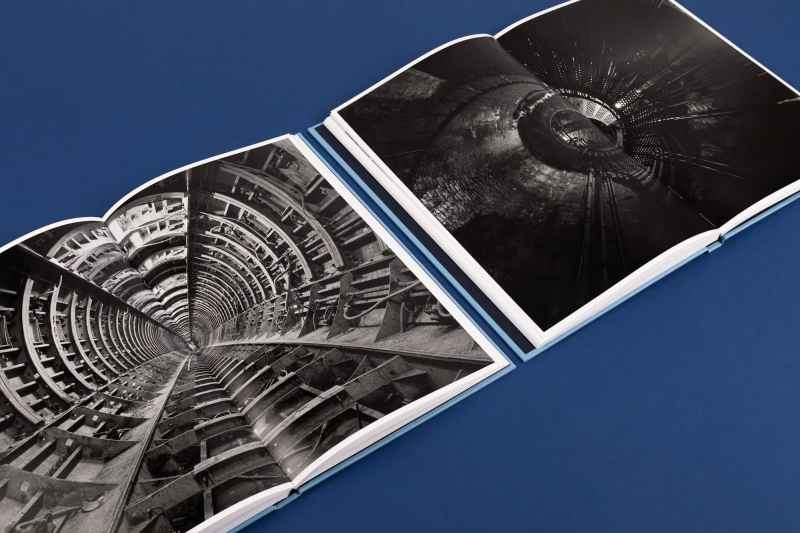
Big, bold, and beautiful: infrastructure is the easiest architecture to either love or hate. From the geometry of bridges and electric powerline towers vaulting through space to the enigma of solid objects projecting into our space with no windows, no scale, and seemingly no purpose, these marks of what it takes to keep our lives in the metropolis going are both easy to miss and hard to ignore once you see them. They are architecture condensed or expanded, abstracted and made monumental.
Now two books document the containers for the most ephemeral aspects or urban streams: water and air. Documenting vent shafts in the United Kingdom and New York’s hundreds of miles of dams, weirs, sluices, pipes, vents and manhole covers that lubricate the lives of its eight million people, they draw our attention to weirdness, beauty, and grandeur we usually don’t notice.
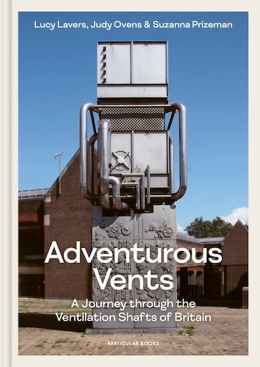
Adventurous Vents, by Lucy Lavers, Judy Ovens and Suzanna Prizeman. Published by Particular Books, 2026.
The British examples are older and the type more defined. In Adventurous
Vents authors Lucy Lavers, Judy Ovens and Suzanna Prizeman look at those objects, by their nature vertical, that pop out of the ground to let air into or smoke out of usually underground spaces: tunnels, mines, heating installations and, later, parking garages.
Their examples start with simple brick and stone shafts, some of which date back to the Middle Ages or even before, that are still visible mainly in rural sites. Over so much time, nature has come back to reclaim them. Covered with moss and partially sunk into the soil, they are not far distant from grave markers, cairns, or even piles of rock that memorialize human constructions across time.

Eduardo Paolozzi's Ventilation Tower sculpture, Pimlico Station, London.
Over that same time, these vents have accreted human embellishments that mark the ebb and flow of styles that are almost as natural as the passing of the seasons and eons: classical simplicity, baroque and rococo elaborations, returns to a more severe, neo-classicism, Gothic fantasies, exotic references, and modern severity succeed each other, sometimes layered on the same structure. To see them played out across the pages of Adventurous Vents is to read an alternative, condensed history of architecture.

Scarty’s Monument in Aberdeen harbor, Scotland. Photo courtesy wikipedia.
Some of the older shafts, such as Scarty’s Monument in Aberdeen harbor, have a grand monumentality, while others hide in that civic purpose; who knew that the Wellington Arch in London is also a ventilation shaft? The most attractive of these enigmas to me remain the shafts built during the period in the twentieth century, roughly from the Roaring Twenties to the period before the Oil Crisis, when we believed both in building a better world and showing that optimism.
Rooted in the work of Antonio Sant’Elia and Le Corbusier, structures such as the Queensway Tunnel shaft, the Tyne Tunnel shaft, and the Barbican Spiral are concrete monuments to a welfare society that was going to make everybody happy and productive.
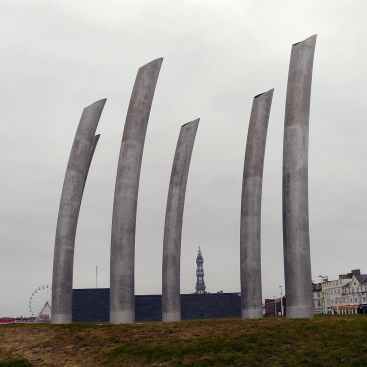
Venting Pipes at Manchester Square Pumping Station. Photo copyright Copyright Gerald England/Creative Commons Licence.
More recent attempts to bring some of that elan back to the back-office business of metropolitanism include the Manchester Square Pumping station with its curving stacks, the “Earth Tubes” at One Angel Square, also in Manchester, that suggest Le Corbusier’s “light cannons,” and the twisted vent of the Tideway Super Sewer in London.
All designed either in-house by municipal teams or by relatively anonymous engineering and design firms, they bring some of mystery back to the world of increasingly invisible infrastructure.
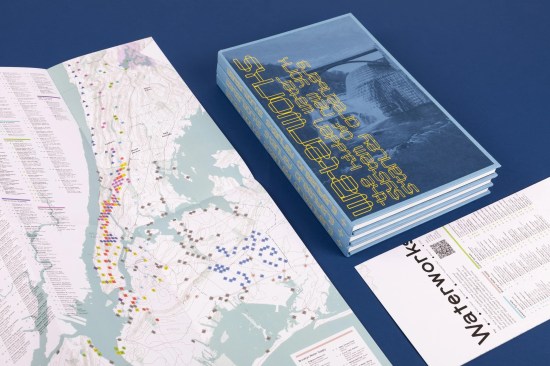
WATERWORKS: The Hidden Water System of New York by Stanley Greenberg. Published by KGP Monolith Books, 2025
The New York system is more coherent, built over a shorter period (with very few recent examples), and much less stylish. The best work author and photographer Stanley Greenberg has collected are, in my opinion, the manipulations of nature that harness water far away from New York in the Catskills and Poconos. The fact that there are almost no contemporary objects tells you a lot about our country’s lack of respect for design.
The book opens with the New Croton Dam, a mastaba of cement blocks placed next to the tiers of cascades that were there before in 1999 and surrounded on both sides by the older dam proper, which sends a thin layer of steel over a delicate arch to support a service road.
The complexity of the composition as Greenberg framed it is astonishing. Over the next few pages, the author contrasts the geometry of dewatering apparatus in Manhattan with the earthworks of a spillway in Sullivan County. The elements of architecture as it contains, inserts itself into, and alters nature are both clear in their parts and obtuse as monuments.
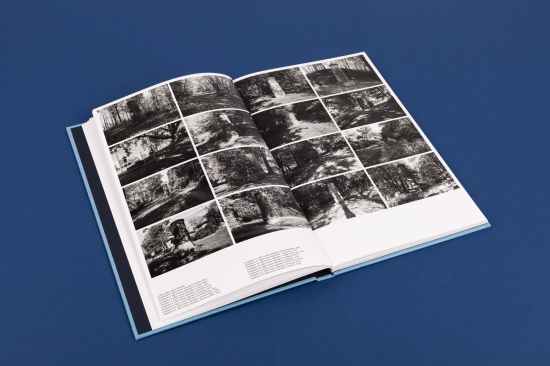
Photo by Stanley Greenberg.
Though such moments of beauty, which Greenberg highlights by photographing only in black and white, reappear throughout the book, most of the rest of the volume are taken up by grids that index shafts (much less dramatic than those in the British book) water tanks and containers, and manholes.
The bigger photographs are given over to the tunnels that bring water to and sewage out of Manhattan and the buildings, usually open brick containers supported by steel skeleton, where those fluids are moved around, pumped, purified, and otherwise treated.
He takes us inside the huge tunnels that bring water through the Bronx and Manhattan, showing their Pharaonic scale and expressive equipment. A pumping station in Jamaica is evident as site-specific piece of sculpture: a concrete drum emerging amid rows of gabled single-family homes. One of the few pieces of new architecture, Ennead’s Newton Creek Wastewater Treatment of 2023, shows off its high-tech bulges
Alas, Greenberg’s work hovers between the drama of the Brazilian photographer Sebastião Salgado, who was an expert at making what humans do to nature grand and terrifying, or the aerial shots of Edward Burtynsky, and the documentary eeriness of Bernd and Hilla Becher, who begat a whole generation of photographers expert at making the normal look weird and the weird sorta normal.
What this collection does achieve is to make us realize how the waterworks are everywhere around us hiding in plain sight. Mainly underground, they are most evident in the countryside around the cities, narrowing in scope to interruptions such as water towers, aqueducts, and pumping stations as the water is sucked towards the urban centers, before dissolving into the fabric of the city, leaving facades with no windows on buildings housing pumping equipment, strange artifacts popping up from the street as vents or release valves, or just marking their course in those ubiquitous manhole covers (documented last century in the Melnicks’ book on that subject, and more recently the subject of a small stream of specialized studies on ones in various cities).
Both these books do us the service of making us notice the signals of the other world that allows us to function. Although New York has a particular density of such aqueous notes, it would be great to see similar studies of cities across the country and globe.
As a longtime California resident, I was hyperaware of the systems that brought water from beyond the desert into Los Angeles and San Francisco, and that supposedly cleaned our waste before it was dumped into the Pacific. The architect William Morrish once proposed building monuments to make people aware of this empire of water and sewage, down to Postmodern taps that would allude, in the manner of Roman fountains, to the sources of the material.
We live in a post-monumental world, so such memorials are perhaps not appropriate, but the documentation and celebration of what marks are visible in our human made world is welcome.
I will walk around the streets of New York and, when I go to England next week, travel around that country newly tuned to the shadow flows around me.
The views and conclusions from this author are not necessarily those of ARCHITECT magazine.
Read more: The latest from columnist Aaron Betsky includes reviews of: Interior Design | Viollet-le-Duc | Malibu High School | Architecture without Architects | Louis Kahn’s Fisher House | Meow Wolf | Generative AI | Frank Gerhy | Robert A.M. Stern | Lars Lerup | Princeton Art Museum | Victor Legorreta | Mexico City Underwater | On Vitruvius | On Olive Development | Calder Gardens | White House and Classical Architecture | Louis Kahn’s Esherick House | Ma Yansong’s Fenix Museum | The Cult of Emptiness | An Icon in Waiting | Osaka Expo | Teamlab | the Venice Biennale of Architecture | On Michael Graves | On Censorship or Caution? | Uniformity in Architecture | Book on Frank Israel | Legacy of Ric Scofidio| Fredrik Jonsson and Liam Young | DSR’s New Book | the Stupinigi Palace | Living in a Diagram | Bruce Goff | Biopartners 5 |Handshake Urbanism | the MONA | Elon Musk’s Space X | AMAA | DIGSAU | Art Biennales | B+ | William Morris’s Red House | Dhaka | Marlon Blackwell’s new mixed-use development | Eric Höweler’s social media posts,| Peter Braithwaite’s architecture in Nova Scotia,| Powerhouse Arts, | the Mercer Museum, | and MoMA’s Ed Ruscha exhibition.
Keep the conversation going—sign up to our newsletter for exclusive content and updates. Sign up for free.