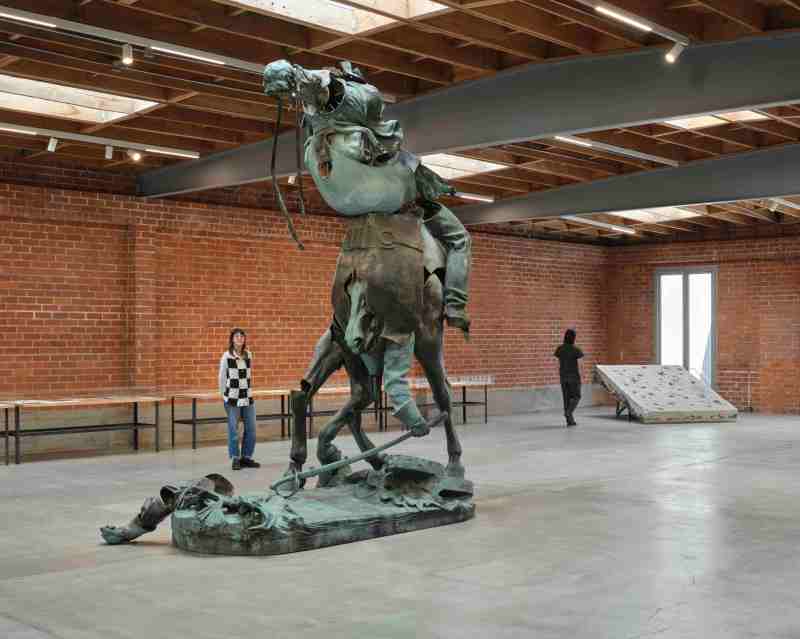
What do we remember and how? Those are the key questions to which two exhibitions of signal importance and achievement on view in Los Angeles right now provide very concrete answers. Presented at the Geffen Contemporary site of Los Angeles’ Museum of Contemporary Art (MOCA) (through May 3) and at the independent art space The Brick (through May 7), Monuments focuses on how we remember the struggle to liberate black people in this country, a still ongoing conflict in which it has been until recently only the supposed losers of Civil War have erected physical reminders.
By appropriating and altering some of those memorials and by suggesting counter-objects, Monuments not only develops a new set of cultural markers but also teaches us something about monumentality itself.
The showstopper is without a doubt the assemblage Kara Walker has fashioned at The Brick out of the monument to Confederate General Robert E. Lee that once stood on Monument Avenue in Richmond, Virginia. It is still astonishing that for more than a century the memorials to those who fought to maintain slavery vastly outnumbered those to the heroes who defeated them, but now these monuments to criminals are finally coming down –or were, until we started indulging in the kind of rewriting (re-righting?) of history that would have made the Nazis proud.
What to do with the remaining relics has been the kind of problem that has confronted societies at least since Queen Hatshepsut’s name was excised from the vast tomb she built for herself in the cliffs overlooking the Nile in the first documented instance of damnatio memoriae.
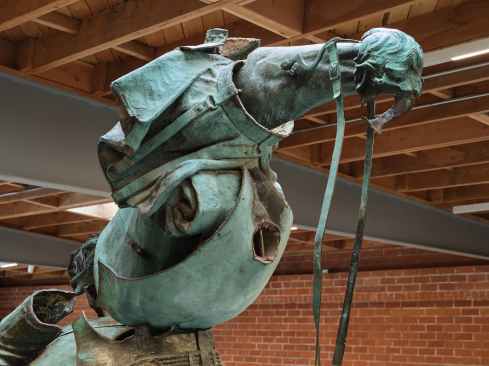
Walker’s solution is not to bury this emblem of the horseback rebel general, but to reassemble it into a new kind of beast: man, arms, and horse all mixed together. The fact that there are three elements sets the piece aside from the traditional satyr-like depictions of man and beast merged.
Technology in the form of bridles, swords, and plates pierces or adorns the various body parts, articulating their differences while weaving them together and occasionally gesturing at a new kind of elegy, now not of the Lost Cause but of the senseless violence the statue embodied, but also repressed.
The sculpture is also breathtakingly beautiful. Walker’s command of composition, gesture, and boiled-down allusion, so evident in all her work, here reaches new heights. The piece makes its arguments by being a great modern work of art, not just by shouting political statements.
That is what, I believe, makes it a model for new monuments. Perhaps rather than trying to preserve emblems of state power such as the FBI Building in Washington, D.C., or reminders of corporate bravura such as the windowless, thirty-story tall AT&T Long Line Building in lower Manhattan, we should consider a similar operation.
The much larger exhibition at the Geffen shows other strategies we could employ. Though some of the work takes the shortcut to political sloganeering without stopping to make an object or image worth considering in the first place that is commonplace in such political art, most of the displays are objects of perverse and troubling attraction in and of themselves.
The photographs of Klansmen in their hoods, each conveying not so much individual personalities, as the lack of identity that masks provide, Andres Serrano took remind us of that hard looking at that which hides has the effect of seeing what is there as it tries to shield itself from us.
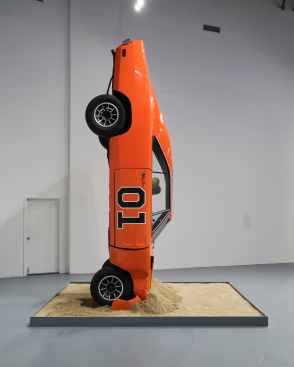
Hank Willis Thomas’s Suspension of Hostilities, a replica of the bright orange car used in the Dukes of Hazard series upended on a base of sand reminds us of how the Confederacy’s legacy has imbued our popular culture, but also lets us see the beauty in this drag racing car that, in this position, cannot be dismissed by asking about its aerodynamics or other functional characteristics. It becomes an object of aesthetic consideration akin to Richard Prince’s heavily worked car hoods.
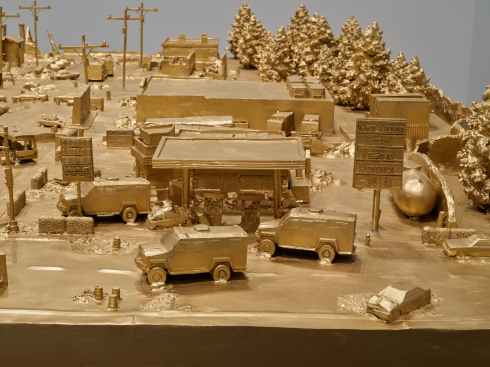
The Southern California artist Kahlil Robert Irving presents two parts of his New Nation series, in which he used high-fidelity scanning and photogrammetry to recreates sites of Civil War battles. Covered with gold paint, the results are the equivalent of trainsets, but also of miniaturized versions of the staging used by both the movie industry and battle reenactors.
Looking down at the table and its slightly blurred details, though, you feel as if you are in charge of this scene, and that it has become a table ornament, while in fact it reminds us of the violence the battles embodied.
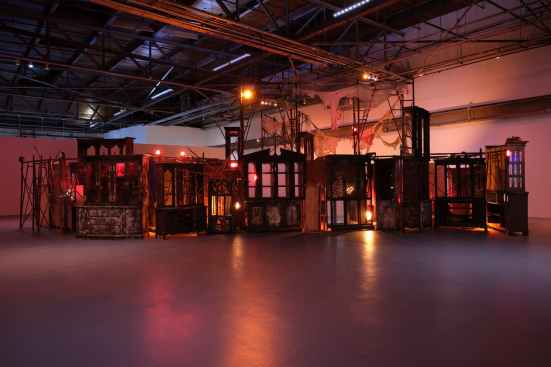
By contrast, Abigail Deville has created a completely immersive experience, Deo Vindice, that lets us wander through the (recreated) charred remains of homes burned down in Richmond during the Civil War. Presented as another form of stage set propped up by industrial scaffolding, the pieces are lit in such a way that we are blinded by the highly visible lamps if we try to peer at the pieces too closely. The illumination’s red hues evokes the fires but also give the installation the air of a bordello. We see a memory of violence, but also of the luxuries the inhabitants could afford because of slave labor.
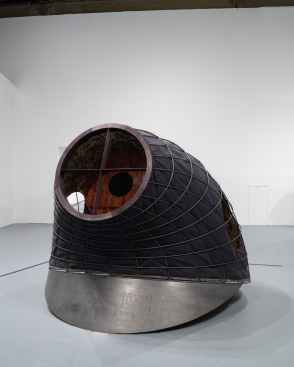
Some of the most striking pieces are more abstract. Martin Puryear has contributed one of his warped horns, Tabernacle, and his pieces are always gorgeous, but enigmatic.
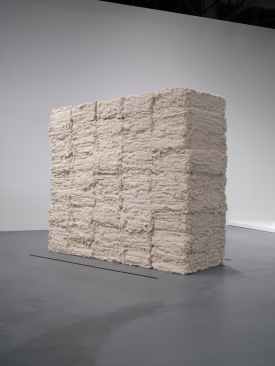
The somewhat lesser-known assemblage artist Leonardo Drew slays it with his stack of cotton, Number 363. Monumental in scale, it is also as sensuous as a winter sweater and brings what the artist Claudia Jongstra does with wool.
The relationship of the material to the forced labor of the slaves that went into this stack is an obvious reference, but its dazzling whiteness makes the point even more evident. By showing the actual material that generated such an important part of the conflict in three-dimensions at a scale and with a tactility you can’t avoid, Drew is able make you ponder questions of race, capitalist and agrarian production, and power in ways unfettered by any direct reference.
That is the final power of these deeper and less directly referential monuments. If the history of such objects goes back to the entombing and thus keeping alive in an altered form pf specific people and deeds, they have over time become both more diverse and time-bound, while also transforming into objects of use that fix the powers that commissioned them in time and place.
This exhibition is a forensic exhumation of what makes monuments and what they could mean in our current society. That is not to belittle Monuments’ ability to remind us of what the Civil War and its still continuing aftermath is all about in a way I think is more effective than any Ken Burns documentary, but also to point out that we have made monuments as the central generator and focal point of our arts, very much including architecture, and that we cannot ignore their place and power. It is up to us to figure out how an un-making, disassembly, and eerie reinvigoration of their elements can transform them into key elements in a strategy of liberation and collective affirmation.
The views and conclusions from this author are not necessarily those of ARCHITECT magazine.
Read more: The latest from columnist Aaron Betsky includes reviews of: Infrastructure | Interior Design | Viollet-le-Duc | Malibu High School | Architecture without Architects | Louis Kahn’s Fisher House | Meow Wolf | Generative AI | Frank Gerhy | Robert A.M. Stern | Lars Lerup | Princeton Art Museum | Victor Legorreta | Mexico City Underwater | On Vitruvius | On Olive Development | Calder Gardens | White House and Classical Architecture | Louis Kahn’s Esherick House | Ma Yansong’s Fenix Museum | The Cult of Emptiness | An Icon in Waiting | Osaka Expo | Teamlab | the Venice Biennale of Architecture | On Michael Graves | On Censorship or Caution? | Uniformity in Architecture | Book on Frank Israel | Legacy of Ric Scofidio| Fredrik Jonsson and Liam Young | DSR’s New Book | the Stupinigi Palace | Living in a Diagram | Bruce Goff | Biopartners 5 |Handshake Urbanism | the MONA | Elon Musk’s Space X | AMAA | DIGSAU | Art Biennales | B+ | William Morris’s Red House | Dhaka | Marlon Blackwell’s new mixed-use development | Eric Höweler’s social media posts,| Peter Braithwaite’s architecture in Nova Scotia,| Powerhouse Arts, | the Mercer Museum, | and MoMA’s Ed Ruscha exhibition.
Keep the conversation going—sign up to our newsletter for exclusive content and updates. Sign up for free.