For decades, the story of California Modernism has been told through a familiar cast—Neutra, Lautner, the Case Study Houses—often framed as a West Coast extension of ideas that originated in Europe. But as architect and historian Alan Hess put it simply, “modernism was not born in Europe.”
That reframing anchored The Known and the Overlooked: Expanding the Story of California Modernism, a sold-out panel discussionat the Palm Springs Art Museum during Modernism Week last month, moderated by ARCHITECT Editor-in-Chief Paul Makovsky and underwritten by Marvin. Featuring Hess and architect Chris Kurrle of San Francisco-based Feldman Architecture, the discussion positioned California Modernism as a generational, regionally responsive tradition rather than a stylistic import.
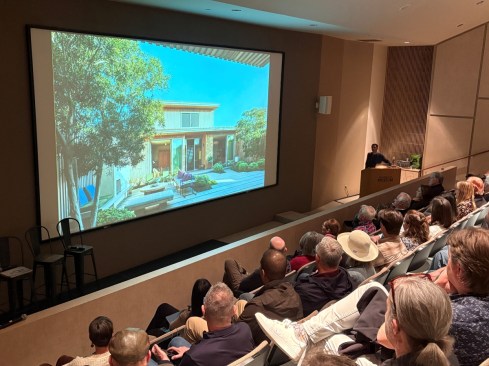
Architect Chris Kurrle presenting at the Modernism Week event. Photo by Mary Beth Blom.
Makovsky described the conversation not as a revisit of well-known work, but as an expansion. “Each year, we gather to celebrate iconic houses and familiar names, but this conversation is about something a little bigger,” he says. “It’s about how California modernism emerged from a specific climate, landscape, and way of living—and why that still matters today.”
A Parallel Origin Story
Hess pushed back on the idea that modern architecture simply moved west from Europe. Instead, he positioned California as a parallel—and in some cases independent—site of early modern experimentation.
“In California and in other places around the world, as well, in the late 19th century into the early 20th century, there were architects dealing with modern materials, modern technology and engineering, modern ways of life … and reconceiving traditional architecture in a brand new way,” he said.
The implication is significant: California Modernism wasn’t derivative, but co-evolving—shaped parallel trajectory shaped by local conditions that demanded new architectural responses. Concrete tilt-up construction, aerospace engineering, and the rise of the automobile weren’t peripheral influences. They were foundational.
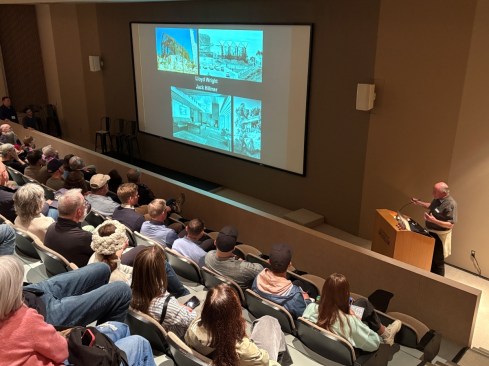
Architect and historian Alan Hess presenting at the event. Photo by Mary Beth Blom.
That regional specificity extended beyond technology into culture and climate, resulting in a form of modernism that prioritized experience over ideology. “Nature was so prominent here in California, both visually, aesthetically, but also in terms of climate and how that allowed people to live indoors and outdoors,” Hess said.
The Overlooked Majority
If the story of California Modernism is broader than its best-known figures, it is also deeper. Throughout the discussion, Alan Hess returned to a wide range of architects and designers—figures like Lutah Maria Riggs, Harwell Hamilton Harris, E. Stewart Williams, and Helen Liu Fong—whose contributions were central to the movement’s development but have often been left out of the standard narrative.
“There are so many names that we really need to know and integrate into the story,” he said.
The reasons for that omission are not accidental. Makovsky pointed to a shift in curatorial priorities in the mid-20th century—particularly at institutions like the Museum of Modern Art—where architects working in environmentally responsive, regionally grounded ways were gradually pushed aside in favor of a more formal, image-driven version of modernism.
The result was a narrower lens—one that not only minimized architects like Riggs, Harris, and Williams, but also overlooked figures such as Fong, whose work in commercial and interior design helped extend modernism beyond the custom house into the broader everyday landscape of California.
For Hess, what links these architects is not stylistic divergence, but continuity. “She’s an example of that kind of ongoing tradition, one generation learning from the next … but also the idea of understanding the nature of the particular place and embracing modern ideas.”
Lineage, Not Isolation
Kurrle brought the historical lineage into the present. His presentation of Surf House, a coastal home in Santa Cruz, framed the project as part of a larger network of influence rather than a standalone work. Pointing to an intricate graphic tracing the career connections of major American architects, he said, “What amazes me here is the associations, the direct employment protege relationships, and how few kind of individual islands there are.”
That emphasis on mentorship and proximity shifts the focus away from individual authorship. As Kurrle noted later, nodding to his Feldman Architecture team, “We should all remember that there are big teams behind all of us that do what we do.”
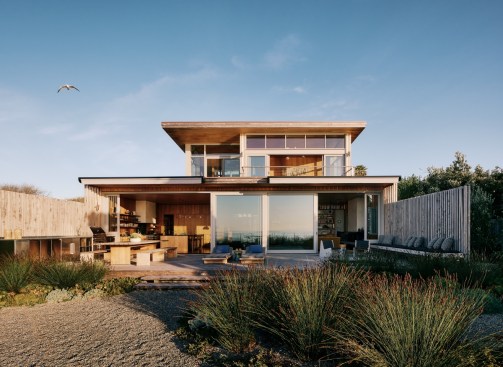
The Surf House in Santa Cruz, Calif., by Feldman Architecture. Photo by Joe Fletcher.
The Surf House itself responds to its site in a way that aligns with an approach long embedded in California Modernism. Rather than imposing a form, the design grows out of environmental conditions—wind, coastal setbacks, and long views. “The importance of site and the importance of the environment… we took that as the starting premise,” he said.
The house relies heavily on Monterey cypress, sourced and used with a focus on efficiency and minimal waste. The choice wasn’t just visual—it was sensory and rooted in place. “The most memorable thing is the smell,” he said. “It just feels like you’re in a pine forest.”
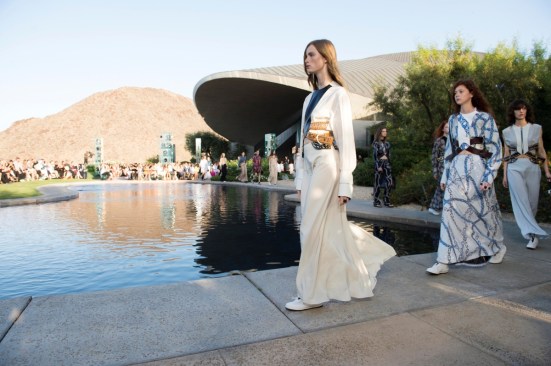
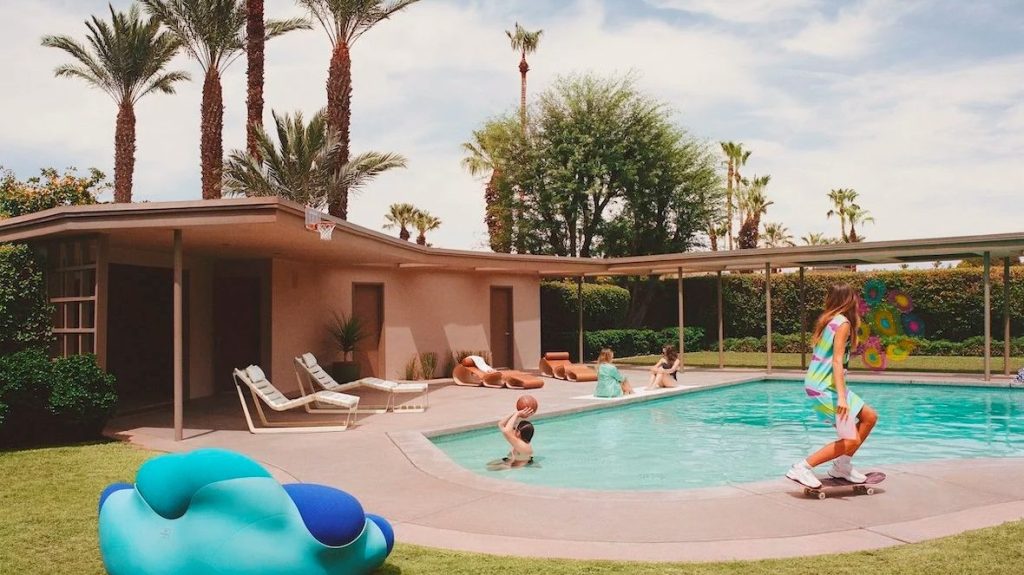
Nicolas Ghesquière's Palm Springs Cruise show at Bob Hope's House, 2015. Photo by Giovanni Giannoni, courtesy of Louis Vuitton.
Christine Vendredi, executive director of the Palm Springs Art Museum, was unable to attend, but her perspective still shaped the discussion. Drawing on earlier conversations with Vendredi, Makovsky explored how California Modernism has become part of the global language of luxury—where pools, landscape, and an effortless indoor-outdoor lifestyle have become powerful visual shorthand, particularly in fashion and brand imagery.
That idea is on display as part Fashioning Architecture: What the Runway Borrows from Architecture, curated by Vendredi, on view through June 7, 2026, at the Palm Springs Art Museum’s Architecture and Design Center, Edwards Harris Pavilion.
Rethinking Sustainability
The conversation returned often to sustainability, framed less as a new priority than as a continuation of long-standing principles. Makovsky connected those ideas to broader shifts in the market: “Luxury is shifting away from opulence toward simplicity, climate responsiveness, and indoor-outdoor connection,” he said.
Kurrle offered a practical perspective: “The most sustainable thing anyone can do is really build a home that will last decades without someone wanting to touch it.”
That definition places durability and long-term relevance at the center—with sustainability reframed as longevity rather than technology—aligning with the movement’s original emphasis on livability and connection to place.
Craft, Labor, and the Missing Layer
Alongside materials and site, the discussion surfaced another critical factor: craft.
“There aren’t craftsmen—tradespeople—learning these skills today. We haven’t valued them enough,” Hess said.
Kurrle pointed to both challenges and opportunities, noting renewed interest among younger generations. “There’s a tactility that I think this younger generation is really gravitating towards.”
The gap, the group suggested, is generational—and closing it will depend as much on how skills are passed down as on how buildings are designed. In that sense, the future of California Modernism may depend less on form than on who, exactly, is still capable of making it.