1
of 4
Alan Karchmer
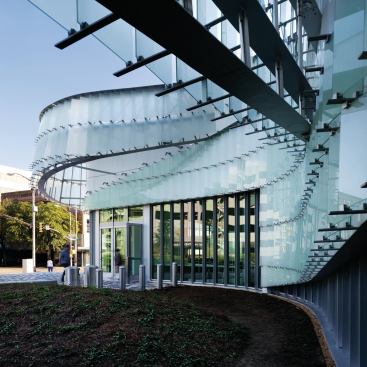
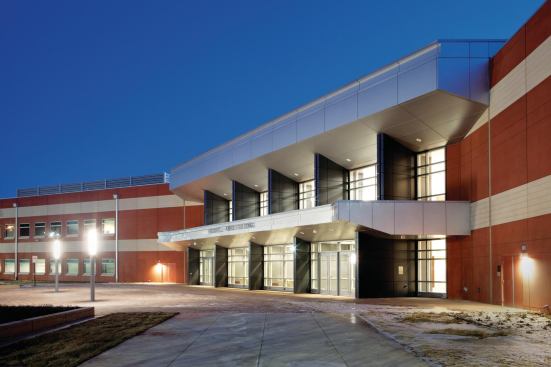
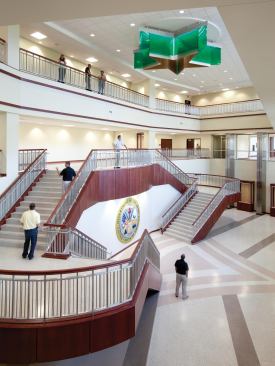
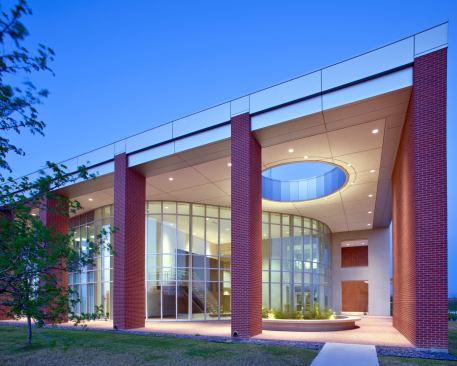
The General Services Administration commissioned Schwartz/Silver…

Alan Karchmer
The General Services Administration commissioned Schwartz/Silver…
An architect interested in becoming an Accredited Tier Designer can enroll in the UI’s courses, which are held worldwide. The training is geared toward engineers, design/build team managers, and project owner representatives.
Numerous government criteria documents can also help firms prepare for mission-critical project needs. Unified Facilities Criteria (UFC) documents, for example, provide planning, design, construction, restoration, and modernization criteria for all U.S. military and defense agencies. Created in 2000 by the Department of Defense (DOD), the UFC provides definitions for requirements such as standoffs from parking and from roadways. Nonmilitary government agencies also frequently use the UFC criteria in their RFPs. “The DOD documents have a large amount of design standards one must become comfortable with,” Luman says.
The U.S. Army Corps of Engineers, the Naval Facilities Engineering Command, the Air Force Center for Engineering and the Environment, and NASA have established the Tri-Service Committee for Unified Design Guidance to manage the related Unified Facilities Guide Specifications program.
Another important government player is the Interagency Security Committee (ISC), which was created in 1995 by a presidential executive order to set minimum security standards for all federal, domestic, and non-DOD facilities. “That’s the overarching design standard,” says Les Shepherd, chief architect for the General Services Administration (GSA). The ISC stipulations are guiding the design of the Department of Homeland Security’s new St. Elizabeth’s campus in Washington, D.C.
Finally, the National Infrastructure Protection Plan, developed in 2006 by the Department of Homeland Security, integrates a range of government-agency efforts designed to enhance the safety of the nation’s GSA-defined Critical Infrastructure Sectors, such as food and agriculture, banking and finance, information technology, energy, and critical manufacturing.
Teamwork Matters
Pursuing the highly technical market of mission-critical architecture requires more than learning procedures and preconditions. “You’ve got to know your client and your team,” Luman says. Beyond developing expertise in the building design and security requirements, firms need to reach out to the integral trades—namely the MEP and IT specialists. “You’ve got to coordinate all these people who don’t even know how to talk to each other,” he says.
Finding an IT partner is essential to the successful pursuit of a project containing any mission-critical aspect, Shepherd says. “Whether it’s federal or private, I think you’ll see more of a requirement [in the RFP process] that there’s security built into your projects to varying degrees,” he says. Though the GSA will take an architectural firm’s past experience into consideration, he encourages firms to team with an IT consultant. “I can’t think of an architectural practice that has an IT specialty or that sort of in-house expertise,” he says.

No recommended contents to display.