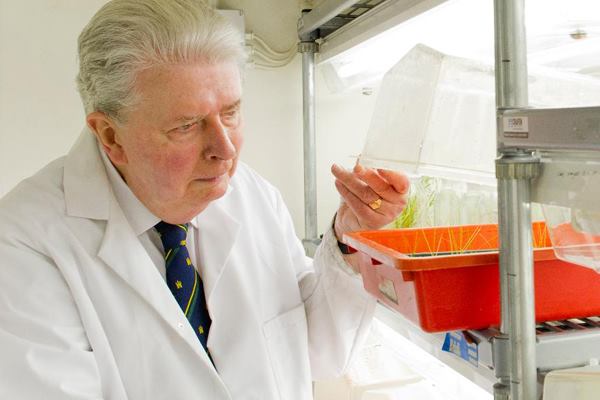
Pollution caused by nitrates has become a global environmental problem. Nitrogen-based fertilizers, which are used ubiquitously to provide plants with nutrients necessary for their survival, have caused dead zones in the oceans as well as problems in the atmosphere.
Professor Edward Cocking at the University of Nottingham believes the solution lies in an alternative way for plants to absorb nitrogen—not through the soil, but through the air. Noting that nitrogen-fixing bacteria enable legumes to fix nitrogen from the atmosphere, Cocking sought to transfer this capability to other plants. He developed a method to implant a widely-adaptable strain of the bacteria within the seeds of plants, and the process—called N-Fix—makes it possible for every cell in the plant to fix nitrogen from the air.
Notably, N-Fix does not involve genetic engineering; nor does it employ synthetic chemicals like the fertilizers it seeks to make obsolete. Rather, it is a method to create a symbiotic biology from two distinct organisms—plants and nitrogen-fixing bacteria. Based on the success of his experiments, Cocking is now working with Azotic Technologies, founded to commercialize N-Fix.
“Helping plants to naturally obtain the nitrogen they need is a key aspect of World Food Security,” said Cocking in a university press release. “The world needs to unhook itself from its ever increasing reliance on synthetic nitrogen fertilisers produced from fossil fuels with its high economic costs, its pollution of the environment and its high energy costs.”
Blaine Brownell, AIA, is a regularly featured columnist whose stories appear on this website each week. His views and conclusions are not necessarily those of ARCHITECT magazine nor of the American Institute of Architects.