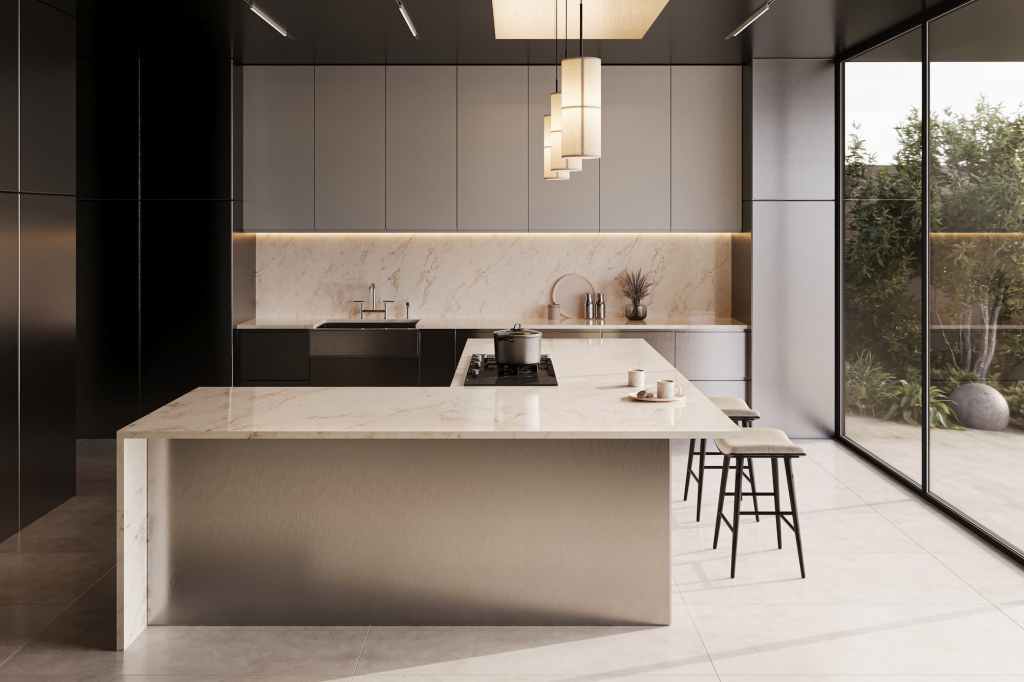
For decades, the engineered-stone category has thrived on a paradox: materials marketed as technological upgrades to natural stone often relied on increasingly questioned industrial practices and shallow visual effects. With the launch of Éclos, Cosentino Group is making a pointed intervention—not just into surface aesthetics, but into the assumptions that have governed the category since quartz first reshaped the countertop market in the late twentieth century.
Positioned as a standalone brand alongside Silestone, Dekton, and Sensa by Cosentino, Éclos introduces what the company defines as an Inlayered Mineral Surface. The distinction is more than semantic. Where most engineered materials rely on surface-level patterning—printed, pressed, or otherwise cosmetic—Éclos embeds its visual language throughout the body of the slab. Veins, tonal variation, and depth persist through edges and profiles, a detail that matters less in marketing images than in actual architectural detailing.
For designers accustomed to disguising seams, softening miters, or avoiding exposed edges altogether, the implications are tangible.
From Surface Effect to Material Depth
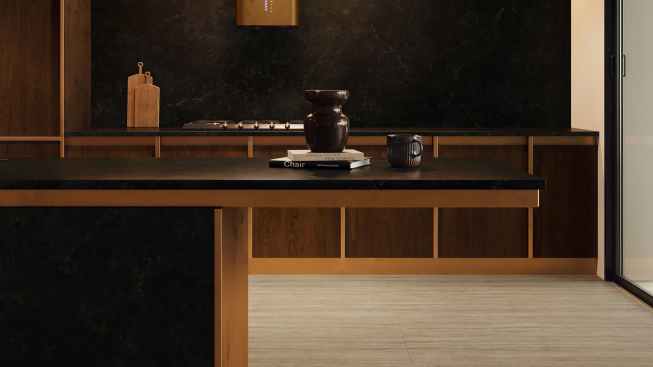
Eclos Phantome pattern shown here.
At the center of Éclos is Cosentino’s Inlayr technology, a layered manufacturing process that uses robotics and multi-stage decoration to produce a three-dimensional visual field integrated across the slab’s thickness. Rather than mimicking stone as image, the material behaves more like a stratified section—one whose internal logic remains legible even when cut, carved, or detailed.
This approach quietly reframes what engineered surfaces are allowed to be. Instead of competing with natural stone on spectacle alone, Éclos positions itself as a designed material with its own formal rules—arguably a more honest proposition for contemporary architecture.
A Material Shaped by Labor and Regulation
If the visual shift is notable, the compositional one is more consequential. The first Éclos collection is formulated with zero crystalline silica, responding directly to intensifying global scrutiny of silica exposure risks in fabrication shops. For an industry facing regulatory pressure and mounting ethical questions, this move suggests a recalibration of priorities—one that places worker safety alongside performance and aesthetics rather than treating it as an afterthought.

Eclos Tajnar pattern shown here.
Recycled content further underscores that repositioning. All Éclos colors contain at least 50 percent recycled material, with some nearing 90 percent—a figure that exceeds category norms and reflects a broader push toward circular material systems. Importantly, these gains are paired with improved flexibility and impact resistance, reducing breakage during handling and installation—an unglamorous but critical concern for fabricators and contractors alike.
Performance metrics remain competitive: Éclos tolerates direct heat contact up to 428°F, positioning it squarely within the demands of kitchens and other high-use architectural applications.
Not a Product Line—A Strategic Reset
Cosentino is framing Éclos less as a product launch than as a structural reset, recalling earlier moments when the company helped redefine market expectations—Silestone in the 1990s, Dekton in the 2010s. Whether Éclos achieves similar ubiquity is an open question, but its intent is clear: to move the industry past both quartz dependency and surface-deep design.
That ambition arrives at a moment of market expansion. The global countertop sector is projected to approach $50 billion by 2028, with mineral and porcelain surfaces accounting for a growing share—particularly outside North America. Yet growth alone no longer guarantees legitimacy. Architects are increasingly pressed to account for labor conditions, embodied carbon, and material transparency, even in interior finishes once treated as purely decorative.
Éclos enters this context not as a neutral option, but as a proposal: that engineered surfaces must now be safer to make, materially explicit, and visually honest about how they are constructed.
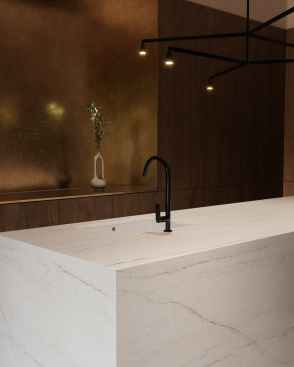
Eclos Ivora pattern shown here.
Whether the industry follows remains to be seen. But with Éclos, Cosentino has made one thing difficult to ignore—the quartz era is no longer the future, and the next chapter will demand more than polish.