For decades, architects have occupied an uneasy position in the building-products ecosystem—deeply influential in theory, but often peripheral in practice. They specify materials, systems, and technologies that define performance, sustainability, and user experience, yet rarely control how those products are conceived or developed. A new report from the American Institute of Architects (AIA) suggests that tension is reaching a turning point.
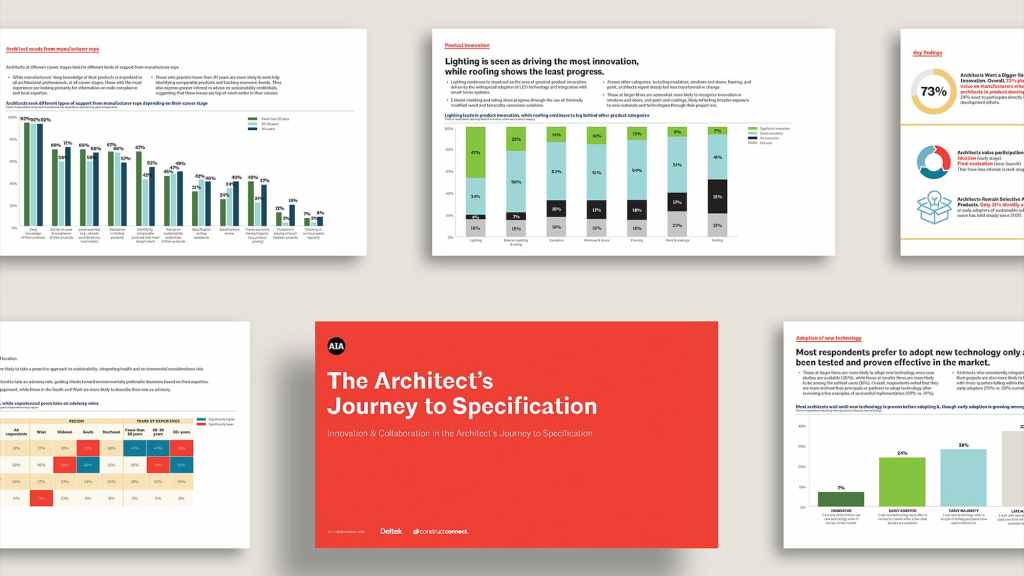
Published in late February, Innovation & Collaboration in the Architect’s Journey to Specification offers a detailed snapshot of how architects today engage with manufacturers, adopt emerging technologies, and integrate sustainability into their design processes. Developed in collaboration with Deltek and ConstructConnect, the study updates the AIA’s ongoing Journey to Specification research series, which tracks the evolving forces shaping product selection in architectural practice.
What emerges is a profession that wants more influence—but is still negotiating how, and how far, it wants to go.
The Influence Gap
One of the report’s most striking findings reveals a paradox at the heart of architect–manufacturer relationships. While 73 percent of architects say they highly value being involved in product development by manufacturers, only 24 percent express a desire to participate directly in those efforts.
The gap points to a profession that sees product innovation as critical to its work, yet remains cautious about deeper entanglement with industry. Liability concerns, time constraints, procurement rules, and the blurring of professional boundaries may all play a role. Still, the appetite for influence is clear: architects want products that respond more precisely to design intent, performance goals, and sustainability mandates—even if they are not ready to step fully into co-development roles.
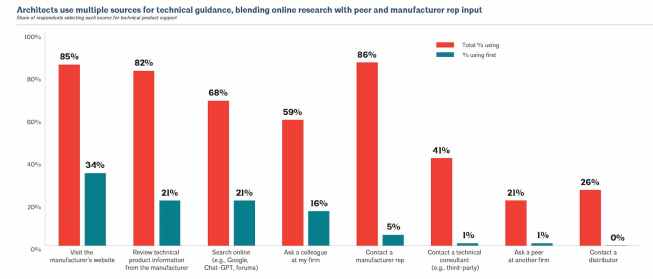
According to the report, architects increasingly evaluate manufacturers not just on product availability, but on the quality of technical information, responsiveness, and long-term collaboration potential. Where architects once relied heavily on catalogs and reps, they now expect data-rich digital tools, transparent environmental metrics, and early engagement during design development.
Sustainability: From Optional to Expected
If architects remain cautious about product co-creation, they are far less tentative about sustainability—at least in terms of recommendation and integration.
The share of architects who proactively recommend or integrate sustainability options has risen sharply, from 58 percent in 2020 to 79 percent in 2025, signaling a decisive cultural shift within the profession. Sustainability is no longer a specialty concern or a client-driven add-on; it is becoming a baseline expectation across building types and regions.
Yet adoption patterns remain uneven. The report finds that only 31 percent of architects identify as early adopters of sustainable solutions, a figure unchanged since 2020. Among that group, however, a notable overlap emerges: 57 percent of sustainability early adopters also embrace new technology. The data suggests that innovation—whether environmental or digital—tends to cluster among the same segment of forward-leaning practitioners.
For manufacturers, this presents both a challenge and an opportunity. Products that combine sustainability with measurable performance gains and technological integration are more likely to resonate with architects pushing the boundaries of practice.
Why “Made in the U.S.” Still Matters
In an era of globalized supply chains, architects are also signaling a renewed preference for domestic manufacturing. Seventy-two percent of architects say they prefer U.S.-manufactured products, citing energy performance, durability, occupant health, and supply-chain stability as primary drivers.
That preference reflects lessons learned from recent disruptions—pandemic-era shortages, shipping delays, and geopolitical uncertainty—as well as a growing emphasis on lifecycle performance and accountability. Domestic manufacturing often offers clearer documentation, faster response times, and greater confidence in regulatory compliance, all of which matter in increasingly complex projects.
Information, Trust, and the Future of Collaboration
Beyond statistics, the report paints a picture of a profession recalibrating its relationship with industry partners. Architects are no longer passive recipients of product information; they are active evaluators of credibility, transparency, and alignment with broader design values.
“This report reflects the voices of architects across the country and provides actionable insights for manufacturers, design professionals, and industry partners,” said AIA EVP/Chief Executive Officer Carole Wedge, FAIA. “By understanding these trends, the profession can strengthen collaboration, accelerate innovation, and advance sustainable practices that benefit clients and communities.”
Her statement underscores a central takeaway of the study: collaboration is no longer optional, but it must be redefined. Architects want manufacturers to innovate faster, communicate more clearly, and embed sustainability and performance into the DNA of their products. At the same time, many architects remain wary of blurring professional boundaries or assuming new risks.
A Profession in Transition
Taken together, the findings suggest that architects are at an inflection point. They are more engaged with sustainability than ever before, increasingly selective about manufacturing partners, and eager to shape the tools and products that define the built environment. Yet they are still negotiating the limits of their role—how much influence they want, how directly they want to engage, and what collaboration should look like in a rapidly changing industry.
For manufacturers, the message is clear: architects are watching closely, asking harder questions, and rewarding those who align innovation with transparency and trust. For architects, the challenge may be whether the desire for influence ultimately translates into a willingness to claim it.
Learn more and download Innovation & Collaboration in the Architect’s Journey to Specification from the American Institute of Architects.