
Leading by Example

Two Lighting Firms Explore Energy-Efficient Lighting Strategies For Their Own Offices

4 MIN READ
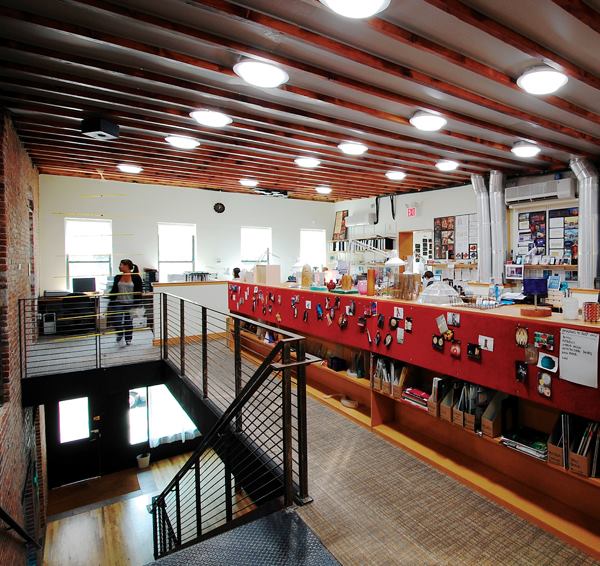
Forty-five, 14-inch-diameter tubular skylights with custom-designed socket assemblies that hold 23W 3500K CFL lamps, bring natural light into the second-floor main workspace at Focus Lighting's new office.

J.P. Lira/focus lighting

Forty-five, 14-inch-diameter tubular skylights with custom-designed socket assemblies that hold 23W 3500K CFL lamps, bring natural light into the second-floor main workspace at Focus Lighting's new office.

Lighting designers and architects are often so busy working on projects for their clients that they don’t devote time to designing their own offices. But for two well-known lighting practices—Lighting Design Alliance (LDA) in Long Beach, Calif., and Focus Lighting in New York —designing a new office was a necessity. Each firm had worked in less-than-ideal conditions for several years and had significantly outgrown their workspaces. LDA had a series of small semi-detached buildings and Focus Lighting had a four-story townhouse on the Upper West Side. After finding real estate that was ripe for transformation—a dark, old auto warehouse for LDA and three adjacent storefronts for Focus—LDA’s president Chip Israel and Focus Lighting’s principal Paul Gregory knew they needed to act.

For both Israel and Gregory, the chance to build a new office was not just about square footage, but about creating a workspace that would foster communication between staff and serve as laboratory for ideas and strategies. Also, both wanted to implement energy-efficient measures, not merely because they felt it was the right thing to do, but because it was a way to practice what they preach. “I wanted the office to be a place where we could show clients, in real time, what we were communicating in the drawings,” Israel says.

To that end, a range of market-available lighting is on display, from active and passive daylighting systems to solar-fed fiber-optic accent lights. “You can have the best of intentions,” Gregory says. “But you never know if you are doing a good job until the electric bill arrives. That’s when you really see if your lighting choices are on target.” With the aid of basic energy monitoring software, both firms have been able to better understand their energy use and how that translates into kilowatt-hours and dollars. “Once you see how the lighting is translating into real-time energy use you can adjust and turn lights on and off so you eliminate the peak periods,” Gregory explains.

The offices have become more than just places for people to work, they represent a communal sense of ownership. “The staff takes great pride in the space,” Israel says. “Everyone is fully invested in it and wants to see it perform to its highest levels.”

About the Author

Elizabeth Donoff

Elizabeth Donoff is Editor-at-Large of Architectural Lighting (AL). She served as Editor-in-Chief from 2006 to 2017. She joined the editorial team in 2003 and is a leading voice in the lighting community speaking at industry events such as Lightfair and the International Association of Lighting Designers Annual Enlighten Conference, and has twice served as a judge for the Illuminating Engineering Society New York City Section’s (IESNYC) Lumen Award program. In 2009, she received the Brilliance Award from the IESNYC for dedicated service and contribution to the New York City lighting community. Over the past 11 years, under her editorial direction, Architectural Lighting has received a number of prestigious B2B journalism awards. In 2017, Architectural Lighting was a Top Ten Finalist for Magazine of the Year from the American Society of Business Publication Editors' AZBEE Awards. In 2016, Donoff received the Jesse H. Neal Award for her Editor’s Comments in the category of Best Commentary/Blog, and in 2015, AL received a Jesse H. Neal Award for Best Media Brand (Overall Editorial Excellence).Prior to her entry into design journalism, Donoff worked in New York City architectural offices including FXFowle where she was part of the project teams for the Reuters Building at Three Times Square and the New York Times Headquarters. She is a graduate of Bates College in Lewiston, Me., and she earned her Master of Architecture degree from the School of Architecture at Washington University in St. Louis.

No recommended contents to display.

Upcoming Events

  • Charlotte Dealmakers

    Sonesta Charlotte Lower South End

    Register Now
  • Columbus Dealmakers

    Renaissance Columbus Downtown Hotel

    Register Now
  • Homes that Last: How Architects Are Designing a Resilient Future

    Webinar

    Register Now
All Events