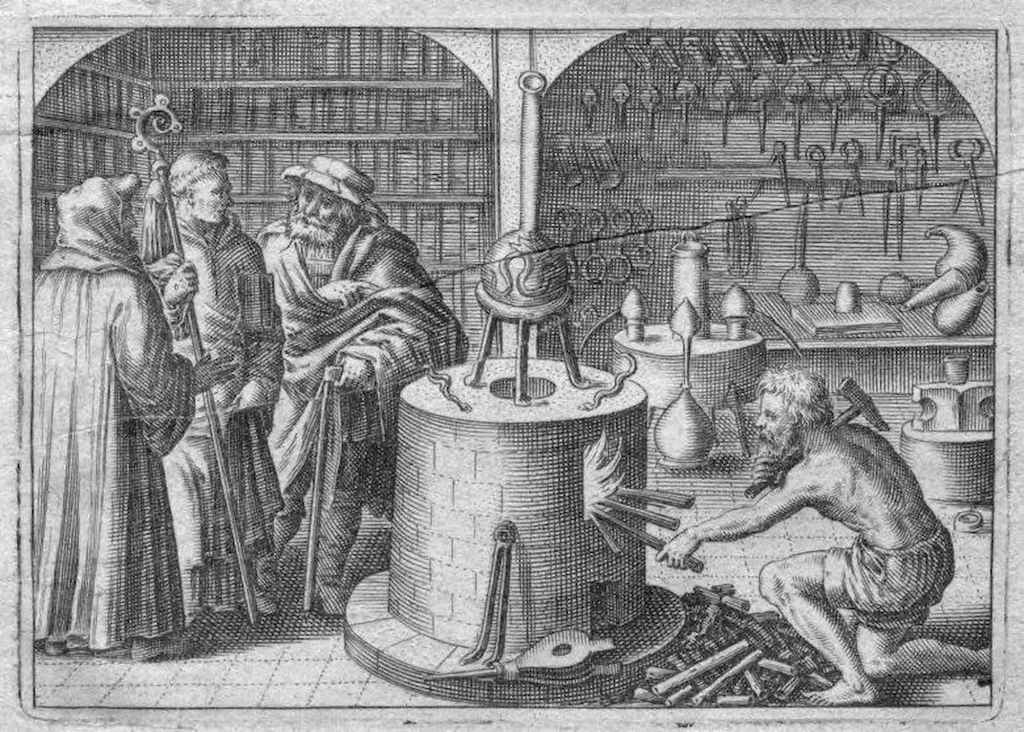
Alchemists once embraced the concept of prima materia, or “first matter,” an idea describing the primordial origins of all materials. This undifferentiated, raw substance invited skillful manipulation to transform it into useful matter. The alchemist’s objective was not merely alteration but interpretation, assessing the latent potential hidden within prima materia that could be coaxed into meaningful realities.
The recent First Matter symposium at the University of North Carolina at Charlotte’s David R. Ravin School of Architecture, conceived and organized by Prof. Alexandra Waller as part of the Marley P. Carroll, FAIA Speaker Series, drew on this analogy to address rapidly changing approaches to architectural design. Today’s first matter is no longer exclusively physical, but increasingly consists of digital information that architects manipulate alongside traditional matter.
Artificial intelligence is the central character, muse, and technology transforming contemporary prima materia. Although AI is typically understood as a potent new design tool, it is also influencing how architects conceptualize the initial states of the design process.
AI invites designers to re-evaluate what we consider the raw materials of design, what information should be included or excluded in the early phases of the process, and how novel computational capacities are shifting the conceptual starting point of architectural invention.
The symposium contributions of Andrew Witt, Karel Klein, and Brandon Clifford—computational design and fabrication pioneers from three different Schools of Architecture—illuminated various dimensions of this evolving paradigm.
Andrew Witt, the inaugural Kavita and Krishna Bharat professor at Washington University in St. Louis, approaches digital information as an architectural material. He explores how computing can reformulate the relationships among systems, resources, and environments at scales far beyond individual buildings.
Witt employs large datasets and simulation models to guide design decisions while imagining novel planetary monitoring systems and speculative global infrastructures—a strategy that might be called computational sustainability. This ambitious approach reveals AI’s potential to collect and interpret data at the scale of planet-wide feedback to track environmental degradation, climate change, and ecological restoration.
In his work with Certain Measures, the firm he co-founded with Tobias Nolte, Witt projects an increasingly cybernetic future for architecture, in which elaborate sensory networks continuously monitor and respond to shifting ecological conditions.
An example is the Vivarium, installed at Dubai’s Museum of the Future, a speculative incubator for novel biologies that could repair a human-degraded future world. Such projects reveal how buildings are not merely static structures but responsive frameworks that sense and enable desirable ecological outcomes. At the same time, the architect’s role is not merely to generate form but to harness flows of data to guide material transformation.
While Witt’s research concerns data systems, Sci-Arc-based Karel Klein investigates the epistemological implications of AI, including how machine learning reframes traditional relationships between creativity, perception, and representation. An architect who began teaching AI design studios a decade ago, Klein takes inspiration from Walter Benjamin’s concept of the “mimetic faculty,” or the human tendency to perceive and emulate patterns in the world. This imitative capacity is evident throughout history, since emulation is a fundamental strategy in architectural design.
AI exponentially expands mimetic faculty by analyzing massive image datasets, identifying nuanced patterns, and rapidly and in large quantities generating new visual interpretations. Klein’s studio-based experiments include training AI models on specific architectural drawings—such as those in Edward R. Ford’s Details of Modern Architecture—and prompting them to generate unprecedented designs by reinterpreting historical data. These experiments rely on the unexpected recombinations of distinct human artifacts, such as buildings and violins, as well as the careful restriction of information.
To avoid Generative Adversarial Networks’ (GANs) tendency to reproduce predictable imagery from large datasets, Klein intentionally limits AI training data to produce novel results. This method relates to the notion of productive ignorance, the strategic limitation of knowledge to inspire more innovative outcomes, which has long existed in human creativity. As architects increasingly employ AI in the design process, they must not only learn to ensure sufficient access to information but also to curate the incompleteness, absence, and ambiguity needed to prompt creative breakthroughs.
The work of MIT architecture professor Brandon Clifford shifts the emphasis from computational processes back to physical matter, revealing additional ways that novel material practices may emerge from historical analysis. Clifford draws inspiration from ancient material practices, such as cyclopean masonry, evident in constructions such as the Moai of Easter Island or the Inca Roca Palace walls in Cusco, Peru.
Noting that ancient societies typically repurposed massive polygonal stone blocks in later constructions, Clifford’s investigations in projective archaeology consider buildings not as static objects but as transitory configurations within expansive material cycles. Clifford’s long view contrasts with today’s short building lifespans and relative lack of material reuse.
Clifford designs and builds novel cyclopean blocks that can be easily moved and reconfigured, and which will inherently outlast many conventional building materials. His constructions take advantage of advanced fabrication techniques and new materials.
Computation provides powerful tools for analyzing geological materials, optimizing resource use, and designing structures capable of enduring deep time. Referencing another dimension of design’s origins, Clifford’s work shows how today’s computational tools can be employed to realize a kind of primitive future, combining the strengths of prehistoric and contemporary technologies.
As these First Matter examples demonstrate, design’s initial conditions increasingly involve sophisticated information systems, processes, and interpretations in addition to the typical elements of matter and form.
Adopting a planetary mindset, knowledge-curation strategies, and a long view of time are compelling ways for architects and designers to reshape the beginning design process in our computational age.