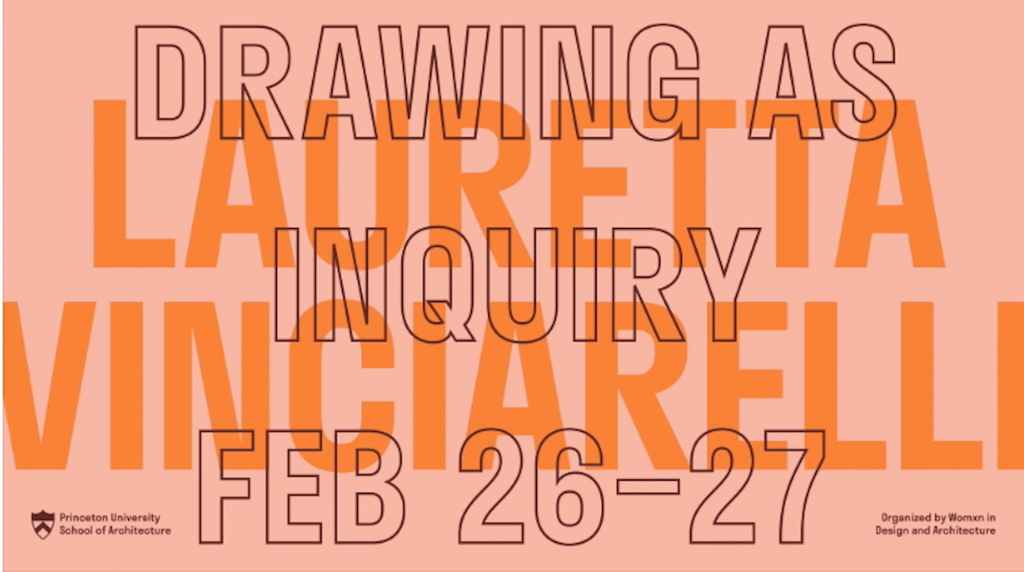
In an architectural culture increasingly dominated by performance metrics—square footage delivered, budgets met, timelines compressed—the tenth annual Womxn in Design and Architecture Conference at the Princeton University School of Architecture advances a more subversive proposition: that drawing itself can be architecture.
Titled Lauretta Vinciarelli: Drawing as ____, the two-day conference, taking place February 26–27, 2026, honors the life and work of Lauretta Vinciarelli, an architect, artist, and educator whose luminous watercolors challenged the profession’s assumptions about authorship, production, and value. The blank space in the title is not rhetorical flourish—it is an invitation. Like Vinciarelli’s work, it resists closure, asking participants to reconsider what drawing can do when freed from the obligation to become a building.
Architecture as Thought, Not Product
Vinciarelli’s career unfolded largely in parallel to the profession’s mainstream narratives. After earning her doctorate in architecture and urban planning from Università di Roma La Sapienza in 1971, she moved to New York City and became affiliated with the Institute for Architecture and Urban Studies. There, she quietly but decisively broke ground—becoming the only woman to receive a solo exhibition at the IAUS and later one of the first women to teach a studio course at Columbia University.
Best known for her meticulously layered watercolors—often labeled “Paper Architecture”—Vinciarelli rejected drawing as mere representation. Instead, she treated it as a mode of inquiry: a way to think through space, light, atmosphere, and ideology without submitting to the constraints of capital, construction, or typology. Her work foregrounded specificity of place and vernacular intelligence, pushing back against the universalizing impulses of modernism and the market logic that followed.
The Princeton conference frames Vinciarelli not as an exception to architectural history, but as a figure whose ideas feel newly urgent—particularly as the profession grapples with stalled construction, planetary limits, and the expanding role of speculative and critical practice.
Opening Night: Drawing as Intellectual Ground
The conference opens Thursday evening, February 26, with a welcome and land acknowledgement by Mónica Ponce de León, George Dutton ’27 Professor in Architecture at Princeton. Her presence signals the institutional weight behind the event, but also its pedagogical stakes: this is a conversation about how architecture is taught, valued, and transmitted.
Following an introduction by WDA member Nneoma Onyekwere, the keynote presentation is delivered by Daniel Sherer, Visiting Faculty at Princeton, whose scholarship has long interrogated architecture’s theoretical and representational frameworks. A discussion and Q&A moderated by WDA members B Ireland and Cara Hu extends the evening beyond lecture, setting a tone of collective inquiry rather than authoritative pronouncement.
Friday: Drawing as Research, Exploration, and Process
Friday’s program unfolds as a carefully structured argument, moving through three thematic panels—Drawing as Research, Drawing as Exploration, and Drawing as Process—each moderated by WDA members and anchored by scholars and practitioners whose work expands the meaning of architectural representation.
The morning begins again with a welcome and land acknowledgement by Ponce de León, followed by an introduction from Cara Hu. At 10:15 a.m., Drawing as Research brings together K. Michael Hays, Eliot Noyes Professor at the Harvard Graduate School of Design; Akima Brackeen, Assistant Professor at the University of Illinois Urbana-Champaign and Community Design Director at Architecture for Public Benefit; and Mary McLeod, Professor of Architecture at Columbia GSAPP. Together, they examine drawing not as illustration but as a form of scholarly production—one capable of generating theory in its own right.
At 11:30 a.m., Drawing as Exploration shifts toward practice-based inquiry, featuring Bruna Canepa, Anna Ciprian of Università Iuav di Venezia, and Troy Schaum of Rice University and Schaum Architects. Moderated by Onyekwere and Lia Mondavi, the panel explores drawing as a speculative tool—one that allows architects to test ideas without committing them to built form.
After a midday break, Drawing as Process brings the conversation full circle. Moderated by Aidan Lozano and Nina Li, the session features Francesca Romana Forlini, Jolanda Devalle of EPFL, and Joan Ockman of the University of Pennsylvania. Here, drawing emerges as a durational act—iterative, embodied, and inseparable from pedagogy and authorship.
Closing the Loop—and Opening the Canon
The conference concludes with a closing conversation led by Ponce de León and a group of WDA alumni whose careers span practice, scholarship, and editorial work, including Keren Dillard, Sheila Lin, Elena M’Bouroukounda, and Shoshana Torn. The session underscores one of the event’s central claims: that Vinciarelli’s legacy is not confined to history, but actively shaping new modes of architectural engagement.
Organized by Womxn in Design and Architecture, founded in 2014, the annual conference has become a counter-canon in its own right. Since 2017, WDA has foregrounded the work of figures such as Helen Liu Fong, June Jordan, Minnette De Silva, Anne Tyng, Norma Merrick Sklarek, Lina Bo Bardi, and Zaha Hadid—architects whose contributions were often marginalized or misread by conventional histories.
That lineage matters. By centering Lauretta Vinciarelli in its tenth year, WDA makes a larger argument about what architecture has been—and what it could still become. In treating drawing as research, exploration, and process, the conference does more than honor a pioneering figure. It proposes an architecture less obsessed with outputs and more invested in thought.
In the open-ended space after Drawing as ____, the conference leaves room for participants to write their own answers. That, perhaps, is Vinciarelli’s most enduring lesson: architecture begins not with construction, but with the courage to think differently—line by line, wash by wash, refusing to behave.