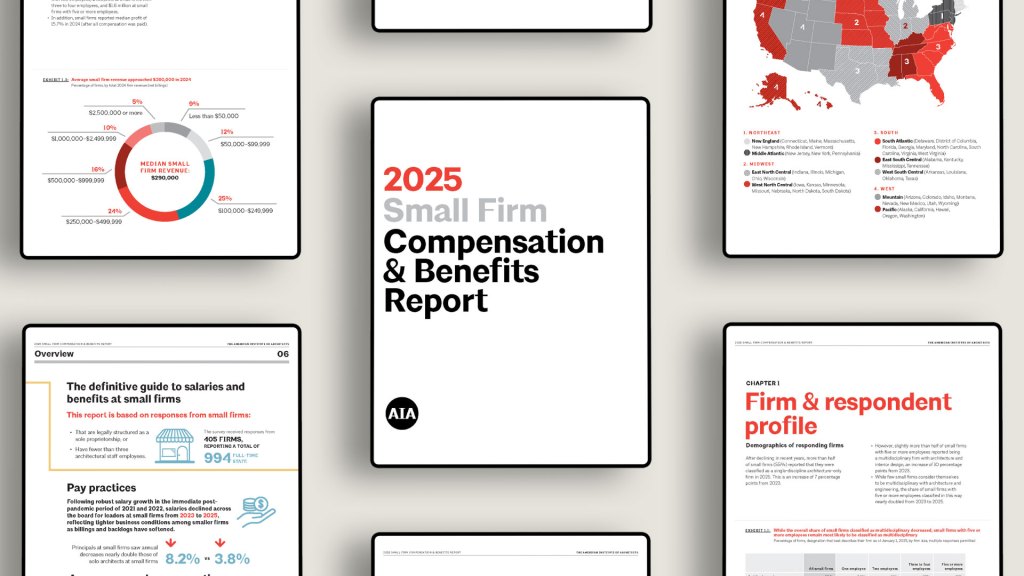
Small firms have always been the architectural profession’s moral center and economic backbone. They are where many architects first learn how to practice, where risk is absorbed personally rather than institutionally, and where design labor is often most directly tied to local communities and clients. According to new data released this week, they are also where the post-pandemic recalibration of architecture is most clearly—and painfully—visible.
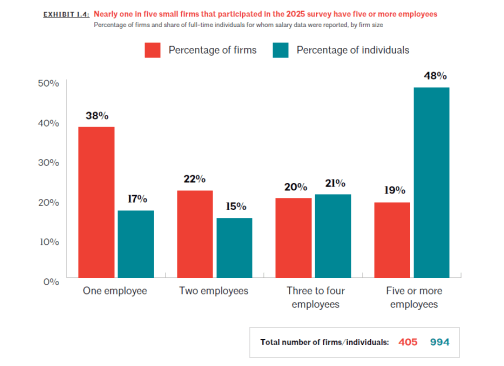
The AIA Small Firm Compensation & Benefits Report, released February 24, 2026, draws on data from hundreds of practices nationwide to document how sole practitioners and firms with fewer than three architectural staff are coping with a profession in economic transition. Together, these firms account for 74 percent of all architectural businesses, a statistic that alone reframes how discussions about “the profession” should be conducted.
Produced by the American Institute of Architects, the report complements the organization’s broader Compensation & Benefits study by focusing on the smallest practices—those most exposed to market volatility and least buffered by scale. What emerges is a portrait of a profession that is still hiring, still mentoring, and still supporting licensure, but doing so under tighter financial conditions that have begun to reshape who bears economic risk.
Modest Gains at the Bottom, Contraction at the Top
One of the report’s most striking findings is a divergence in compensation trends between emerging professionals and firm leaders. Staff architects and early-career professionals saw average annual compensation rise by 4.4 percent between 2023 and 2025, a modest but meaningful increase after inflationary shocks and cost-of-living spikes earlier in the decade.
At the same time, firm leaders experienced salary declines over that same period, reversing the strong gains many saw in 2021 and 2022. The shift reflects what many small-firm principals already know intuitively: as billings and backlogs softened after the pandemic surge, owners absorbed the downturn themselves rather than passing it on to staff.
This pattern underscores a defining feature of small practice: compensation is not simply a payroll issue but a risk-management strategy. In the absence of deep reserves or diversified portfolios, principals often function as the profession’s shock absorbers—smoothing volatility for employees by internalizing financial pressure.
Benefits, Flexibility, and the New Baseline of Practice
Despite tightening margins, small firms are not retreating from professional support. The report documents expanded offerings for licensure assistance, AIA membership dues, mentorship programs, and flexible work arrangements, including remote work, flexible hours, and parental accommodations.
What once might have been considered perks are now baseline expectations, even in the smallest offices. The pandemic accelerated this shift, but its persistence suggests something more structural: talent retention in architecture now depends as much on workplace culture and flexibility as on salary alone.
For firms operating with one or two architectural staff, these benefits represent a significant investment. Yet the data suggests that small practices view them not as optional but as essential to sustaining a viable pipeline of professionals—particularly as licensure timelines lengthen and student debt remains a barrier to entry.
Students in the Office, Even as the Market Tightens
Another signal of cautious optimism appears in hiring patterns. In 2024, 55 percent of small firms with five or more employees hired at least one architecture student for part-time work. At a moment when many firms are scrutinizing every line item, this commitment to students points to a longer view of professional continuity.
Student hiring has historically been an early indicator of confidence in future workload. That it remains relatively strong—even amid softened billings—suggests that small firms are betting on recovery, or at least on the necessity of maintaining a generational bridge regardless of short-term uncertainty.
A Profession Quietly Rebalancing Itself
Taken together, the findings depict a profession that is neither collapsing nor rebounding triumphantly, but rebalancing. The exuberance of the immediate post-pandemic period has given way to a more sober assessment of what small practice can sustainably support. Compensation growth has slowed. Leadership pay has contracted. Flexibility and professional support have become non-negotiable.
The report’s stated goal is pragmatic: to equip firm leaders with actionable, data-driven insights for decision-making. But its broader significance lies in what it reveals about architecture’s underlying structure. When three-quarters of firms operate at this scale, their collective adjustments amount to a redefinition of professional norms.
Small firms may not dominate skylines or headlines, but they continue to define how architecture is practiced day to day. This report makes clear that they are adapting—not by abandoning values, but by redistributing sacrifice. In the process, they offer a candid snapshot of a profession learning how to live with less volatility, fewer illusions, and a clearer sense of who carries the cost when work slows.
For more details, the AIA Small Firm Compensation & Benefits Report is available now.