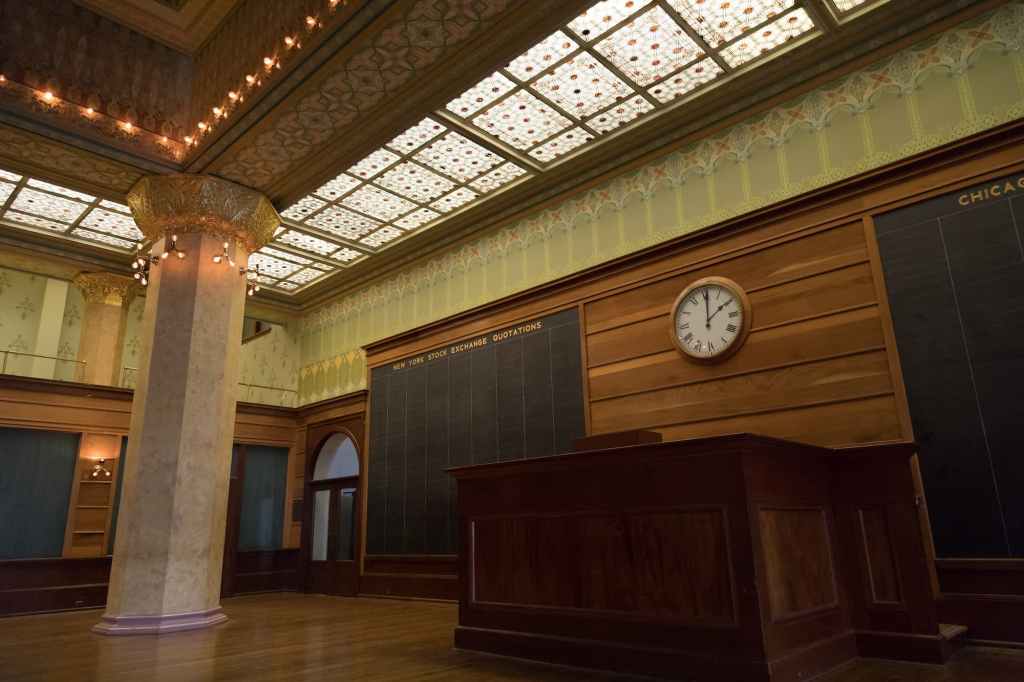
A preservation campaign is gathering momentum over fears that the historic Chicago Stock Exchange Trading Room, one of the most celebrated surviving interiors of the American architect Louis Sullivan, could be demolished as part of a future expansion at the Art Institute of Chicago.
A petition circulating on Change.org calls on the public to oppose any plan that would remove the reconstructed interior, which has been displayed inside the museum since 1977. Advocates argue that destroying the room would erase a landmark of architectural history that had already survived one dramatic rescue half a century ago.
A Masterpiece Saved From an Earlier Demolition

Photo courtesy: hWikimedia Commons/CC BY 1.0.
The trading room originated in the Chicago Stock Exchange Building, completed in 1893 and designed by Sullivan and his partner Dankmar Adler. Widely considered a masterpiece of early modern architecture, the building embodied Sullivan’s philosophy that ornament and structure should work together to create a unified organic whole.
Despite its architectural importance, the building was demolished in 1972, an event that became one of the most consequential losses in American preservation history.
The demolition also claimed the life of architectural photographer Richard Nickel. Nickel had spent years documenting Sullivan’s work and attempting to salvage architectural fragments from endangered buildings. He died when part of the structure collapsed while he was photographing and rescuing elements during the demolition. His death became a powerful symbol for the emerging historic-preservation movement.
A Remarkable Reconstruction
Although the building itself was lost, its most extraordinary space—the two-story Chicago Stock Exchange Trading Room—was carefully dismantled and saved.
With support from preservationists, architects, and philanthropic donors, the room was reconstructed inside the Art Institute in 1977 after roughly five years of work. The project required meticulous documentation and the reassembly of Sullivan’s elaborate architectural components.
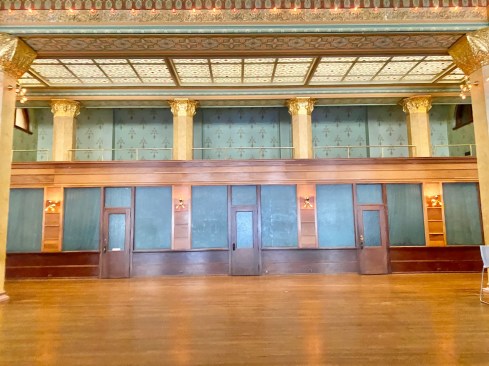
Photo courtesy: Warren Lemay/CC BY-SA 2.0.
The restored hall measures roughly 100 feet by 75 feet and rises two stories. Visitors entering the space encounter towering ornamental columns, stained-glass skylights, and intricately stenciled wall surfaces featuring more than fifty hues in stylized botanical patterns. For many architects and historians, the room offers one of the most immersive surviving experiences of Sullivan’s work.
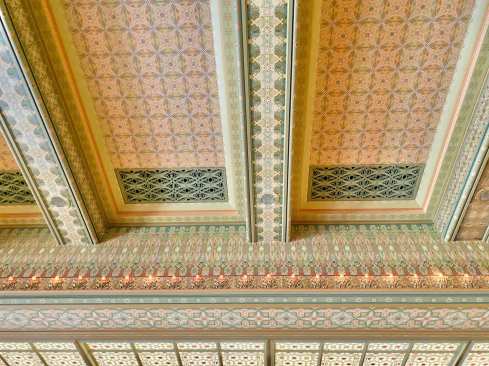
Photo courtesy: Warren Lemay/CC BY-SA 2.0.
Fragments from the original building—including terra-cotta ornament, decorative metal grilles, and stair balustrades—were also dispersed to museum collections worldwide, including the Museum of Modern Art, the Metropolitan Museum of Art, the Musée d’Orsay, and the Victoria and Albert Museum.
Expansion Plans Raise New Concerns
Preservation advocates say the newly circulating petition was prompted by recent reporting about potential expansion plans at the Art Institute.
According to coverage in the Chicago Tribune and the Chicago Sun-Times, museum officials have been studying options for a new gallery wing along Michigan Avenue. Reporting suggested that the east side of the museum campus—where the trading room is located—could provide space for new galleries, though the museum has not announced a final decision.
The concerns intensified after preservation group Preservation Chicago included the trading room and nearby McKinlock Court on its 2026 list of the city’s most endangered places.
Petition organizers say they attempted private discussions with the museum for roughly a year before bringing the issue into the public arena.
Preservationists Propose an Alternative
Advocates behind the petition say they support the museum’s growth but argue that expansion could occur without sacrificing the historic interior.
Their proposal calls for constructing the new wing over the sunken railroad tracks adjacent to the museum campus—a strategy already used nearby when Millennium Park was constructed over rail lines in the early 2000s.
They argue that building over the tracks could improve circulation through the museum complex while preserving the trading room and the adjacent McKinlock Court garden.
Calls for Landmark Protection
Supporters of the petition are urging the city to grant the trading room Chicago Landmark status, which would provide legal protection against demolition or significant alteration.
For preservationists, the issue carries symbolic weight far beyond a single gallery space. The loss of the original Chicago Stock Exchange Building in 1972 helped galvanize preservation activism across the United States. Advocates argue that allowing the reconstructed trading room to disappear now would repeat one of the most painful episodes in architectural history.
“The ability to stand inside this room today is extraordinary,” the petition states, describing the space as an irreplaceable example of Sullivan’s architecture and a tangible reminder of the preservation battles that shaped modern heritage policy.
For now, the future of the trading room remains uncertain. The Art Institute has said no final decision about the expansion site has been made.
But the growing preservation campaign suggests that any proposal affecting one of Chicago’s most famous architectural interiors will face intense scrutiny from historians, architects, and the public alike.