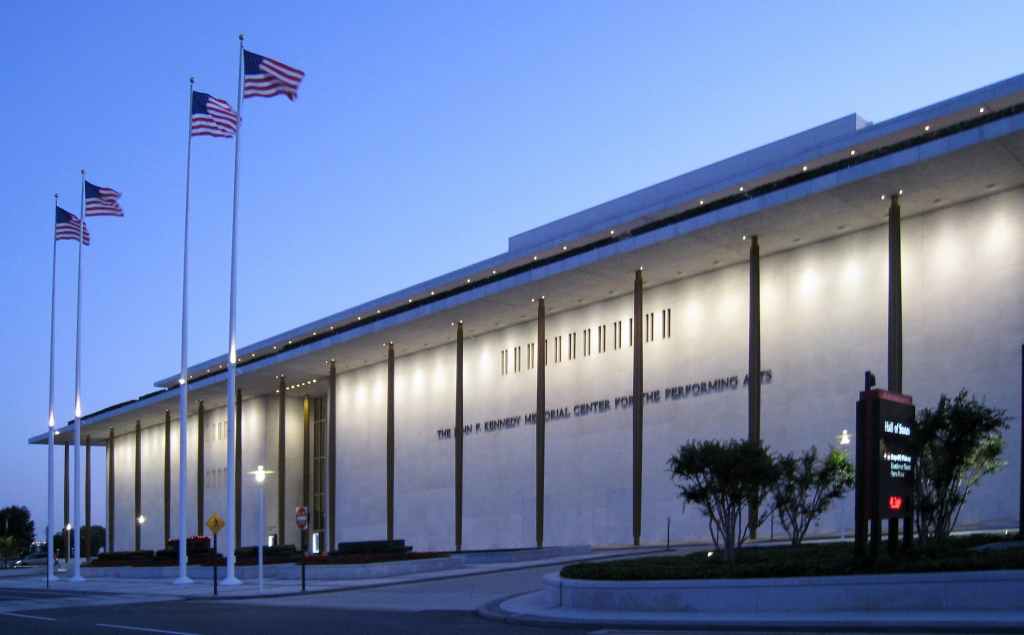
In Washington, D.C., where monuments are typically treated as untouchable symbols of national continuity, a legal battle is unfolding that could redefine how the United States treats its architectural legacy. At the center of the fight is the John F. Kennedy Center for the Performing Arts—a building that is not only a cultural institution but a national memorial—and a sweeping set of proposed changes by Donald Trump that critics say threaten to irreversibly alter it.
On March 23, 2026, a coalition of eight of the most influential organizations in architecture, landscape architecture, and historic preservation filed suit in federal district court. Their goal: to force the federal government to comply with longstanding preservation laws before undertaking any major alterations to the Kennedy Center.
The case is extraordinary not only for its target but for its scale. Never before, plaintiffs say, have so many national organizations aligned to defend a single building.
A Coalition That Signals Alarm
The plaintiffs read like a who’s who of the built environment: the American Institute of Architects, American Society of Landscape Architects, National Trust for Historic Preservation, Society of Architectural Historians, Docomomo US, and The Cultural Landscape Foundation, among others.
Collectively, they represent more than one million members and supporters. Their alignment is not incidental—it is a signal.
“This case is not about politics or aesthetics,” said Abbe David Lowell, Founding Member of Lowell & Associates. “It is about whether the President can impose major changes to historic buildings while denying the public voice that federal law requires.”
At stake is not routine maintenance. Congress has already appropriated $257 million for that. What the coalition is challenging is something far more fundamental: the possibility of dismantling and remaking one of the country’s most important cultural buildings without public review, expert consultation, or congressional authorization.
“Down to the Steel”
The lawsuit follows statements by President Trump suggesting that the Kennedy Center could be taken “down to the steel” during a proposed two-year closure beginning July 4, 2026.
For preservationists, that language is not rhetorical—it is a red flag.
The complaint points to a recent precedent: assurances that the White House East Wing would remain intact during construction of a new ballroom, followed by its complete demolition. That episode has become a cautionary tale for those now watching the Kennedy Center.
“The administration is advancing sweeping changes to some of the nation’s most important civic landmarks without transparency or public process,” said Greg Werkheiser, Founding Partner at Cultural Heritage Partners. “When decisions about America’s heritage are made behind closed doors, the rule of law is the only safeguard.”
A Modern Monument Under Threat
Completed in 1971 and designed by Edward Durell Stone, the Kennedy Center occupies a singular position in American architecture. It is at once a Modernist landmark, a functioning performing arts venue, and the nation’s official memorial to President John F. Kennedy.
That hybrid identity is precisely what makes the stakes so high.
“The Kennedy Center is not a personal project of any president,” said Rebecca Miller, Executive Director of the DC Preservation League. “It is a national cultural monument built to honor John F. Kennedy and to serve the American people.”
The building has been determined eligible for listing on the National Register of Historic Places—a designation that triggers protections under the National Historic Preservation Act and the National Environmental Policy Act. These laws require federal agencies to evaluate impacts, consult experts, and involve the public before undertaking major changes.
The lawsuit argues that those processes are not optional—they are the law.
Process vs. Power
At its core, the case is about process. The plaintiffs are not arguing that the Kennedy Center must remain frozen in time. They are arguing that any transformation must follow established legal pathways.
Carol Quillen, President and CEO of the National Trust for Historic Preservation, framed the issue bluntly: “We’re concerned that, as with the White House East Wing, the potential scope of planned changes is understated and will result in irreparable loss.”
The coalition is expected to file for a preliminary injunction to halt any demolition or major alteration until those processes are completed.
That request could set up a high-stakes legal confrontation over executive authority versus statutory safeguards—a familiar tension in American governance, but rarely one that plays out so directly on the terrain of architecture.
The Architecture Community Draws a Line
For architects, the case touches on something deeper than preservation: professional responsibility.
“Architects have the core responsibility of protecting the health, safety, and welfare of the public and that includes our nation’s civic and cultural landmarks,” said Illya Azaroff, FAIA, President of the AIA.
Others emphasized the Kennedy Center’s role as a designed landscape as much as a building.
“The Kennedy Center campus is a nationally significant example of Modernist design,” said Charles A. Birnbaum of The Cultural Landscape Foundation, pointing to its terraces, processional sequence, and views across the Potomac.
For preservationists of modern architecture—a category that has historically struggled for recognition—the threat feels especially acute.
“It is unconscionable that the administration has already begun actions to degrade and irreparably harm the Kennedy Center,” said Liz Waytkus of Docomomo US.
A Precedent With National Consequences
What happens next will likely reverberate far beyond Washington.
The case brings together three law firms that have already challenged multiple high-profile federal interventions in historic sites—from proposals to alter the Eisenhower Executive Office Building to redevelopment plans for the East Potomac Golf Course.
Taken together, these cases suggest a broader pattern: an aggressive federal approach to reshaping historic properties, and an equally aggressive legal response from preservation advocates.
Brad McCauley, President of the ASLA, framed the stakes in systemic terms: “Following proper process to honor the Kennedy Center’s role as a national civic landmark matters.”
If the plaintiffs prevail, the case could reaffirm the strength of federal preservation laws and the necessity of public input. If they fail, it could open the door to a new era in which even the country’s most iconic cultural buildings are subject to rapid, unilateral transformation.
The Bigger Question
Beneath the legal arguments lies a more fundamental question—one that architects, policymakers, and the public will be forced to confront:
Who controls America’s cultural landmarks?
Is a building like the Kennedy Center a living work, open to reinterpretation by each generation? Or is it a shared civic artifact, bound by collective memory and protected by law?
For now, the answer will be decided in court.
But the coalition’s message is already clear: the fight over the Kennedy Center is not just about one building. It is about the rules that govern the nation’s architectural inheritance—and whether those rules still hold.