In the standard histories of architecture, women rarely appear before the twentieth century. The narrative typically begins with the arrival of a handful of pioneering practitioners—figures who fought their way into architecture schools and professional offices in the late nineteenth and early twentieth centuries. Before that, the story suggests, women were largely absent from architectural culture.
A new exhibition at ETH Zurich in Switzerland challenges that assumption—and proposes a more radical idea: that women were never absent from architecture at all.
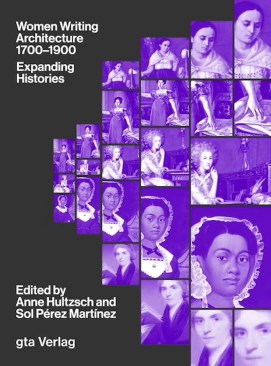
“Women Writing Architecture 1700–1900,” on view from March 4 to May 8, reframes architecture not simply as a profession of buildings but as a field shaped by discourse, critique, description, and imagination. The exhibition grows out of a five-year research project funded by the European Research Council that investigates how female authors contributed to architectural culture through writing.
The project begins with a deceptively simple premise: that writing itself is a spatial practice.
“The project begins with the hypothesis that writing is a spatial practice, presenting, therefore, one of the processes that constitute architecture as both discourse and built manifestation that is made, experienced, used, and critiqued,” the curators explain.
In other words, architecture is not only designed and constructed—it is also narrated, analyzed, debated, and imagined through language. And women, even when excluded from formal architectural institutions, were participating in that process.
Writing Architecture—Not Writing About It
The exhibition’s title deliberately omits a preposition.
“Women Writing Architecture 1700–1900 purposefully omits a grammatical preposition between ‘women writing’ and ‘architecture’. Rather than adding ‘on’, ‘of’, or ‘about’ architecture, and thus positioning female authors outside of architecture, we claim that the built environment is meaningfully constructed also through writing: women (and others) writing architecture.”
That linguistic shift signals a broader revision of architectural historiography. The exhibition suggests that the discipline’s canonical narratives have overlooked a vast body of writing that shaped how architecture was understood, described, and experienced.
Even in an era when women were largely excluded from positions of authority in architecture, they exercised agency through print culture.
“In a period in which women are largely invisible in positions of power within the historiography of architecture, they did have agency in the built environment.”
Architecture in Unexpected Places
The curatorial team—led by architectural historian Anne Hultzsch in collaboration with researchers Sol Pérez Martínez and Elena Rieger—explored a wide range of texts across English-, German-, and Spanish-speaking contexts, including parts of South America.
What they discovered was architecture hiding in unlikely places.
Travel writing proved especially important. In the eighteenth century, it became one of the first literary genres in which European women achieved significant public success. These narratives often described landscapes, cities, and buildings in detail, linking spatial observation with cultural commentary.
But travel literature was only the beginning.
Women also wrote about architecture in journalism, as essay periodicals expanded across Europe and the Americas. They documented cities, commented on urban development, and participated in emerging public debates about space and society.
Even more surprising are the genres in which architecture appears unexpectedly: etiquette manuals, gardening guides, cookbooks, and domestic instruction texts.
“Instructive writing, too, increased dramatically over the period, and we have found architecture in such publications as cookbooks, etiquette manuals, or textbooks on gardening and home economics.”
Poetry and religious writing also played a role. Urban poetry could function as a form of civic chronicle or activism, while mystical writings by nuns offered spatial metaphors and visions that intersected with architectural thought.
A Forest of Postcards
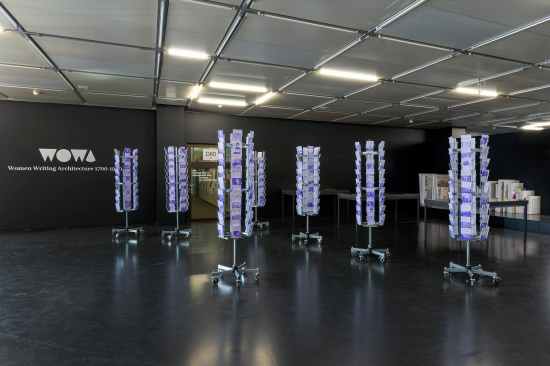
The exhibition translates this research into a striking physical installation.
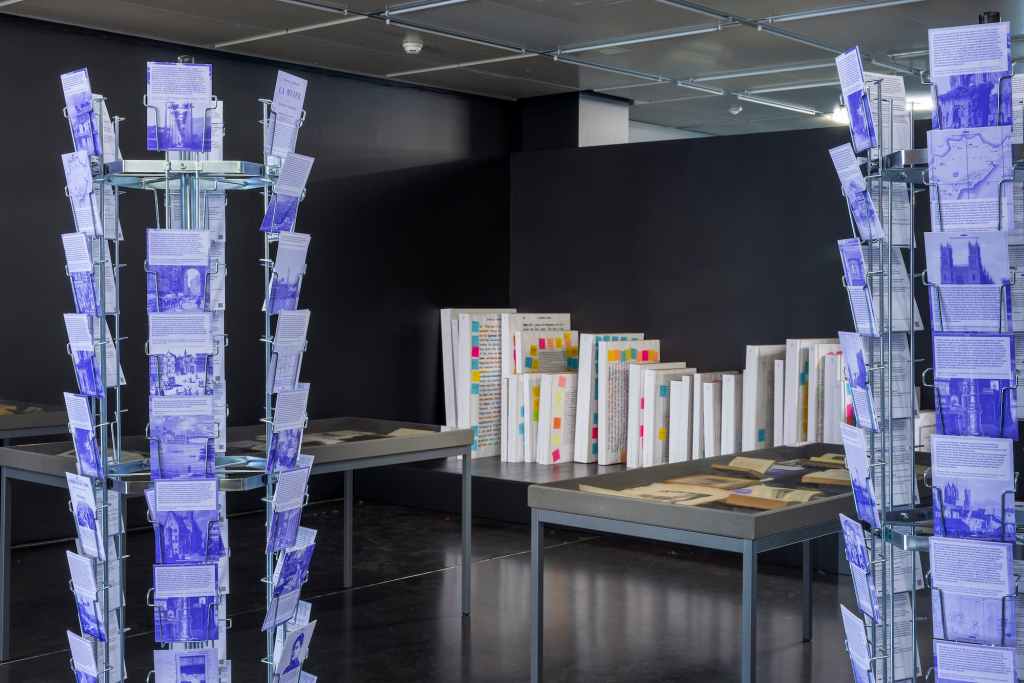
Visitors enter a space populated by a “forest” of postcards, each dedicated to a different author. Every card introduces one woman and her engagement with architecture, space, or landscape through a combination of image, quotation, and short explanatory text.
The subjects range widely:
descriptions of cities and landscapes,
instructions for organizing domestic space,
accounts of colonial land appropriation,
design criticism and stylistic history,
technical manuals,
political pamphlets advocating women’s rights and property ownership.
Some texts are practical; others speculative or poetic. All expand the boundaries of what counts as architectural discourse.
“Postcards present descriptions of buildings, cities, and landscapes, instructions on spatial organization and movement, mappings of colonial land grabbing and othering, recipes for architectural cakes, stylistic histories, construction manuals, political pamphlets on women’s rights and landownership, design criticism, urban reporting, mystical evocations, aesthetic theory, technical reports, and much more.”
The postcard format is not accidental.
Emerging in the nineteenth century as a communication medium combining image and message, postcards historically helped circulate architectural images across Europe and beyond. By adopting that format, the curators turn the exhibition itself into a tool of dissemination.
Visitors are encouraged to take postcards home—transforming them into carriers of architectural history.
“Visitors become addressees: we invite them to take a postcard home to ponder: What did she have to say? What happens if we listen to her? And: who else have we missed?”
Rethinking the Architectural Canon
The exhibition also asks a more provocative question: what would architectural history look like if these voices had been included from the beginning?
“What would be missing without her? And what if we had always included her in our historical research?”
Such speculation pushes beyond simple recovery of overlooked figures. Instead, it suggests an alternate intellectual genealogy for architecture—one that includes critics, theorists, journalists, and activists alongside designers and builders.
“What would our canon, our common knowledge framework, our shared spatial consciousness look like?”
To explore those possibilities, the project identifies roles these women assumed within architectural culture: critic, historian, designer, educator, theorist, surveyor, patron. Each role appears on the exhibition’s postcards, aligning the writers with categories commonly used in architectural historiography.
Reading Architecture Differently
Another section of the exhibition features an oversized bookshelf containing large cardboard mock-ups of books. Inside are enlarged pages originally used during collaborative workshops held in Zurich, Rengo in Chile, and Montreal.
Participants—from students to professors—gathered to conduct collective close readings of historical texts using a specially developed “Reading-with Guide.” The pages are filled with annotations, highlights, and sticky notes documenting the process.
“Post-its and highlight markings bear witness to our slowing down to read anew and differently.”
Visitors can remove the pages and read them at a dedicated reading window, effectively stepping into the research process itself.
Evidence in Print
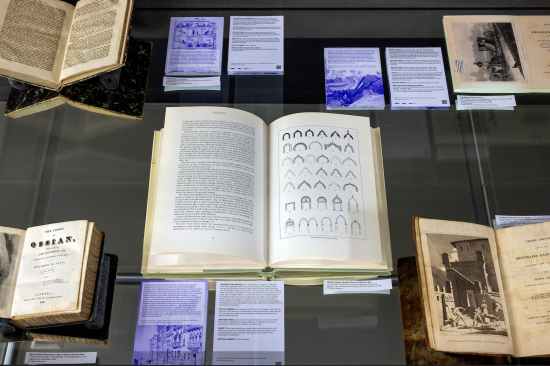
Historical books and journals displayed in vitrines offer further evidence of women’s presence in architectural discourse.
Many survive today in antiquarian bookshops and online marketplaces, often at modest prices—a reminder that the texts were widely circulated in their own time.
“They tell us that female writers found an audience – the well-used fragment of the English 18th-century cookbook with who-knows-which food stains or the list of subscribers in the German women’s journal speak for themselves.”
Such artifacts demonstrate that women were not writing in isolation. Their work was read, discussed, and disseminated.
“These women writing architecture found their public voice and made a public space for themselves.”
Writing Architecture Today
Ultimately, the exhibition extends its argument into the present.
If writing helped shape architecture historically, it continues to do so today. Architects, critics, historians, journalists, policymakers, and developers all participate in constructing the built environment through language.
“Going beyond the historical context, this exhibition also invites reflection on architecture as a practice of writing today.”
The implication is clear: architectural culture has always been broader than the profession itself.
And perhaps the most provocative question posed by the exhibition is also the simplest.
Who else has been left out?