For a quarter century, the Serpentine Pavilion in London has functioned as architecture’s most visible summer experiment: a temporary structure that routinely carries the weight of permanent ambition. Since its inception in 2000 with Zaha Hadid’s inaugural design, the pavilion has been a proving ground for architects at pivotal moments in their careers—sometimes confirming reputations, sometimes creating them outright. As the commission reaches its 25th edition, Serpentine has chosen not to mark the milestone with a star turn or an architectural exclamation point, but with something quieter, slower, and materially grounded.

Isabel Abascal and Alessandro Arienzo of LANZA atelier. Photo: © Pia Riverola
The 2026 Serpentine Pavilion will be designed by LANZA atelier, the Mexico City–based practice founded in 2015 by Isabel Abascal and Alessandro Arienzo. Titled a serpentine, the pavilion will open to the public at Serpentine South on June 6, 2026, supported by Goldman Sachs for the twelfth consecutive year.
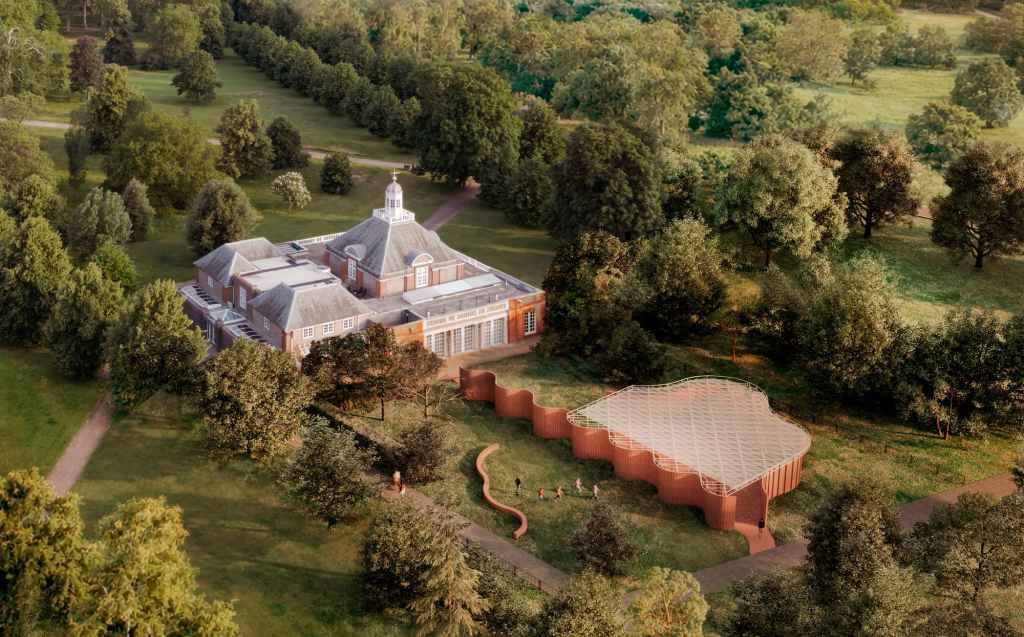
At first glance, the proposal resists the visual shorthand that has come to define many recent pavilions. There is no singular object, no sculptural flourish designed for instant circulation. Instead, LANZA atelier’s project centers on a wall—specifically, a serpentine or crinkle-crankle wall—whose alternating curves form the pavilion’s primary architectural gesture.
The typology is deceptively modest. Serpentine walls originated in ancient Egypt and later became widespread in England after being introduced by Dutch engineers. Their curving geometry provides structural stability through lateral resistance, allowing a one-brick-thick wall to stand with fewer materials than a straight counterpart. In LANZA atelier’s hands, the form becomes both structural logic and conceptual anchor, quietly folding engineering efficiency, historical memory, and spatial choreography into a single move.
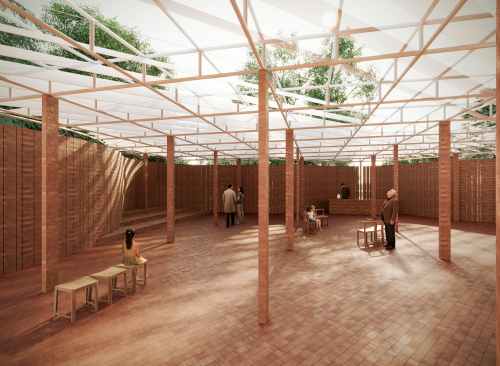
The pavilion’s layout unfolds as a dialogue with its surroundings. One curving brick wall traces the northern edge of the site, subtly echoing the nearby Serpentine Lake, itself named for its gentle bends. A second wall responds to the existing tree canopy, working around it rather than against it. A translucent roof rests lightly on a rhythmic grid of brick columns, evoking a grove rather than a hall. Light and air filter through the structure, softening the distinction between inside and outside and encouraging visitors to drift, pause, and gather.
Brick—chosen deliberately—is the project’s primary material. Its selection acknowledges a distinctly English building tradition while establishing a direct conversation with the brick façade of Serpentine South, which originally served as a tea pavilion. As the walls shift from solid to porous through repetition and spacing, the pavilion moves between opacity and permeability, functioning less as an enclosure than as a framework for encounter.
Serpentine Pavilion 2026 a serpentine, designed by Isabel Abascal and Alessandro Arienzo, LANZA atelier. Design render, aerial view. © LANZA atelier. Courtesy Serpentine.
That emphasis on encounter is central to LANZA atelier’s practice. Since founding the studio, Abascal and Arienzo have pursued an architecture rooted in the everyday and the informal—one attentive to how craft, technology, and spatial intelligence emerge under ordinary conditions. Their work consistently locates value not in finish or iconography, but in use, assembly, and collective experience. Drawing and model-making remain central to their process, treated not as representational tools but as active instruments of thought.
For the architects, the Serpentine commission carries particular resonance.
“It is an honour to be selected as the architects of the 25th Serpentine Pavilion, a milestone year for the commission,” LANZA atelier said. “We are deeply grateful for the opportunity to share our work with a wider public and to contribute to the Pavilion’s ongoing legacy of experimentation and collective encounter.”
The studio describes the serpentine wall as a spatial device that both guides and withholds—organizing movement while creating moments of compression and release. The form draws on the symbolic figure of the serpent as both generative and protective, as well as on England’s historic fruit walls, which tempered microclimates to support growth.
“From this idea emerges a pavilion built of simple clay brick, foregrounding vernacular craft and the elemental capacity of architecture to bring people together,” the architects said, describing a structure “that both reveals and withholds: shaping movement, modulating rhythm, and framing thresholds of proximity, orientation, and pause.”
For Serpentine, the selection reflects a continued shift toward emerging practices whose work engages context, material intelligence, and public life without relying on spectacle. Over the past decade, the pavilion programme has increasingly prioritized younger studios and broader geographies, expanding its role from architectural showcase to civic platform.
Serpentine CEO Bettina Korek framed the pavilion as a rare opportunity to test ideas in public.
“For 25 years, the Serpentine Pavilion has been a leading global platform for architectural experimentation,” she said. “It offers a rare brief: to test ambitious ideas in an open, accessible setting.”
Korek emphasized that LANZA atelier’s appointment strengthens cultural exchange with Mexico while reaffirming the pavilion’s role as a free civic space at the heart of Serpentine’s summer and autumn programmes.
That programme—often described internally as a “content machine”—will once again activate the pavilion through lectures, performances, screenings, and discussions across music, film, theatre, dance, literature, philosophy, fashion, and technology. Each event responds not only to the pavilion’s architecture but to its capacity to host collective experience.
Serpentine Artistic Director Hans Ulrich Obrist situated the 2026 pavilion within the longer arc of the commission’s history.
“Over the last 10 years the Serpentine Pavilion has increasingly focussed on giving opportunities to younger architectural practices,” he said, noting LANZA atelier’s “deep engagement with the local context, materials and lived experience.”
Obrist also linked the anniversary to the pavilion’s origins, recalling Zaha Hadid’s founding role and her insistence that “there should be no end to experimentation.” That legacy will be formally acknowledged through a special partnership with the Zaha Hadid Foundation, which will collaborate with Serpentine on a dedicated architectural program throughout 2026. The initiative will revisit Hadid’s contributions while opening space for transgenerational and transnational dialogue about architecture’s future.
In a moment when temporary architecture often competes for immediacy—measured in images, metrics, and social reach—LANZA atelier’s pavilion proposes a different tempo. Its ambition lies not in visual dominance but in spatial generosity; not in novelty for its own sake, but in the quiet intelligence of a wall that bends, stabilizes, and invites.
At 25, the Serpentine Pavilion is no longer asking what architecture can look like, but what it can do—and LANZA atelier’s answer is a space that bends, shelters, and gathers rather than performs.