
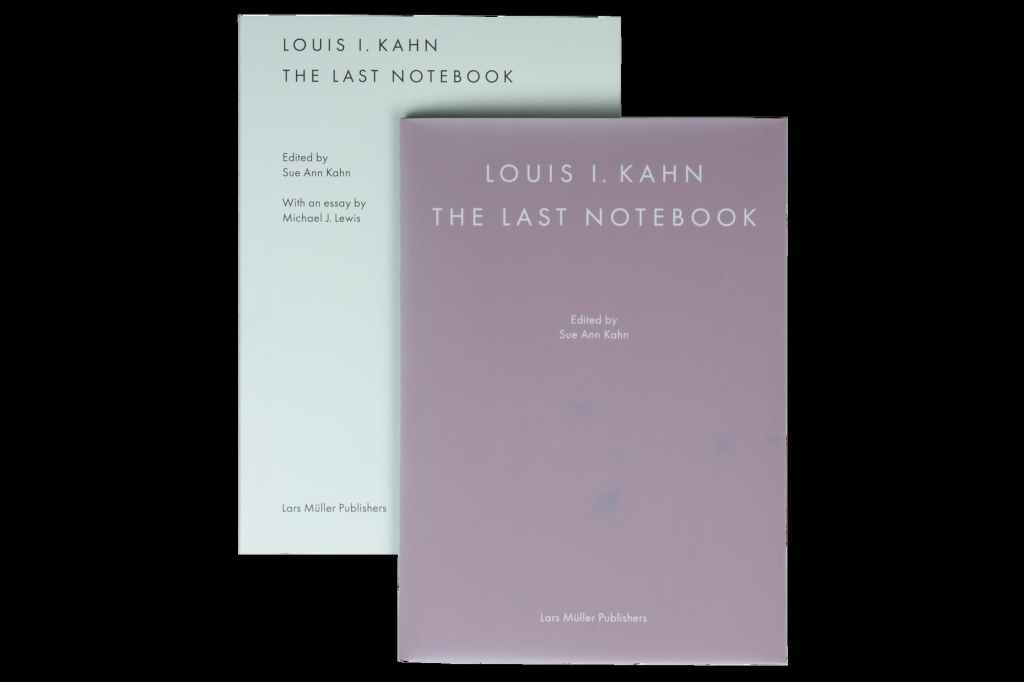
For 16 years, publishers said no. What Sue Ann Kahn held onto wasn’t just a diary—it was the missing key to one of architecture’s most mythologized lives.
Imagine being Sue Ann Kahn—daughter of Louis Kahn—holding in your possession what may be the most intimate document of one of the 20th century’s most revered architects, and being told, repeatedly, that it shouldn’t exist in public.
For 16 years, she tried to publish it.
And for 16 years, she was rejected.
The object in question—a compact red, hardbound notebook produced by Winsor & Newton—was not a polished manuscript, nor a curated archive. It was something far less conventional and far more revealing: a working document from the final year of Kahn’s life, spanning 1973 to 1974. It is at once chaotic and lucid, fragmentary and precise—a “jumbled hodgepodge,” as Williams College professor Michael Lewis describes it in his accompanying essay.
Today, that notebook has finally been published as Louis I. Kahn: The Last Notebook (2024), by Lars Müller Publishers—the very house that once rejected it.
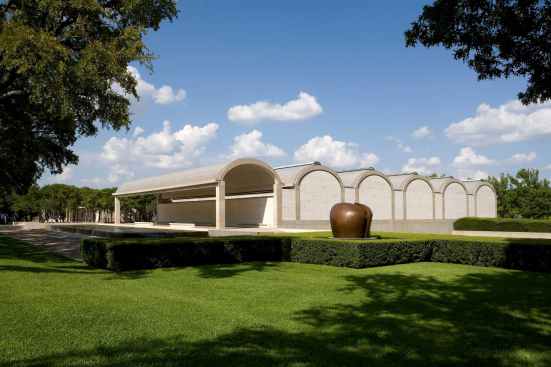
The Kimbell Art Museum.
“It’s a private diary not meant to be seen by anyone,” Kahn said ahead of a conversation at the Kimbell Art Museum with museum director Eric Lee as part of a two-day celebration of his 125th birthday on Friday, February 20. The event also coincided with the 52nd anniversary of his death. It was also a thank you to the Kimbell Art Foundation, which supported the first edition.
The irony is difficult to ignore: the same industry that has endlessly canonized Kahn hesitated for over a decade and a half to publish perhaps his most human document.
The Architect Who Needed to Draw
Louis Kahn’s notebooks were never meant to be archival objects. They were tools—extensions of his restless mind.
“He always wanted something on hand so he could draw,” Sue Ann said.
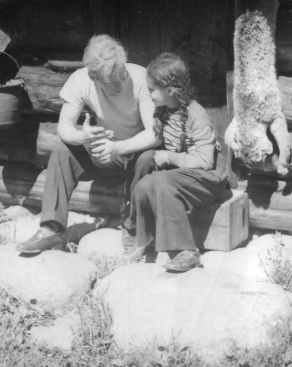
Louis Kahn with his daughter, Sue Ann Kahn, in Lake Placid, N.Y., August 1949. Credit. Esther Kahn.
Across his lifetime, Kahn filled nearly 20 notebooks. Today, their distribution is scattered: Sue Ann owns five, her brother Nathaniel holds one, the University of Pennsylvania houses ten, and three reside in Harrisburg—though not without mystery.
“[Those three] belonged to someone who forgot to return them somewhere,” she said jokingly.
These notebooks followed Kahn everywhere. He was constantly in motion—traveling between continents, overseeing projects, delivering lectures, accepting awards. The pages absorbed everything: ideas, fragments of speeches, project sketches, names, addresses, impressions.
But this final notebook is different.
Not just because it captures his last year—but because it captures it incompletely, obliquely, in a way that required reconstruction.
Decoding the “Hodgepodge”
Knowing when the notebook was written did not mean understanding it.
“He wasn’t systematic,” Sue Ann said.
That lack of order—arguably central to Kahn’s creative process—also made the notebook nearly indecipherable. Dates were unclear. Names were abbreviated or misspelled. Events blurred together.
What followed was an almost forensic effort.
Researchers cross-referenced entries with photographs, project timelines, institutional records, and living witnesses. Gradually, fragments aligned. Dates became legible. Context emerged. A chronology took shape.
What appeared at first as disarray resolved into a remarkably detailed portrait of an architect at the height of his intellectual and professional intensity.
A Party, a Prize, a Network
One of the notebook’s most revealing moments begins as speculation.
Sue Ann noticed a cluster of names and addresses—figures tied to the art and design world—and inferred that Kahn must have been at a social gathering in New York on May 16, 1973.
“He was very social,” she said. “So I thought he was at a party in New York.”
He was.
Not just any party, but one held in his honor—the day he received the Gold Medal from the American Academy of Arts and Letters.
The notebook captures this moment not through narrative, but through proximity: a constellation of names including designer and architect William Katz—known for consulting artists such as Anselm Kiefer and Cy Twombly—and Priscilla Morgan, wife of Isamu Noguchi, whose installation Constellation sits on the Kimbell campus.
What emerges is not just biography, but network: Kahn embedded within a dense cultural milieu, moving fluidly between architecture, art, and intellectual life.
Projects in Flux: Roosevelt Island and Tehran
Interspersed throughout the notebook are sketches tied to two of Kahn’s most consequential late-career projects—one realized decades after his death, the other never built.
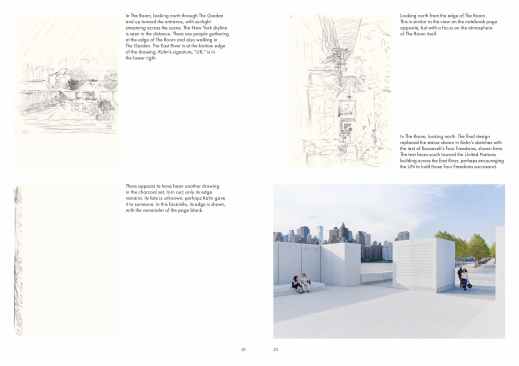
via Sue Ann Kahn and Lars Müller Publishers.
The first: the Franklin D. Roosevelt Memorial on Roosevelt Island.
The notebook reveals a process bordering on obsession. Kahn repeatedly redrew the project—iterating, revising, refining—only to have proposals pushed back by the client, the New York State Urban Development Corporation. The pages register both ferocity and frustration.
Yet they also document resolution. Over time, the concept clarifies, culminating in a final scheme that would, long after Kahn’s death, be realized as the Franklin D. Roosevelt Four Freedoms State Park, opening in 2012 in close fidelity to his vision.
The second project is even more ambitious—and more elusive.
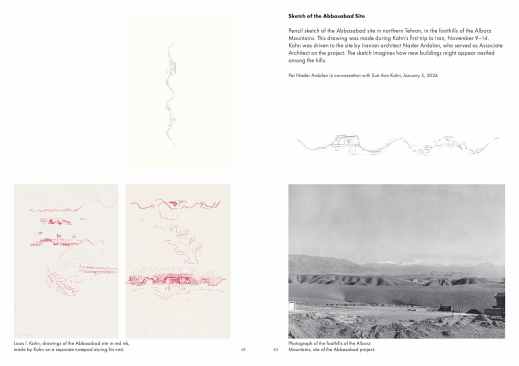
via Sue Ann Kahn and Lars Müller Publishers.
The Abbasabad master plan in Tehran, commissioned by the Shah and developed in collaboration with Japanese architect Kenzo Tange, was intended as a monumental national district.
Sue Ann had not even been aware of its scope.
The notebook suggests deep tensions between the collaborators. Tange pursued monumentality; Kahn sought a more human-scaled approach. Their differences remained unresolved at Kahn’s death, and the project was never built.
Yet traces of that conflict appear in the notebook—most strikingly in a rendering that seems to mock Tange’s approach: a development shaped like a human head.
It is a rare glimpse of Kahn not as the serene philosopher-architect of legend, but as a participant in creative conflict—sharp, opinionated, even irreverent.
The Smallest Drawing
Amid the projects, lectures, and professional milestones, one image stands out for its simplicity: a drawing of a star.
“It’s the most beautiful thing, like a fairy tale or from the book ‘The Little Prince.’ He loved fairy tales,” she said. “It has a lot of personality.”
In a notebook filled with institutional ambitions and geopolitical scale, this small, almost childlike image feels disproportionately powerful.
It suggests another Kahn—one less concerned with monumentality than with wonder.
A Personal Reconstruction
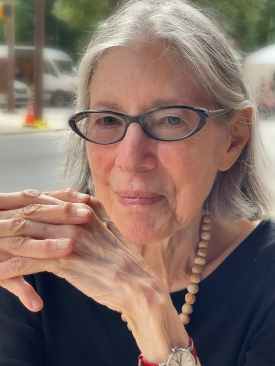
Sue Ann Kahn.
For Sue Ann Kahn, the notebook is not just an archival artifact. It is a form of connection.
In the years leading up to his death, her father was largely absent—traveling constantly, immersed in work, moving between continents and commissions.
She did not see him often.
Working through the notebook became, in effect, a way of reconstructing a relationship that had been interrupted.
“Every time I opened this one, I felt him,” she said.
Why It Matters Now
The delayed publication of The Last Notebook raises an uncomfortable question for architecture culture: why was this document resisted for so long?
Part of the answer may lie in its refusal to conform. It is not a tidy archive or a definitive statement. It is messy, contradictory, unresolved—much like the process of design itself.
But that may also be precisely its value.
At a moment when architecture is increasingly mediated through polished imagery and controlled narratives, Kahn’s notebook offers something rarer: access to uncertainty, to iteration, to doubt.
It reveals not just what Kahn made, but how he thought—and how thinking itself can be nonlinear, fragmented, and deeply human.
That it took 16 years for this to be recognized is telling.
That it exists at all is remarkable.