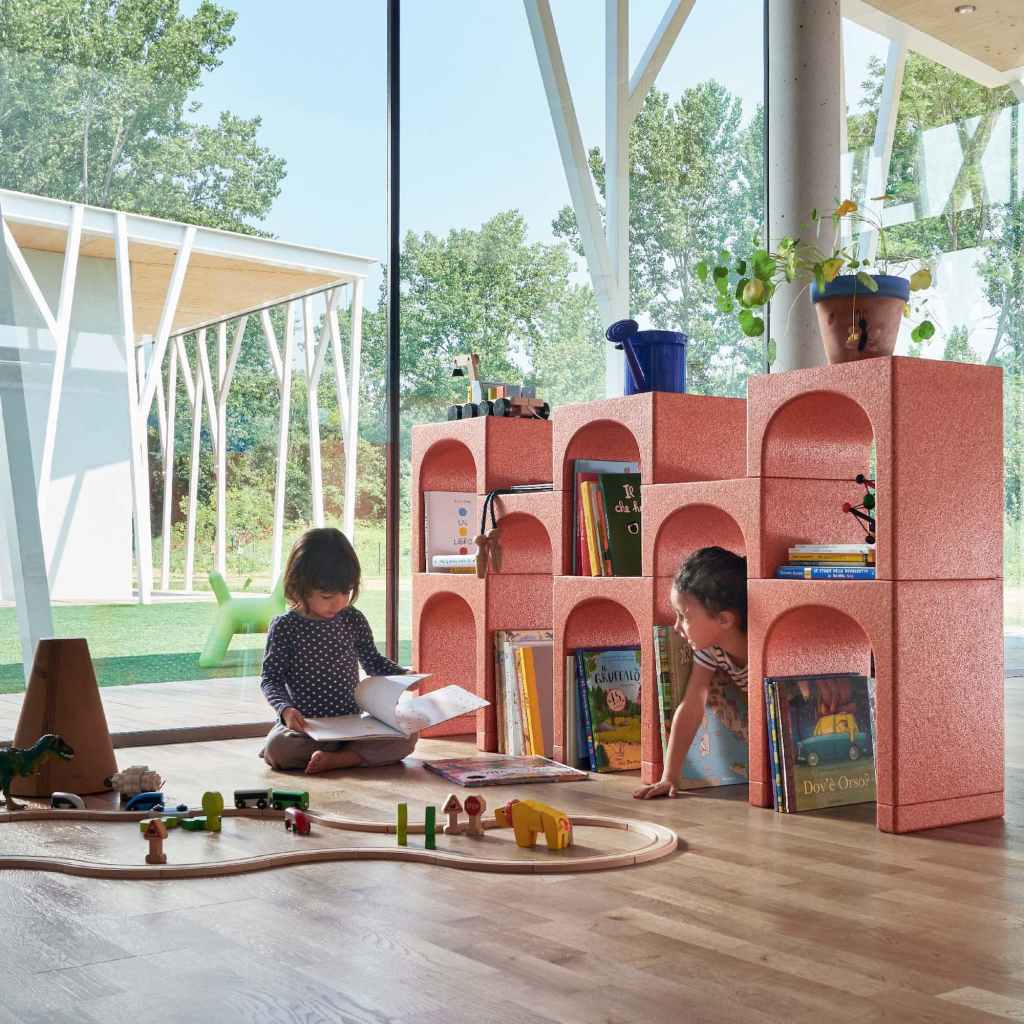
From April 1 to September 20, the Design Museum Brussels presents Designing Childhood: A History of Children’s Design, an exhibition co-organized with the Centre Pompidou that does something deceptively simple—and quietly radical. It places children’s furniture at the center of 20th-century design history.
What emerges is not a niche category of diminutive chairs and playful forms, but a powerful lens onto modernity itself: a story about how societies redefined the child, reimagined the home, and ultimately redesigned the future.
“A testing ground for experimentation and innovation, children’s furniture has left its mark on 20th-century design history. It embodies the ambitions, social changes, and technological advancements of its time.”
That claim is not rhetorical. Across a century of objects—beds, desks, hybrid toy-furniture—the exhibition demonstrates that children’s design has consistently been where new ideas are first allowed to take risks.
The Invention of the Modern Child
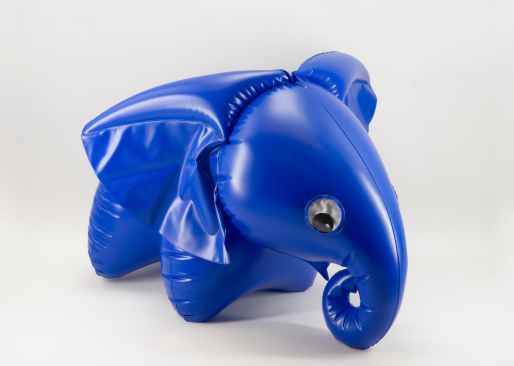
Libuse Niklova – Inflatable Elephant, c 1970 © Design Museum Brussels.
At the heart of the exhibition is a conceptual shift that feels both obvious and profound: the child as a design subject.
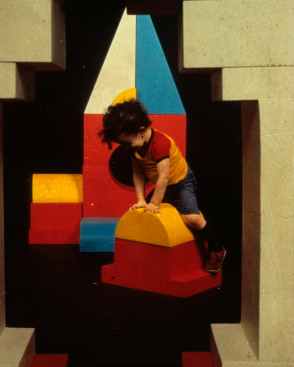
K4999. Courtesy Archivio Museo Kartell, ITA.
“Children’s furniture is characterized by its playful dimension as toy-furniture and its versatility, while also reflecting the evolving role of the child within the family and social structure.”
For much of history, children were treated as scaled-down adults—socially, culturally, and spatially. Furniture followed suit. But the 20th century marked a rupture.
“Gradually recognized as a person in their own right, the child ceases to be perceived as a ‘little adult’ and carves out a specific place in the home, society, and the design market.”
This recognition triggered a cascade of design consequences. Bedrooms became pedagogical spaces. Furniture became adaptable, flexible, even didactic. The domestic interior—long a site of hierarchy—began to reorganize itself around growth, play, and autonomy.
Children’s furniture, in other words, didn’t just respond to social change. It actively produced it.
A Century of Prototypes for Living

Lucien Engels – Chaise et Bureau Type A, 1957 © Andy Simon.
The exhibition unfolds as a transnational dialogue spanning the entire 20th century, anchored by key figures who treated children’s design as a laboratory.
Early examples include children’s bedrooms by Pierre Chareau in the 1920s and Sylvie Feron in 1930s Belgium—spaces that already begin to question rigidity in favor of flexibility and intimacy.
By the 1930s, school furniture becomes a site of industrial and social experimentation. Designers like Jean Prouvé and Arne Jacobsen approach desks and chairs not as static objects, but as systems—lightweight, modular, and scalable.
Postwar reconstruction intensifies this agenda. Designers such as Marcel Gascoin and Jules Wabbes rethink children’s bedrooms as integrated environments—where storage, sleep, and study collapse into a single spatial logic.
Then comes the 1960s.
“In the 1960s, Pop aesthetics and the widespread use of plastics marked the apogee of children’s design through lightweight and flexible furniture.”
Here, children’s furniture becomes not only experimental but expressive—colorful, synthetic, and mass-produced. Plastic doesn’t just reduce weight; it signals a new cultural attitude toward disposability, mobility, and freedom.
Belgium’s Quiet Influence
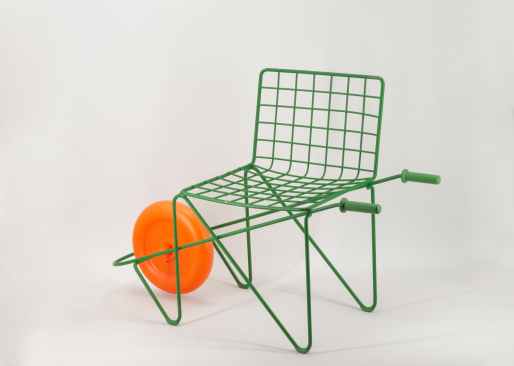
Rogier Martens – Trotter Children's Chair, 2015 © Design Museum Brussels.
While the narrative is international, the exhibition places particular emphasis on Belgium’s role in shaping children’s design.
“Through this exhibition, the Design Museum Brussels enriches the narrative initiated by the Centre Pompidou through its collection of children’s furniture, highlighting the Belgian contribution.”
This contribution is less about stylistic dominance than about a consistent attentiveness to social and educational contexts. Belgian designers, as the exhibition suggests, often approached children’s furniture as part of a broader ecosystem—one that integrates pedagogy, material innovation, and social welfare.
“Through pieces from its collections, the Design Museum Brussels highlights the vitality of Belgian design, resonating with major international narratives.”
In doing so, the exhibition reframes Belgium not as peripheral, but as quietly central to the evolution of design thinking around childhood.
From Plastic to Planet
If the 20th century’s story is one of industrial experimentation, the 21st century’s chapter introduces a new urgency: ecology.
“It reveals an approach attentive to children’s needs, integrating ecological and educational considerations from an early stage, as exemplified by the current initiatives of the ecoBirdy duo with their Charlie chair made from recycled plastic.”
The ecoBirdy Charlie chair becomes a kind of contemporary manifesto—transforming plastic waste into a pedagogical object that teaches sustainability through use.
This is not a nostalgic return to craft, but a rethinking of industrial systems themselves. Materials are no longer neutral; they carry ethical weight.
“Today, designers are once again turning to children’s furniture, embracing a dimension of learning and inclusivity that resonates in both collections, where formal innovation is combined with a reflection on society and the environment.”
In this sense, children’s furniture once again becomes a testing ground—this time for a post-carbon future.
Beyond the Exhibition
The exhibition extends beyond the gallery into a broader cultural program. In collaboration with BNA-BBOT, the museum is launching a podcast series dedicated to key figures in Brussels design, beginning with Marie Paquay Wabbes.
Accompanying the exhibition is the book Designing Childhood: Children’s Furniture, edited by Marie-Ange Brayer and Arnaud Bozzini, and published by CFC Éditions. Released on May 12, 2026, the trilingual volume compiles key works from the history of children’s furniture, offering what the museum describes as “an accessible introduction to the evolution of children’s design.”
The Small Objects That Changed Everything
What Designing Childhood ultimately reveals is that children’s furniture has never been marginal. It has been instrumental.
It is where designers test new materials before they enter the mainstream. Where social ideals—education, equality, autonomy—are translated into form. Where the future is rehearsed at a smaller scale before it is built at full size.
If modern design has always claimed to shape how we live, this exhibition makes a sharper argument: it first learned how to do so by designing for children.