The long-anticipated rebound in nonresidential construction never arrived—and now the industry is bracing for years of uneven, inflation-adjusted decline.
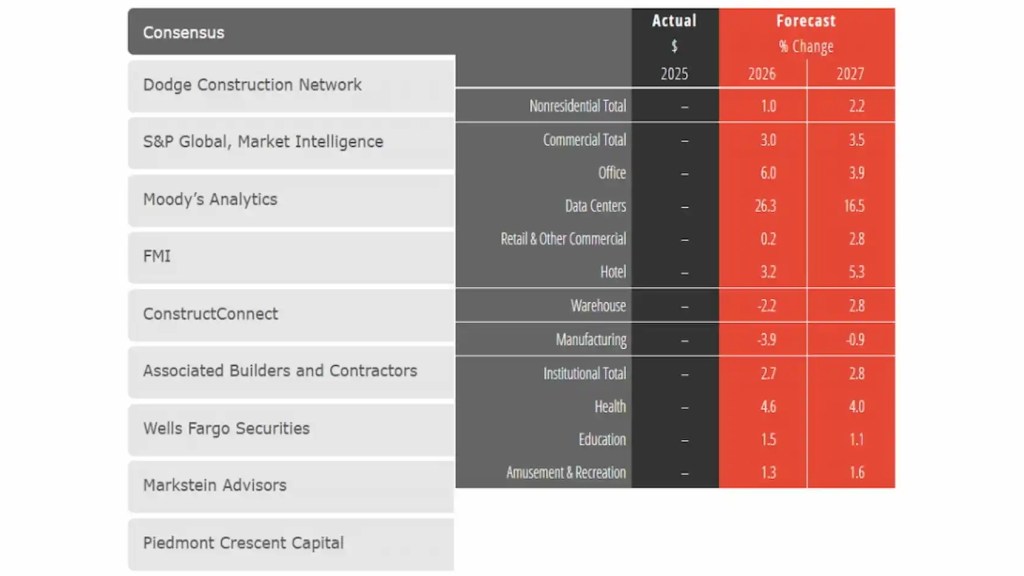
According to the American Institute of Architects’ latest Consensus Construction Forecast, overall building spending is expected to increase just 1.0 percent in 2026, followed by a modest 2.2 percent in 2027. Those gains, the AIA cautions, are not adjusted for inflation, meaning real growth may remain elusive even as construction costs continue to rise.
“Spending on nonresidential building over the second half of last year was disappointing,” said AIA Chief Economist Kermit Baker, Hon. AIA, PhD. “As of midyear last year, members of the AIA Consensus Construction Forecast Panel were projecting that spending on buildings would be up almost 2 percent for 2025, followed by a similar gain this year. Now this modest forecast gain looks instead to have been a decline of a similar magnitude, with disappointing results across the board.”
That reversal has reshaped expectations across nearly every building category—and exposed just how fragile the post-pandemic construction economy has become.
A flat outlook, hiding sharp divides
At the headline level, the forecast suggests stagnation. Look closer, and the picture fractures.
Commercial construction is projected to grow 3.0 percent in 2026 and 3.5 percent in 2027, while institutional facilities are expected to post steadier gains of 2.7 percent this year and 2.8 percent next year. Manufacturing, by contrast, is forecast to decline 3.9 percent in 2026, followed by another 0.9 percent drop in 2027.
But even those averages obscure deeper volatility. Data centers—fueled by the AI investment boom—stand apart from nearly every other building type. Traditional offices, retail, education, and recreation facilities are either stalled or shrinking.
“While very modest gains may be the best description of the overall building outlook,” the report notes, “it is not an accurate portrayal of most of the individual building categories, particularly in the commercial sector.”
An economy defined by uncertainty—and imbalance
The broader U.S. economy remains nominally healthy. GDP grew just over 2 percent last year and is projected to rise 2.5 percent in 2026. Yet that growth, the AIA argues, rests on unstable ground.
The report identifies two defining conditions: uncertainty and imbalance.
Shifting tariff policies have made long-term investment decisions increasingly difficult, particularly for construction projects that unfold over many years. Immigration policy has added further strain: of the 12 million workers in the construction industry, a quarter are foreign-born, rising to one-third among craft workers, with roughly half estimated to be undocumented.
At the same time, federal spending cuts are rippling through the economy. Federal outlays fell by more than $300 billion in 2025, nearly 5 percent of the total budget, while 300,000 federal positions were eliminated. The downstream effects are only beginning to register.
Layered on top of this uncertainty is a deep imbalance in who benefits from growth. AI-related investment, the report notes, has accounted for more than half of recent U.S. economic growth, buoying markets while leaving much of the population behind. Consumer confidence reflects that divide: The Conference Board’s index fell from 79.6 in December 2024 to 54.9 in November 2025, with lower-income households reporting the weakest outlook.
When leading indicators stop agreeing
For architects, the warning signs have been flashing for years.
The Architecture Billings Index (ABI) has remained weak for three consecutive years, and the design contracts index shows no evidence of an impending rebound. In other words, there is no surge of new work waiting in the wings.
Construction starts tell a more optimistic story—at least on paper. Through the first eleven months of 2025, nonresidential construction starts rose between 5 percent and 15 percent, depending on the source. But delays and cancellations are increasingly common, raising doubts about whether those projects will ever materialize.
Contractors are feeling the strain. A recent AGC and Sage survey found that nearly two-thirds of contractors had at least one project postponed, scaled back, or canceled in the past six months, often due to uncertain or unaffordable financing. Backlogs, meanwhile, have fallen to 8.1 months, tying the lowest level since the pandemic.
Four construction economies, moving at once
The AIA’s forecast ultimately divides nonresidential construction into four distinct trajectories:
Strong:
Data centers stand alone. Spending jumped an estimated 32 percent last year and is projected to grow another 26 percent in 2026 and nearly 17 percent in 2027.
Growing:
Health care and hotels show modest momentum. Health care construction is projected to rise 4.6 percent this year and 4.0 percent in 2027, driven by demographic demand. Hotel construction is expected to grow just over 3 percent in 2026, accelerating to 5 percent in 2027 as business travel continues its recovery.
Stalled:
Education, retail, warehouses, and amusement and recreation facilities are projected to grow at—or below—inflation. Education faces shrinking enrollment, reduced federal research funding, and demographic decline, with millions fewer school- and college-aged Americans projected over the next decade.
Declining:
Manufacturing and offices sit on opposite long-term paths but share near-term weakness. After explosive growth earlier in the decade, manufacturing construction fell about 5 percent last year and is projected to decline again through 2027, despite a surge in megaproject starts. Office construction faces steeper declines, as national vacancy rates hit 20.5 percent and conversions to housing accelerate. Excluding data centers, the AIA forecast panel expects double-digit declines in office construction spending in both 2026 and 2027.
A slow road back—if it comes at all
Taken together, the forecast paints a sobering picture: an industry no longer moving in sync with the broader economy, shaped less by cyclical recovery than by structural shifts in labor, technology, demographics, and capital.
Even the few bright spots—data centers, health care, and selective hospitality—are unlikely to lift the sector as a whole. For architects and builders, the next several years may be defined less by growth than by adaptation: fewer bets, longer timelines, and a construction economy increasingly split between what is booming and what may never return.
What this means for architecture firms
For architecture firms, the forecast points to a prolonged period of pressure rather than a near-term rebound. With the Architecture Billings Index and design contracts both remaining weak, there is little evidence of a pipeline recovery in the short term, suggesting continued competition for fewer projects, longer decision timelines, and heightened sensitivity to fees.
Firms most exposed to office, education, retail, and manufacturing work are likely to face ongoing softness, while those with data center, health care, or selective hospitality portfolios may see pockets of resilience—but often accompanied by compressed schedules and higher risk. Perhaps most consequential is that the modest spending gains projected through 2027 are not expected to keep pace with inflation, meaning that even “growth” years may feel flat on the ground, forcing firms to rethink staffing, diversification, and how much uncertainty they can absorb before work actually breaks ground.