
In a profession that often celebrates spectacle, certainty, and signature forms, the 2026 Pritzker Architecture Prize has gone to an architect whose buildings seem to do the opposite: hover, hesitate, and quietly question the permanence of architecture itself.
The Pritzker Architecture Prize announced Smiljan Radić Clarke, the Chilean architect based in Santiago, as the 2026 Laureate, recognizing a body of work that has unfolded over three decades at the edge of the architectural world—geographically, culturally, and intellectually.
For Radić, architecture is not an assertion of dominance over a site or a declaration of stylistic identity. Instead, it occupies a fragile space between permanence and disappearance.
“Architecture exists between large, massive, and enduring forms—structures that stand under the sun for centuries, waiting for our visit—and smaller, fragile constructions—fleeting as the life of a fly, often without a clear destiny under conventional light. Within this tension of disparate times, we strive to create experiences that carry emotional presence, encouraging people to pause and reconsider a world that so often passes them by with indifference,” Radić said.
The jury framed Radić’s achievement as an architectural practice rooted in uncertainty rather than certainty—an approach increasingly resonant in a discipline grappling with climate change, cultural memory, and shifting ideas of permanence.
“Through a body of work positioned at the crossroads of uncertainty, material experimentation, and cultural memory, Smiljan Radić favours fragility over any unwarranted claim to certainty. His buildings appear temporary, unstable, or deliberately unfinished—almost on the point of disappearance—yet they provide a structured, optimistic and quietly joyful shelter, embracing vulnerability as an intrinsic condition of lived experience,” the 2026 Jury Citation states.
Architecture Without a Signature
Radić’s work defies the branding logic that has dominated global architecture for decades. While many architects cultivate instantly recognizable visual languages, Radić resists repetition.
Each project begins almost from zero.
Rather than refining a consistent aesthetic, he approaches architecture as a series of investigations shaped by site, history, social practice, and political circumstance. In Radić’s hands, the idea of “context” expands far beyond physical surroundings to include anthropology, collective memory, and the hidden narratives embedded in place.
This approach has produced a remarkably diverse body of work—yet one unified by a quiet intensity and emotional depth.
Buildings may be partially embedded in the landscape, as in Restaurant Mestizo in Santiago (2006), where the structure sinks into the ground rather than sitting triumphantly above it.
At Pite House in Papudo (2005), the building’s orientation responds directly to coastal winds and harsh light, allowing climate to shape form.
And at Chile Antes de Chile, the extension of the Chilean Museum of Pre-Columbian Art in Santiago (2013), Radić chose adaptive reuse rather than replacement, allowing the past to remain present.
Alejandro Aravena—himself the 2016 Pritzker laureate and chair of the 2026 jury—described Radić’s work as both elemental and radically original.
“In every work, he is able to answer with radical originality, making the unobvious obvious. He reverts back to the most irreducible basic foundations of architecture, exploring at the same time, limits that have not yet been touched. Developed in a context of unforgiving circumstances, from the edge of the world, with a practice of just a few collaborators, he is capable of bringing us to the innermost core of the built environment and the human condition,” Aravena said.
The Architecture of Atmosphere
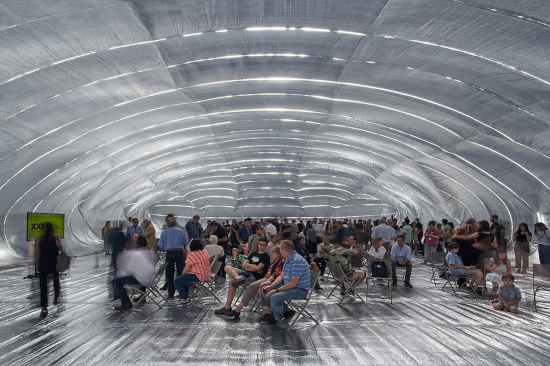
Guatero.
Radić’s architecture often appears deceptively simple.
Concrete, stone, timber, and glass recur throughout his work, but never as neutral materials. Instead, they are composed to manipulate light, sound, gravity, and atmosphere.
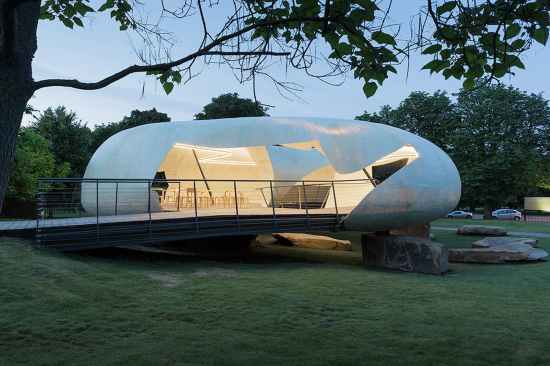
Serpentine Gallery Pavilion.
The 2014 Serpentine Gallery Pavilion in London exemplifies this sensibility. The temporary structure consisted of a translucent fiberglass shell perched on enormous stones—an arrangement that made the pavilion appear both prehistoric and futuristic, hovering between monument and improvisation.
Light filtered through the fiberglass skin, creating a soft, luminous enclosure that never fully separated visitors from the surrounding park.
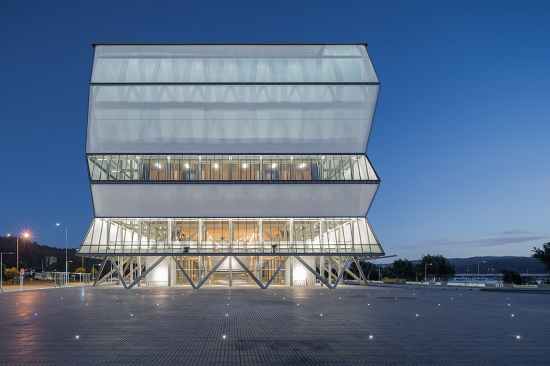
Similarly, at the Teatro Regional del Biobío in Concepción (2018), Radić wrapped the theater in a semi-translucent envelope that modulates daylight while supporting acoustic performance through restraint rather than spectacle.
In these projects, construction itself becomes a narrative device—texture, mass, and light carrying as much meaning as architectural form.
Architecture That Must Be Felt
Part of the challenge in writing about Radić’s work is that it resists verbal description.
The jury acknowledged as much.
“To render the qualities of his architectural work in spoken language is intrinsically difficult, for in his designs he works with dimensions of experience that are immediately palpable but escape verbalization—like the perception of time itself: immediately recognizable, yet conceptually evasive. His buildings are not conceived simply as visual artifacts; rather, they demand embodied presence,” the citation notes.
That embodied quality is central to Radić’s architecture. His buildings often feel protective and introspective—spaces calibrated to heighten awareness of time, weather, and bodily presence.
One of the clearest examples is House for the Poem of the Right Angle in Vilches (2013), a retreat-like dwelling where carefully positioned openings capture shifting light and frame moments of quiet reflection.
A Home That Listens to the Weather
Radić’s own home and studio in Santiago—Pequeño Edificio Burgués (2023)—pushes these ideas further.
The residence shelters its occupants while maintaining a surprising openness to the city and the elements.
From inside, residents overlook the urban landscape below, but the interior remains concealed from the outside by chain-link curtains.
Single-pane glass walls allow rain, sound, and changing light to enter the space, making weather an active participant in daily life.
Beneath the house, the architect’s studio sits partially underground, protected by an earthen berm that filters sunlight and draws nature inward.
The result is architecture that mediates between exposure and refuge.
Ruins, Layers, and Continuity
Radić’s approach to existing buildings similarly avoids conventional categories like restoration or replacement.
Instead, he treats architectural history as a layered condition.
At NAVE, a performing arts center in Santiago completed in 2015, Radić transformed a damaged early-twentieth-century residence into a flexible cultural space.
The existing structure remains intact, while new volumes provide rehearsal rooms, workshops, and performance areas.
Above the building, a rooftop terrace capped by a circus tent introduces an unexpected element of levity—an atmosphere of temporary celebration hovering above the more intimate spaces below.
The intervention allows past and present to coexist without hierarchy.
An Architecture Archive in Motion
Radić’s interest in layered knowledge extends beyond built projects.
In 2017 he founded the Fundación de Arquitectura Frágil in Santiago, an institution conceived as both archive and public platform.
The foundation collects experimental works, studies, and references from architects across generations—an evolving body of research that often informs Radić’s own practice.
Rather than positioning architecture as a solitary act of authorship, the archive treats the discipline as an ongoing conversation.
From the Edge of the World
Radić’s career has unfolded largely outside the traditional centers of architectural power.
Working from Santiago with a small studio, he has produced cultural institutions, houses, installations, and civic spaces across Europe and South America.
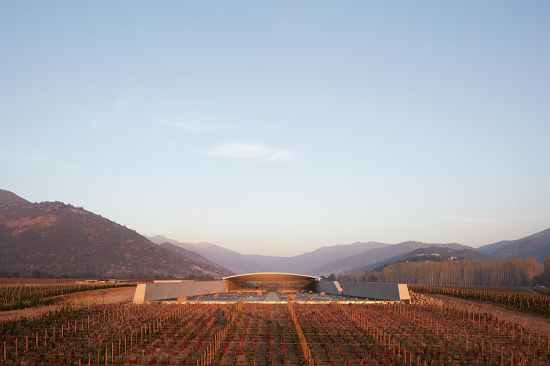
His projects range from Vik Millahue Winery (2013) to experimental installations such as The Boy Hidden in a Fish, created with Marcela Correa for the 2010 Venice Architecture Biennale.
More recent works include Prism House (2020), London Sky Bubble (2021), Chanchera House (2022), and Guatero, produced for the 2023 Chilean Architecture Biennial.
Yet despite this growing international presence, Radić has remained rooted in Chile.
Born in Santiago, he founded his practice Smiljan Radić Clarke in 1995 and continues to live and work in the city.
Upcoming projects are currently planned in Albania, Spain, Switzerland, and the United Kingdom.
The 55th Pritzker Laureate
Radić becomes the 55th laureate of the Pritzker Architecture Prize, joining a lineage that includes figures who have reshaped architectural thinking across generations.
But his selection also signals something else.
At a moment when architecture faces planetary limits and growing skepticism toward monumental ambition, the Pritzker jury appears to be recognizing a quieter paradigm—one where fragility, humility, and uncertainty become creative tools.
Radić’s buildings rarely shout.
They whisper.
And in doing so, they remind architecture that the most powerful spaces may not be those that dominate the landscape—but those that make us pause long enough to notice it.