In New York, the most consequential architectural ideas have often emerged not from towers realized, but from arguments staged—sometimes angrily, sometimes poetically—against the city as it is. Few figures embodied that tradition more fiercely than Michael Sorkin. A relentless critic, polemicist, designer, teacher, activist, and occasional actor, Sorkin spent decades insisting that architecture was never neutral, never merely formal, and never innocent of power.
Now, six years after his death from COVID-19, Columbia University’s Graduate School of Architecture, Planning and Preservation is mounting the first major exhibition of his work not produced by his own office. People Cross Against the Light: Michael Sorkin’s New York, on view from February 26 through June 26, 2026, at the Arthur Ross Architecture Gallery, returns Sorkin to his primary terrain: New York City, understood not as backdrop but as battleground.
Animal Houses
The exhibition assembles eight architectural projects conceived between 1987 and 1996, a decade that marked Sorkin’s pivot from being New York’s most widely read architecture critic—through his withering weekly columns in The Village Voice—to an increasingly ambitious design practice under the banner of Michael Sorkin Studio. Rather than treating criticism and design as separate phases, the show argues that they were inseparable modes of the same project.
Sorkin did not write to clear space for architecture; he wrote to obstruct it. Authority, for him, was something to be slowed, unsettled, rerouted. Codes, capital, infrastructure, and representation were not givens but forces to be contested. The built environment, as this exhibition makes clear, was never a finished object but a layered ecology—one that could be strategically interrupted to allow alternative forms of collective life to emerge.
That idea of obstruction, central to the exhibition, is not framed as negation. In Sorkin’s work, obstruction becomes generative: a way of forcing dominant systems to hesitate long enough for new possibilities to appear. It is a tactic visible across the eight projects on view, from speculative skyscrapers to infrastructural landscapes, from biomorphic housing to ecological urbanism.
Tracked Houses.
The exhibition includes more than one hundred objects—many never before shown publicly—including large-scale models, drawings, sketches, scripts, poems, early digital studies, and archival material drawn from the Michael Sorkin papers and architectural drawings collection at Columbia’s Avery Architectural & Fine Arts Library, which has housed the archive since 2024. Collaborations with figures such as Lebbeus Woods and John Young underscore the extent to which Sorkin’s work emerged from dialogue rather than singular authorship.
Among the most politically charged works are two unsolicited proposals for the Television City site between 59th and 72nd Streets, then being developed by Donald Trump. These projects, conceived at the height of Reagan-era real estate speculation, positioned architecture as an explicit counter-argument to entertainment-driven urbanism and top-down development logic. Sorkin was not content to critique Trump’s vision from the page; he confronted it spatially, proposing alternative urban futures that operated outside conventional legal and regulatory frameworks.
The exhibition’s title is drawn from Sorkin’s 2010 essay “Nine Fabulous Things About New York,” a love letter to the city’s small acts of everyday defiance. People Cross Against the Light captures Sorkin’s attention to the informal, the unsanctioned, and the human-scale gestures that quietly undermine authority. It also signals the humanism that increasingly characterized his later work, where political imagination was rooted in lived urban experience rather than abstract theory.
Across teaching, research, design, activism, and writing, Sorkin returned obsessively to one conviction: “Stability as the by-product of diversity.” Suspicious of singular representations and closed systems, he resisted working within a single medium or style. As he once wrote, “The logjam you don’t even know you’re stuck in will be broken by a shift in representation.” That belief animates the exhibition’s argument that critique, for Sorkin, was never an endpoint. It was the beginning of design.
The projects themselves trace a clear evolution. Mass Movement (1987), developed for a Times Square site with Steve Lewis and John Young, deploys rotating skyscraper volumes generated through early computer modeling, using emerging digital tools to interrogate entertainment culture and speculative real estate. Time Square / The Eleventh Hour (1987), a collaboration with Lebbeus Woods and John Young, responds directly to Trump’s Television City proposal with an experimental collective habitat inspired by the improvised architectures of unhoused communities occupying the Penn Central railyards.
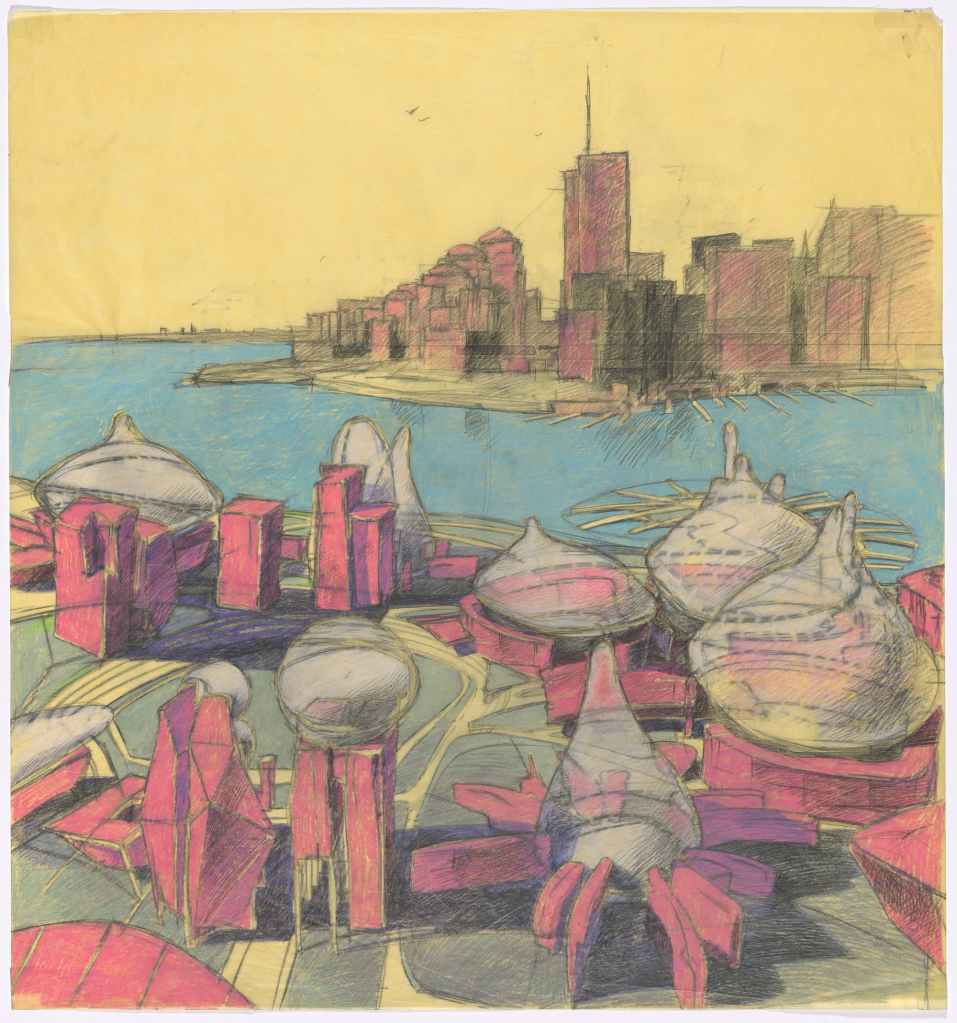
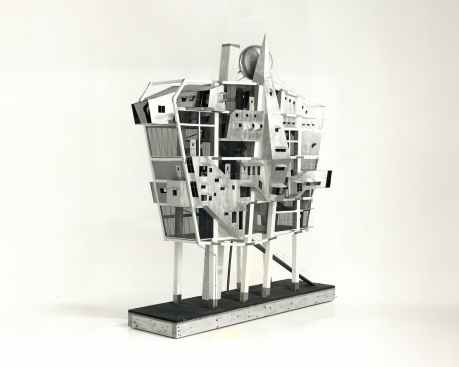
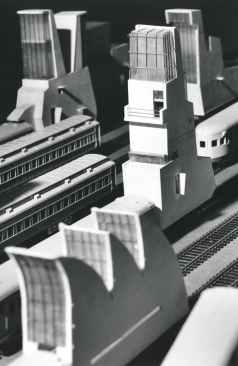
By the late 1980s and early 1990s, Sorkin’s work turns increasingly toward biomorphism and ecology. Animal Houses (1988–89) reject both modernist anti-representation and postmodern exhaustion, proposing siteless, animal-like structures amid debates about simulacra and the “Disneyfication” of 42nd Street. Tracked Houses (1990) weaponizes infrastructure itself, pairing abandoned railway cars with vertical towers to critique suburban tract housing and rethink land ownership, mobility, and mass production.
In Church Street (1991), criticism becomes explicit design method. Drawing on Sorkin’s writings about loft living in SoHo and Tribeca, the project lifts a building above the street, partially obstructing traffic to create new pedestrian and theatrical spaces below. Shrooms (1994), proposed for East New York, collapses the binary between suburb and city, using vacant lots to imagine greenways, collective gardens, and proto-public loft spaces—a precursor to later research on urban self-reliance.
The final projects push most clearly toward ecological urbanism. The Governor’s Island proposal (1995–96) imagines the site as a “University of the Earth,” anticipating contemporary conversations around climate education, waterfront access, and ferry-based transit. East New York (1995–96) begins with a single tree planted in an intersection—an act of obstruction from which an alternative urban fabric unfolds.
Taken together, these works reveal a consistent logic: architecture as friction, not solutionism. They also explain why Sorkin’s ideas feel newly urgent. His writings from the 1980s and 1990s—once responses to Reagan-era deregulation and speculative excess—resonate sharply in today’s political and ecological moment.
The exhibition is curated by Bart-Jan Polman, Director of Exhibitions and Public Programs and Curator of the Arthur Ross Architecture Gallery, with Jean Im, Assistant Director of Exhibitions and Public Programs. A companion symposium on February 27, 2026, will extend the exhibition’s framework to Sorkin’s later work with Terreform and Urban Research, bringing together voices such as Teddy Cruz and Fonna Forman, Thom Mayne, Ana María Durán Calisto, Vyjayanthi Rao, Deen Sharp, and James Wines.
For Columbia, the show is also a reckoning. Sorkin was a product of the institution—educated in literature at Columbia before studying architecture at Harvard and MIT—and later shaped generations of students as a teacher and as Director of the Urban Design Program at City College of New York. His archive’s return to Columbia marks not closure but reopening.
Sorkin once described critical practice as “propaganda for justice.” People Cross Against the Light makes the case that his architecture functioned the same way: not as a set of answers, but as a series of strategic interruptions. In a city—and a profession—still addicted to smoothness, efficiency, and spectacle, Sorkin’s insistence on friction may be his most enduring provocation.