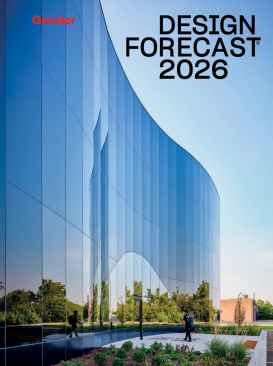
Gensler's Design Forecast 2026.
By any traditional measure, real estate value has long been tied to scale, efficiency, and location. But according to Gensler, those metrics are rapidly losing their grip. In its newly released 2026 Design Forecast, the global architecture and design firm argues that the future of cities—and the business models behind them—will be shaped instead by experience, adaptability, and a new partnership between human creativity and artificial intelligence.
Released last month, the annual report frames 2026 as a tipping point for the built environment, where accelerating technological change, economic volatility, and climate pressure are forcing designers and developers to rethink how space is conceived, delivered, and valued. The forecast identifies six major forces reshaping everything from workplaces and stadiums to transit hubs and aging commercial stock.
For the first time, Gensler’s forecast breaks down its findings by country and region, tracing how global forces manifest differently across markets. In Europe, the emphasis is on cultural vitality and people-centered livability. In Asia, rapid urbanization and density are driving experimentation and innovation. In the Middle East, quality of life and long-term resilience dominate planning priorities.
Gensler’s co-CEOs, Jordan Goldstein and Elizabeth Brink, frame the moment as one of convergence rather than disruption. “Design has always been about imagining what’s next,” they said. “Today we’re seeing an extraordinary convergence of technology and creativity that’s expanding what’s possible. AI isn’t just accelerating our work—it’s revealing patterns in human behavior we’ve never seen before. At the same time, economic volatility is making design agility essential. The organizations that thrive will be those that blend data-driven intelligence with human imagination, turning today’s complexities into tomorrow’s opportunities.”
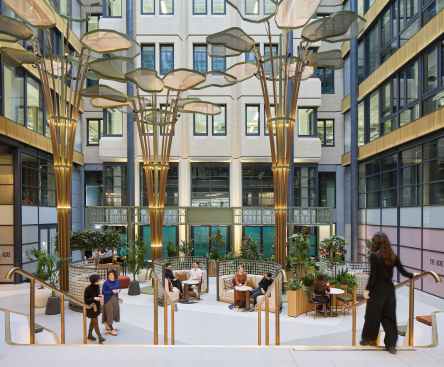
The Acre by Gensler. Courtesy Hufton Crow.
At the core of the forecast is a shift in how value is defined. Experiences—rather than square footage or programmatic efficiency—are becoming the primary currency of real estate. Sports-anchored districts, mixed-use destinations, and immersive environments succeed, the report argues, because they generate emotional connection and narrative identity. Buildings that fail to engage on that level risk becoming interchangeable or obsolete.
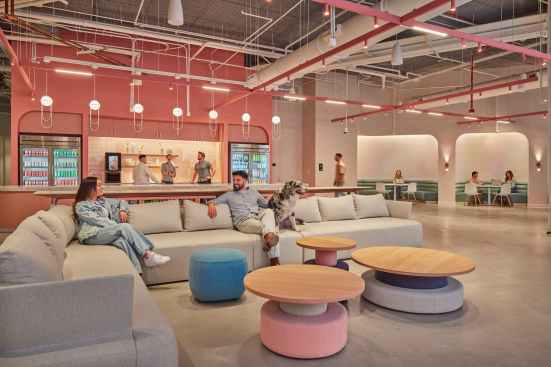
TikTok Offices in Scottsdale, by Gensler.
Workplaces, too, are entering what Gensler describes as their most aggressive transformation since the pandemic. With competition for talent intensifying and organizations recommitting to physical presence, employers are rethinking interiors as strategic assets—spaces designed to reconnect workers with purpose, reinforce culture, and drive innovation rather than simply accommodate desks.
Economic uncertainty looms over nearly every sector of the forecast. Rising construction costs, volatile supply chains, and unpredictable trade policies are forcing developers to treat agility as a core competency. Gensler argues that firms able to integrate predictive cost modeling, real-time collaboration, and data-driven decision-making will be best positioned to absorb shocks without derailing projects.
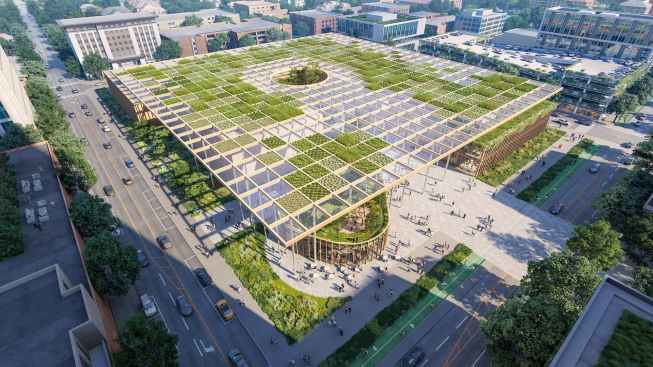
Community Hospital of the Future.
Artificial intelligence emerges as the most transformative—and contentious—force in the report. Rather than framing AI as a productivity tool, Gensler positions it as a creative engine capable of revealing hidden patterns in how people experience space. Used effectively, the firm argues, AI allows designers to prototype, test, and adapt environments at unprecedented speed and scale, shifting the competitive landscape from efficiency-driven to innovation-led.
The forecast also points to a fundamental reworking of urban typologies. As cities adapt to demographic shifts and economic pressure, single-use buildings are giving way to hybrid environments. Stadiums double as civic gathering spaces, transit hubs host cultural programming, and defunct malls are repurposed as universities or community centers—blurring the boundaries between infrastructure, culture, and commerce.
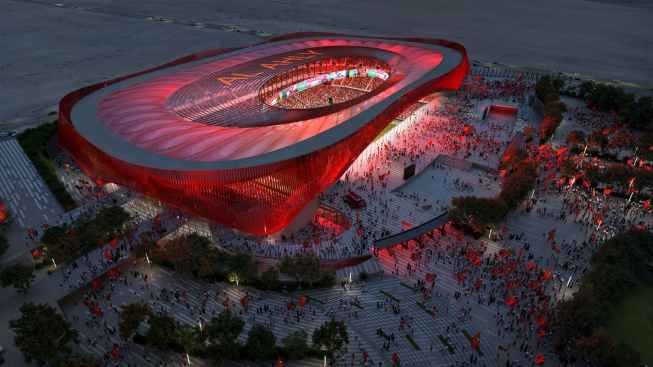
Ahly Stadium by Gensler.
Underlying all six trends is a blunt warning: climate resilience is no longer optional. As extreme weather accelerates in frequency and severity, Gensler argues that urban real estate must become flexible, durable, and regenerative—or risk turning into stranded assets.
Taken together, the 2026 Design Forecast reads less like a trend report than a snapshot of how design practice is already changing. Its message is clear: cities that fail to adapt—to AI, to volatility, to climate reality—will struggle to remain viable. Those that succeed will be the ones that treat design not as a static outcome, but as an evolving system capable of turning uncertainty into opportunity.
The full report is available at gensler.com/publications/design-forecast/2026