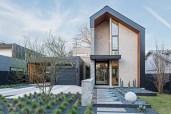
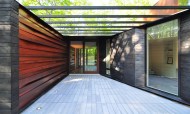
A home’s setting shapes everything from its materials and palette to the way it frames a view.
“When I’m designing a space, I’m always thinking, ‘What do you see in front of you? What happens if you turn left or turn right?’” says architect Paul Lewandowski, founder of Portland, Maine–based Paul Designs Project.
That thinking shows up in projects across the country—from a home Lewandowski designed in the foothills of New Hampshire’s White Mountains to retreats in Utah and Minnesota, where architects use glazing to connect daily life to the landscape.
Echoing the Landscape
At the New Hampshire home Lewandowski designed, the mountains not only informed the way the structure is sited to take in the spectacular view, but they also inspired the home’s distinctive silhouette, massing, and materials.
“It’s important that there be some dialogue between the shape of the house and the land,” he says. So he echoed the nearby mountain pass, known as Franconia Notch, with a glass-enclosed floating breezeway that bridges the main living areas and the primary suite.
“There’s a dramatic change in elevation from where we are to the top of the mountains, so it’s really exciting to be able to design something that can take advantage of that drama that exists in nature,” Lewandowski says.

Notch House in New Hampshire by Paul Designs Project.
Three windows in the living room, each just shy of 8 feet wide and 12 feet tall, take in views of the vast mountain range. The climate’s high winds and cold temperatures called for high-performing windows; these units, made of proprietary high-density fiberglass, offer robust thermal performance and control the impact of air, light, and wind.
“By using the Marvin Modern collection, it worked beautifully,” says Matt LeGeyt, the architectural project manager at Marvin who worked with Lewandowski.
Lewandowski notes that while the panoramic views provide the “wow factor,” smaller “secondary views” along the stairway frame trees and a particular mountain peak to create a balance that is no less special.
“Straight ahead of you, you have the view to the mountain, but you also have these side views that help provide some calm,” he says.
Blurring Boundaries
At a retreat on the outskirts of Park City, Utah, architect Michael Upwall, founder of Salt Lake City–based Upwall Design, did not let extreme topography get in the way of embracing nature. At the heart of the home, he designed an indoor-outdoor living room wrapped in floor-to-ceiling windows and doors that “open up and disappear.”

Pinnacle Sky in Utah by Upwall Design.
Gary Hill, co-owner of Midway Construction Company, the firm that built the house, says the glazing’s low-profile mullions allow for unobstructed views. “As you look through the glass, your eyesight isn’t pulled to a large column or a large window mullion that takes your eye away from that experience,” Hill says.
Slim black spacer and perimeter bars between the glass panes look like minimal shadows and almost disappear.
Upwall mines for special connections with the landscape by quizzing his clients before he begins designing a house. “I like to get more granular: ‘What is your favorite part of the view? Which peaks do you like most?’ Then, I take that into account in the geometry of my design and literally build the home around those ideas,” he says.
Integrating Marvin Multi-Slide doors that effortlessly slide open was key to the experience. “I want to open the door in a single movement to make sure it connects with the rest of the body of the house,” Upwall says. “That elegance is very important.”
Using Glazing as a Design Feature
For a retreat set within Minnesota’s Whitefish Chain of Lakes, architect Jeremy Imhoff, principal and co-founder of Stillwater, Minn.–based Imprint Architecture + Design, drew inspiration from rustic stone cabins, reinterpreted as modern gable forms that connect to a striking two-story glass volume.
Using Marvin Modern and Ultimate glass, the multigenerational home captures sweeping views of the water and wooded landscape. Broad expanses of glazing allow exposed wood, stone, and steel to flow between inside and out with virtually no visual interruption.

Whitefish Lakehouse in Minnesota by Imprint Architecture + Design.
At the heart of the design, a glass core bridges the wooded landscape at the front of the property to the lake on the opposite side. “As you approach the house, you immediately have this view through to the lake beyond, and it pulls you in,” Imhoff says.
In addition to that glass volume, Imhoff turned a cantilevered staircase into a design moment with a two-story wall of windows that, from the front exterior, provides a wider view of the water and sky beyond. “Rather than bisecting that window, we thought, Why not float the stair right in front of it?” the architect says.
On the lake side, expansive sliding doors and window walls connect both levels of the house to surrounding landscape. “The big move on this house was using all this glass to blur the line between indoors and out,” Imhoff says. It’s that balance—of openness and weight, glass and stone—that ultimately defines the experience of the home and grounds it in its setting.