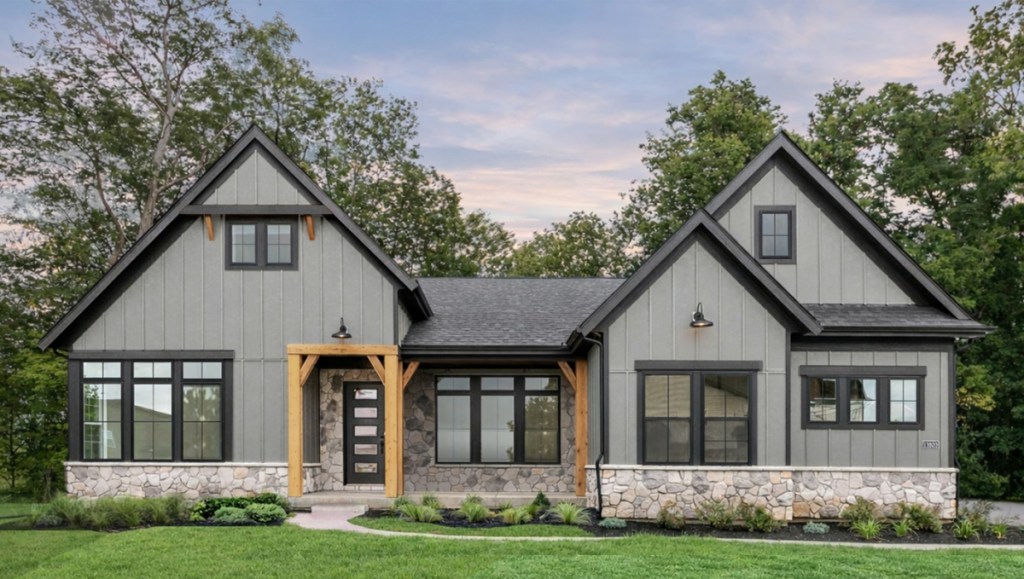
Fischer Homes delivers more than 3,000 homes a year across the Midwest and South, yet still manages to create communities where streetscapes feel curated rather than copy-and-paste.
For Dan O’Connell, that balance comes down to systems, discipline, and a belief that a home’s exterior carries as much emotional weight as its floor plan.
“We feel like we have a distinctive level of architectural variety in our homes,” says O’Connell, Fischer Homes’ director of architecture. “The best billboard is your community.”
Fischer’s product lineup spans first-time homes to semi-custom luxury, along with townhomes, condos, and active-adult offerings. Across collections, the goal is the same: Empower buyers with personalization while maintaining a predictable, scalable operational backbone. It’s made possible by a drawing-management and estimating system the company adopted eight years ago— technology O’Connell calls a “game changer.” What used to take up to five days per plan now takes about an hour. Likewise, the system has streamlined the estimation process from a week to half a day.
The front-end work is extensive—every structural option and elevation package must be fully modeled and coordinated—but once complete, the system enables Fischer to execute far more variety than a typical production builder.
“Once we have that established and created for a plan, the production side of it is very, very smooth,” O’Connell says.
Variety as a Value Proposition
While buyers may begin their search with bedroom counts or square footage, O’Connell argues that exterior design often carries equal weight in purchase decisions.
“When a prospective homeowner drives through your community, they look at the streetscape, the variety, the detailing,” he says. “They start imagining themselves living there. That attractive presentation is really important.”
To avoid monotony, Fischer maintains internal “home mix guidelines” dictating how close the same plan, elevation, or siding palette can repeat. In many municipalities, O’Connell says, Fischer’s standards are more stringent than local zoning requirements. The design challenge for his team: Create four elevation styles for each plan that look “so different you wouldn’t realize they’re the same home—even if we’d never actually build them all in a row.”
Fischer leans on the portfolio of fiber cement products from James Hardie® for its versatility, performance, and range of aesthetic options. The depth of profiles—plank, lap, shingle, panel and more—allows Fischer’s architects to create distinct architectural styles without custom materials.
“It really allows our design team to get pretty creative,” O’Connell says.
Profiles, Textures, and Color: The Toolkit for Variety
Fischer’s approach to elevational variety is rooted in classical proportion, timeless forms, and smart deployment of material changes. Designers pull from historical precedents to avoid trend-surfing while still offering contemporary appeal.
Different siding profiles become tools to accentuate gables, porches, or massing breaks. “Your eye is naturally drawn to contrast,” O’Connell explains. “You can do it subtly by changing texture or more boldly with different siding types and color intensity.”
Buyer preferences vary by market, but across regions, O’Connell sees demand rising for transitional styles that blend traditional massing with modern detailing: asymmetrical window arrangements, cleaner trim lines, metal accent canopies, and black windows.
“People like that it feels timeless but also current,” he says.
Durability also matters, especially in high-wind or high-humidity zones, and the availability of ColorPlus® Technology finishes help divisions streamline field labor by ensuring a consistent, even finish that doesn’t require project changes due to inclement weather or paint schedules.
“Hardie products give us the flexibility to design intentionally and the performance to stand up in the environments where we build,” O’Connell says.
Learn more about how James Hardie supports design versatility, curb appeal, and performance in your communities.