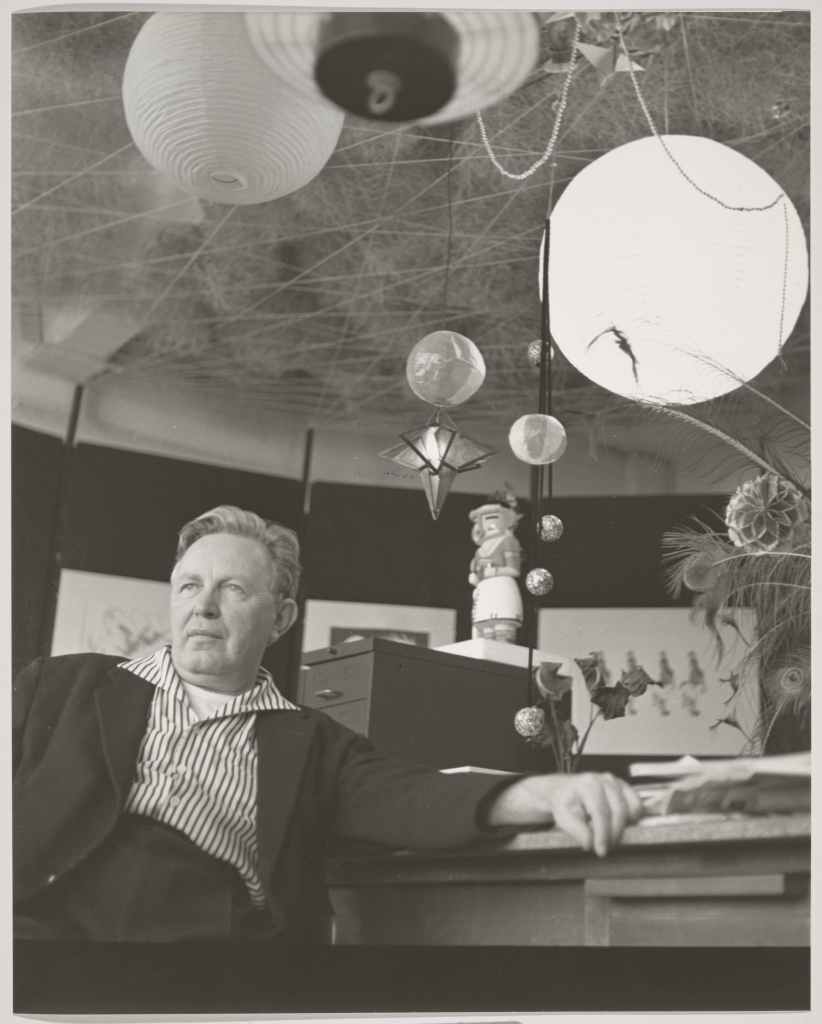
By any conventional measure, Bruce Goff should have been absorbed into the canon of American modernism decades ago. His houses are among the most singular domestic works of the twentieth century; his influence quietly radiates through generations of architects who rejected orthodoxy in favor of experimentation. And yet Goff has remained curiously peripheral—admired, cited, but rarely confronted in full.
That omission is what Art Institute of Chicago seeks to correct with Bruce Goff: Material Worlds, on view through March 29, 2026. The exhibition is the first major museum presentation of Goff’s work in 30 years, and it does not attempt to domesticate him. Instead, it reveals an architect whose practice was never merely architectural, but fundamentally interdisciplinary—restless, sensual, and defiantly plural.
Drawn primarily from the Art Institute’s extensive Goff archive, the exhibition brings together more than 200 works: architectural drawings that verge on hallucination, elaborate models, personal collections, and a surprising selection of abstract paintings. Together, they form a portrait of an architect who refused the disciplinary boundaries that structured modern architecture in the mid-twentieth century—and who paid a professional price for that refusal.
An Architecture of Refusal

Bruce Goff. Glen and Luetta Harder House, Mountain Lake, Minnesota, 1980. © J. Paul Getty Trust. Getty Research Institute, Los Angeles. Photo by Julius Shulman.
Goff is best known for his houses, many of them built far from the cultural centers that traditionally define architectural discourse. Working across the Midwest and Great Plains, he designed homes for clients as varied as artists, bankers, and farmers—figures typically excluded from modernism’s metropolitan mythos. These were not houses that imposed a universal language, but structures that absorbed their contexts: prairie horizons, wooded sites, local economies, and consumer cultures.
That approach placed Goff in conversation with his lifelong mentor Frank Lloyd Wright, but also at a decisive distance from him. Where Wright’s organic architecture often aspired to an idealized unity between nature and form, Goff embraced a messier reality—one in which landscape, popular culture, and industrial surplus collided. His buildings incorporated coal, goose feathers, glass cullet, AstroTurf, cellophane, and sequins, materials that collapsed distinctions between the natural and the synthetic, the sacred and the disposable.
Goff’s formal language was equally insurgent. Domes, spirals, and tetrahedrons recur throughout his work, rejecting the rectilinear discipline and visual restraint that defined much of postwar modernism. These geometries were not stylistic flourishes; they were spatial arguments, insisting that architecture could be experiential, theatrical, and even ecstatic.
Material Worlds, Personal Universes
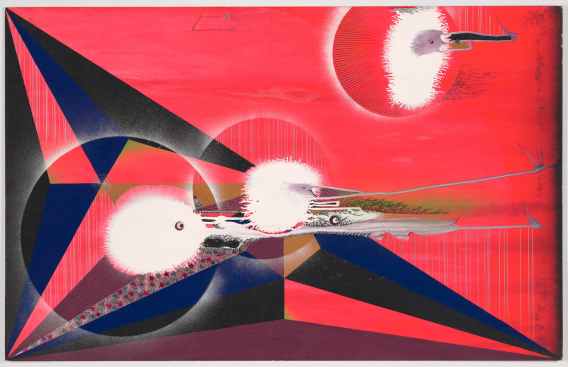
Bruce Goff. Untitled (Composition), 1956. The Art Institute of Chicago, gift of Bob and Sherry Faust.
Material Worlds expands this architectural story by foregrounding Goff’s personal collections—objects that reveal the intellectual and emotional ecosystems from which his work emerged. Seashells and crystals sit alongside popular magazines, clothing, and Japanese craft. The effect is not decorative but diagnostic, tracing a mind attuned to pattern, tactility, and transformation across scales.
These objects also illuminate Goff’s unusually broad range of influences, encompassing Native American art, queer modernisms, science fiction, and East and Southeast Asian art and music. In an era when architectural discourse was narrowing around professional consensus, Goff cultivated an expansive worldview that treated architecture as one medium among many.
“We hope visitors will be inspired by Goff’s expansive worldview and his radical, interdisciplinary practice,” said Alison Fisher, the Harold and Margot Schiff Curator of Architecture and Design. “From monumental churches to avant-garde paintings, this exhibition demonstrates Goff’s singular position within 20th-century American architecture.”
That interdisciplinarity extends beyond visual culture. One of the exhibition’s most unexpected moments is auditory: a customized player piano performs one of Goff’s own musical compositions, underscoring his deep engagement with sound as a spatial and emotional force. For Goff, music was not an analogy for architecture—it was a parallel practice, governed by rhythm, variation, and resonance.
Exhibition as Interpretation
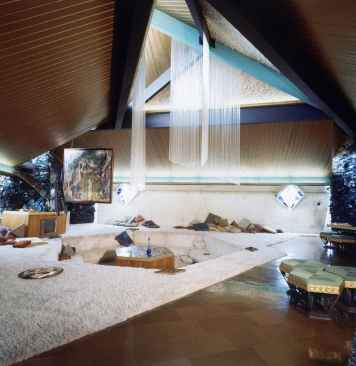
Bruce Goff. Living Room of Etsuko and Joe Price House, Bartlesville, Oklahoma, 1972 Photo by Horst P. Horst for Vogue.
The exhibition’s design, by New York–based firm New Affiliates, resists the neutralizing tendencies of museum display. Led by Ivi Diamantopoulou and Jaffer Kolb, the firm approaches the show as an active environment rather than a passive container, echoing Goff’s own refusal of neutrality. The result is a dynamic spatial narrative that allows materials, drawings, and objects to speak across categories rather than being siloed by discipline.
“As the holder of Bruce Goff’s comprehensive archive, the Art Institute is uniquely positioned to present his daring and eclectic body of work to the public,” said James Rondeau, Eloise W. Martin President and Director of the Art Institute of Chicago. “The museum is proud to introduce this influential architect to a new generation of museumgoers and highlight new research on Goff’s important career.”
That research unfolds across several companion exhibitions. A rotating presentation of 35 Japanese prints from the Goff estate—dating from the 1930s and 1940s—will appear in the museum’s Japanese Art galleries, contextualizing his long-standing engagement with Asian visual traditions. In the Modern Wing, commissioned photographs by Los Angeles artist Janna Ireland document the lived interiors of Goff’s Al Struckus House in Woodland Hills, California, emphasizing habitation over abstraction. Meanwhile, newly acquired large-scale drawings by New Affiliates respond directly to the material and labor histories of three key Goff houses, extending his legacy into the present tense.
Why Goff Matters Now
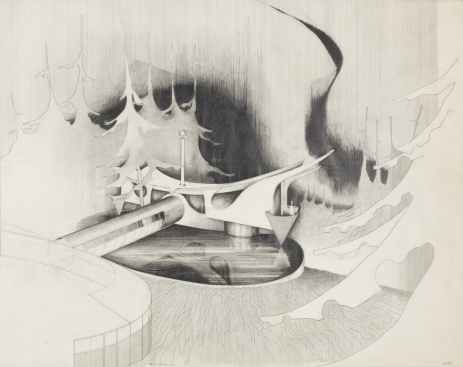
Bruce Goff and Robert Kramer. Elaine A. and William C. Gryder III House, Ocean Springs, Mississippi, Perspective, 1960. The Art Institute of Chicago, gift of Shin’enKan, Inc.
To encounter Bruce Goff today is to confront an alternative genealogy of American architecture—one that values excess over restraint, curiosity over coherence, and lived experience over formal purity. At a moment when architecture is again reexamining its materials, labor practices, and cultural assumptions, Goff’s work feels less like an outlier than a provocation.
Bruce Goff: Material Worlds, curated by Alison Fisher and Craig Lee, does not attempt to resolve Goff’s contradictions. Instead, it embraces them, presenting an architect whose work was as complex and unruly as the worlds he inhabited. Accompanied by a lavishly illustrated catalogue featuring essays from scholars in fields ranging from gender studies to musicology, the exhibition positions Goff not as a footnote to modernism, but as a necessary challenge to its limits.
In finally giving Goff the institutional space his work demands, the Art Institute is not merely revisiting history. It is asking a more urgent question: what kinds of architecture—and what kinds of architects—have we been trained to overlook?