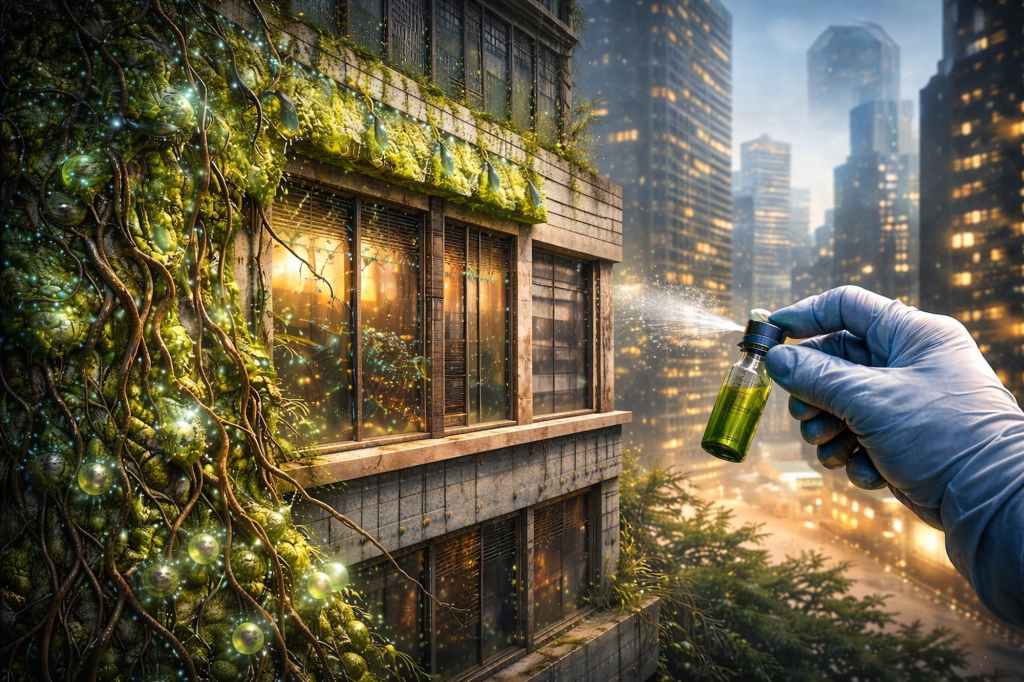
The notion of living architectural materials was once a fantasy. The emergence of responsive systems such as microalgae facades demonstrated the possibilities of living-organism-supported building applications—albeit experimental ones. The interest in commercializing living systems in products and buildings has inspired a new category of material technology called Engineered Living Materials (ELMs).
These biologically based substances enable capacities such as environmental responsiveness, self-repair, and growth—behaviors that conventional products lack. The significance is profound: ELMs bridge the gap between biology and construction, redefining building materials as dynamic and evolving participants in the constructed environment.
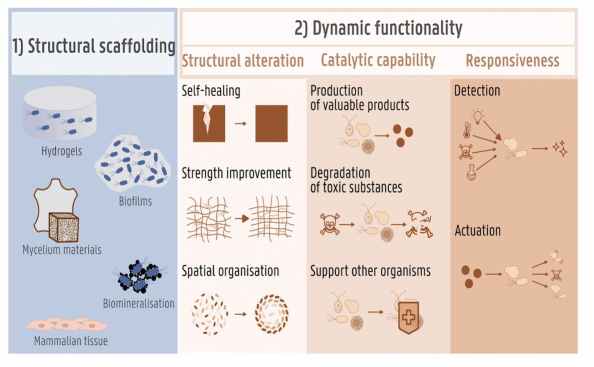
Schematic categorization of living organisms in ELMs. The two main aspects within an ELM are: (1) the structural scaffold and (2) the dynamic functionality. The function of all living organisms in currently developed ELMs can be assigned to one of these subcategories. © The Author(s) 2025. Published by Oxford University Press on behalf of FEMS.
Within this evolving field, multistrain ELMs hold particular promise. Single-strain materials rely on a single organism to perform multiple tasks. In contrast, multistrain systems integrate different microbial or fungal species to perform tasks such as sensing, mineralization, structural formation, or metabolic support. This hybrid functionality mimics the performance of natural systems like bone, coral, and soil ecologies, which gain resilience from both cooperation and redundancy.
As a result, multistrain ELMs can better adapt to environmental changes and with greater sophistication than single-strain versions. Given the pressures to increase the climate adaptability and robustness of buildings, this ecologically inspired and derived approach offers a new paradigm for architecture: materials that respond, transform, and grow with changing needs and circumstances.
One of the most compelling examples of multistrain ELMs joins fungal mycelium and biomineralizing bacteria. Mycelium provides a shapeable, lightweight network while bacteria catalyze the formation of bio-cement via calcium carbonate precipitation within this fibrous matrix.
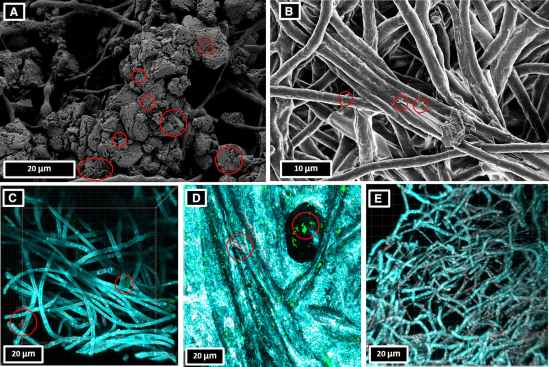
SEM and confocal microscopy images of S. pasteurii grown in liquid cultures with non-viable mycelium scaffolds.
A team of researchers from Montana State University and other institutions has demonstrated the initial success of a biocomposite made from Neurospora crassa mycelium and Sporosarcina pasteurii bacteria. Inspired by the structure of cortical bone, the engineers fabricated biomineralized scaffolds with a similar internal microarchitecture. S. pasteurii bacteria effectively biomineralized the mycelium matrix, increasing the mass of the biocomposite. The team found that the material demonstrated high viability, remaining alive and responsive for nearly a month at 30°C.
Another promising trajectory pertains to infusing polymer hydrogels with engineered microbes. These gelatinous, hydrophilic substances are optimal environments for living organisms, offering a hydrated matrix conducive to microbial activity while enabling the distribution of nutrients and gases.
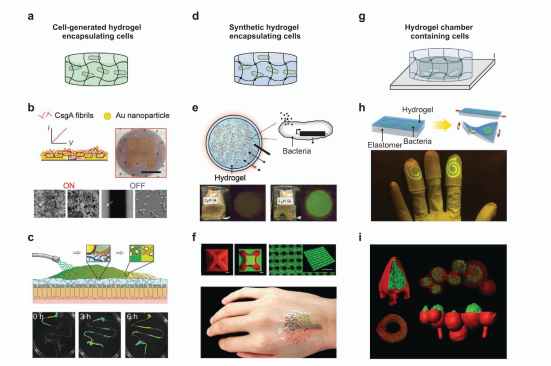
Representative hydrogel matrices in engineered living hydrogels. a–c) Living microbial cells dispersed in cell-generated hydrogels. Exam- ples include b) an Escherichia coli (E. coli)-produced curli fibril biofilm used as an electrical switch and c) an E. coli-generated curli hydrogel used as a mucoadhesive patch in the gut. b) Reproduced with permission.[41] Copyright 2014, Springer Nature. c) Reproduced with permission.[42] Copyright 2019, Wiley-VCH. d–f) Living microbial cells dispersed in synthetic hydrogels. Examples include e) microbial cell-laden hydrogel beads used as a heavy-metal detector in the environment and f) a 3D-printed, cell-laden hydrogel pattern used as a biosensor on the skin. e) Reproduced with permission.[24] Copy- right 2021, Springer Nature. f) Reproduced with permission. [22] Copyright 2018, Wiley-VCH. g–i) Living microbial cells enclosed in hydrogel chambers. Examples include h) a stretchable hydrogel-elastomer hybrid containing microbial cells in channels and i) a 3D-printed, core–shell hydrogel structure containing microbial cells in cavities. h) Reproduced with permission. [46] Copyright 2017, National Academy of Sciences. i) Reproduced with permis- sion. [53] Copyright 2013, National Academy of Sciences.
Research conducted by MIT engineers has resulted in ELM hydrogels infused with multiple strains of engineered E. coli. Different microbes can detect environmental toxins such as heavy metals, release protective enzymes, and exhibit color changes. These varied roles cannot be easily performed by one strain; thus, the material benefits from multiple, parallel functions. Architecturally, hydrogel ELMs could lead to smart membranes or bioskins that respond to pollutants or self-regulate their porosity in response to climatic fluctuations, offering a new paradigm for programmable materials.
Nutrient-sharing cross-protection systems are among the most sophisticated and biomimetic multistrain ELMs, because their engineered microbial populations are mutually auxotrophic—meaning they are metabolically dependent on one another for essential nutrients such as vitamins, enzymes, and amino acids. This mutualistic relationship enhances the material’s resilience and endurance. For example, under environmental stresses such as heat, dryness, or salinity, some microbes may become dormant, while others remain active to protect the system. Roles then reverse as circumstances change.
Studies by the Swiss Federal Institute of Technology Lausanne (EPFL) and other labs have determined that such ELMs can outlast monocultures even under changing conditions. A material that self-stabilizes and evolves under stress is desirable for building construction applications. For example, such an ELM would be advantageous in facade systems or subterranean contexts where challenging conditions are anticipated. The material would not require frequent maintenance or replacement, but an occasional recharging via light or moisture.
Despite progress, the commercialization of multistrain ELMs faces challenges. For example, long-term viability remains a limitation. Most ELMs begin to degrade within weeks or months due to nutrient depletion, microbial competition, or desiccation. Realizing a self-sustaining multistrain ecology will require significant innovations in metabolic engineering and material design.
Another hurdle is biosafety. Although most strains are not pathogenic, regulators will likely seek strict controls to prevent potential contamination or unrestrained microbial growth—that is, once regulations catch up to the technology. Presently, building codes and performance standards are not equipped to evaluate or approve materials that grow, mutate, and evolve. Nor is the general public ready to embrace the idea of biological building surfaces.
Nevertheless, multistrain Engineered Living Materials show the potential of a fundamentally new material paradigm in architecture. As climate volatility accelerates and traditional, passive building products continue to degrade under increasing stress, living materials that detect changing circumstances and respond and self-repair as needed offer tangible benefits.
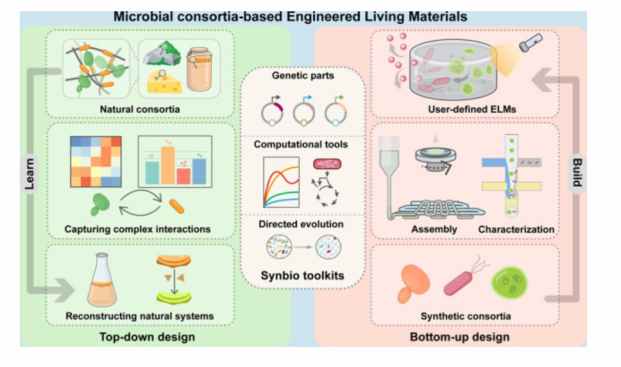
Microbial consortia-based Engineered Living Materials.
In the future, material assemblies will not merely be specified, but cultivated. Modular microbial toolkits will offer functional strains that design and construction teams can select for particular functions, such as pollution detection, crack repair, UV resistance, or carbon sequestration.
ELMs also have the potential to support dynamic building systems, interacting with HVAC, daylighting, and occupant health monitoring via biosignals. Building envelopes will become sites of climatic repair, not just passive shields. In such applications, the materials will thus serve as semi-autonomous collaborators rather than static products.
In these ways, multistrain ELMs invite us to reimagine architecture not as an assemblage of inert products, but as a living ecosystem. Although they remain experimental, these materials offer a glimpse of a more responsive, regenerative, and adaptive—albeit uncanny—built environment.