In Hong Kong’s Central district—one of the most relentlessly present-tense places on earth—Snøhetta is asking diners to slow down. Not just to savor a meal, but to experience something far more abstract: the passage of time itself.
The firm’s newly completed Solstice Culinary Space is, on its surface, a compact hospitality project. Spread across 340 square meters and two floors at 8 Lyndhurst Terrace, it combines three programs: a cooking studio, Sol restaurant on the fifth, and Uncle Quek a more casual eatery on the sixth. But the ambition is clearly larger. This is not simply a place to eat. It is, as the architects frame it, “a journey through time, a reflection of nature’s rhythms, and a celebration of transformation in all its forms.”
SOL Restaurant. Photo: Harold de Puymoin, HDP Photography.
That ambition is embedded in the project’s organizing concept: the solstice. Marking the sun’s highest and lowest points in the sky, the solstice becomes here less an astronomical event than a spatial narrative device.
SOL Restaurant. Photo: Harold de Puymoin, HDP Photography.
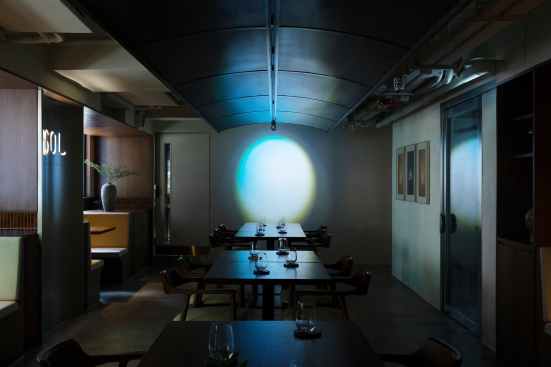
The interiors are designed to oscillate between two conditions—winter and summer—expressed through shifts in material, light, and atmosphere.
Solstice Cooking Studio. Photo: Harold de Puymoin, HDP Photography.
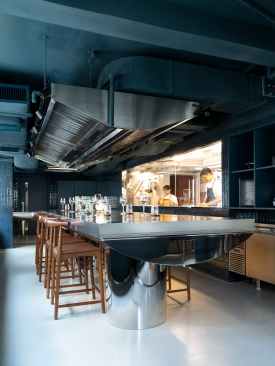
On the lower end of that spectrum is the Solstice Cooking Studio, conceived as an analogue to the Winter Solstice. The space leans into darkness and introspection, with a palette of charcoal and indigo and surfaces that emphasize tactility over reflection. Ceramic tiles and stainless steel create a grounded, almost hushed environment, evoking what the architects describe as “the long nights and quiet hush of the season.”
Move through the project, and the mood lifts. The dining areas transition toward a brighter, more open condition associated with the Summer Solstice. Here, natural light is allowed to dominate, filtering through open windows and bouncing off lighter materials—wood, terracotta, and mirrored surfaces—that amplify a sense of warmth and expansion. The shift is not abrupt but choreographed, a gradual unfolding that attempts to mirror the cyclical transitions of the natural world.
“By designing a space that embodies the celestial transitions, we aim to create an immersive experience where the flow of time is palpable in every detail – from the shifting light to the evolving flavors on the plate,” says Ana Patricia Castaingts Gómez, Lead Interior Architect at Snøhetta.
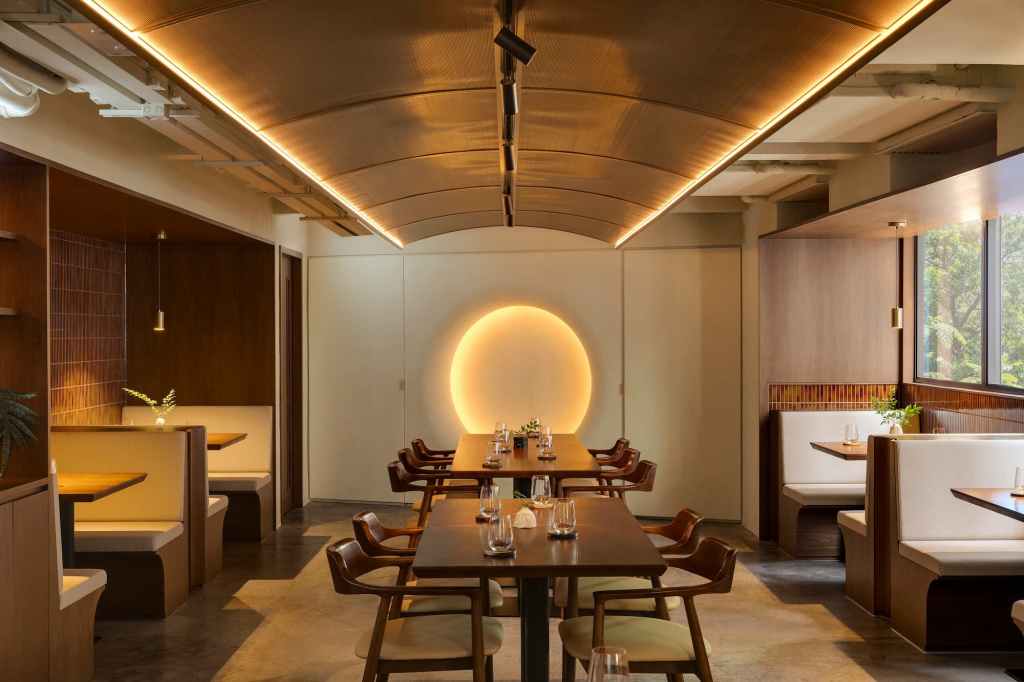
That choreography is most legible in the project’s treatment of light. Two sculptural installations positioned at opposite ends of the space stand in for the sun and moon, establishing a symbolic dialogue between day and night. Elsewhere, lighting is calibrated to shift subtly over the course of the day, echoing natural changes in daylight.
At the center of the main dining area, a concave ceiling becomes the project’s defining architectural gesture. Its gentle curvature diffuses both natural and artificial light, casting a soft, ambient glow across the room. The form is not arbitrary: it traces the arc of the sun, reinforcing the project’s overarching narrative. Concealed linear LEDs follow this curve, producing a layered, cinematic effect that evolves with changing light conditions.
The result is an interior that is carefully composed, even meticulous. Every surface, every gradient, every shift in brightness is calibrated to support the idea of transformation. The question is whether that idea translates into something genuinely felt—or whether it remains, like many concept-driven interiors, more legible as a story than as an experience.
“Solstice Culinary Space aims to be an experience as much a restaurant – it is a journey through time, a reflection of nature’s rhythms, and a celebration of transformation in all its forms,” says Emily Yan, Director of Snøhetta’s Hong Kong studio.
There is no doubt that the project succeeds in constructing a coherent narrative. It is spatially fluid, materially consistent, and atmospherically controlled. It also aligns with a broader shift in hospitality design, where restaurants are increasingly expected to deliver not just food but immersion—spaces that perform, transform, and tell stories as much as they serve meals.
But Solstice also raises a familiar question: how much concept is too much? When architecture becomes this carefully orchestrated, does it deepen experience—or risk overdetermining it?
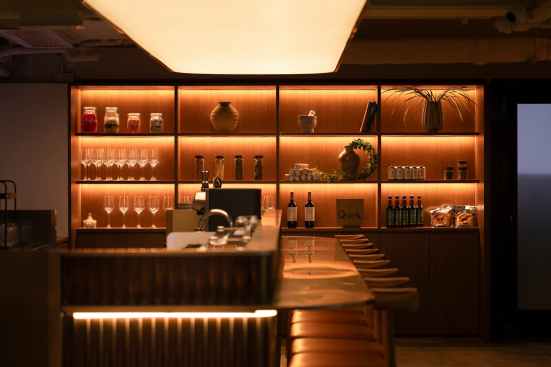
Uncle Quek. Photo: Harold de Puymoin, HDP Photography.
For now, the project offers a clear answer of its own. It positions itself not just as a destination for dining, but as a stage for communal rituals—cooking, eating, gathering—that have always marked the passage of time. Whether visitors experience that passage as something profound or simply atmospheric may ultimately be beside the point.
In a city defined by speed and density, even the suggestion of cyclical time—of winter giving way to summer, of light shifting across a room—can feel like a small act of resistance.