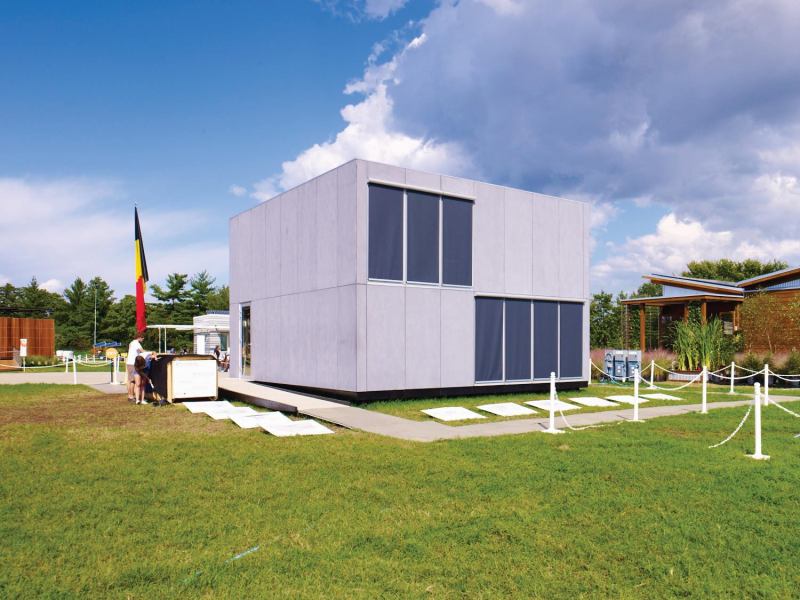
Team Belgium aimed for simplicity with E-Cube, a modular house that’s stripped of nonessential components and finishes, leaving the plywood-sandwich façade exposed inside. The house was conceived as an affordable building kit that can be assembled in just days. A boltless, pallet-rack system forms the main structure, with technical systems grouped together in a small compartment. The open plan can be expanded by adding floor panels to the existing beams. “The pallet rack is so flexible—it just clicks together,” says recent graduate Charlotte Vyncke. Team Belgium tied for first in affordability, the team’s success aided by the ease of construction. “In calculating the labor cost, they took into account if the labor was skilled or not,” Vyncke says. “Our house did not require a lot of skilled labor, and I think that’s why we won.”
Estimated cost: $249,568.09
2011 Solar Decathlon
For full coverage of every team, slide shows of the houses, video walkthroughs, interviews, and an essay by Lawrence Biemiller on the importance of the competition, click here.