
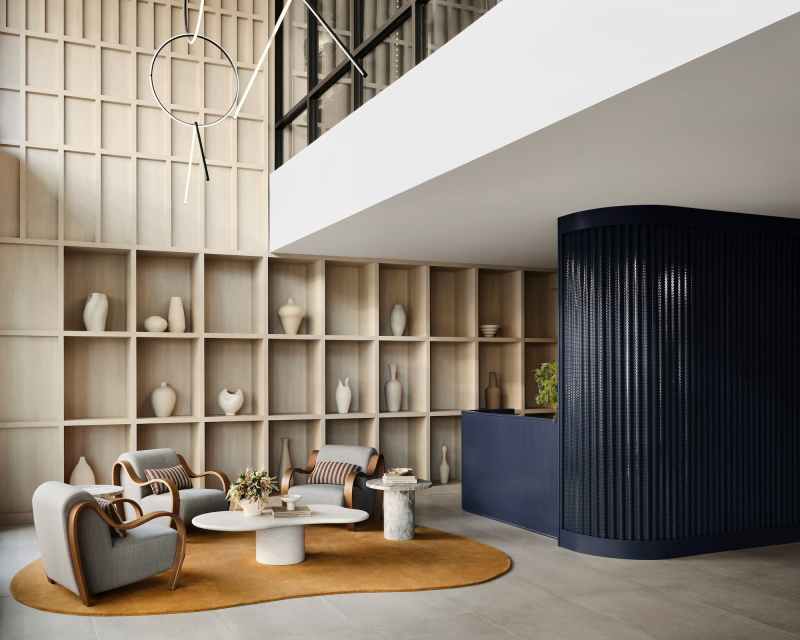
The most important spaces in a building are no longer the offices or the apartments. They are the spaces in between.
Lobbies, terraces, cafés, and lounges—once treated as circulation or afterthought—have quietly become the reason a building succeeds or fails. They are where people actually spend time, where they decide whether a place feels alive, and where buildings reveal whether they understand how people live now.
For decades, architecture prioritized efficiency—rentable square footage, unit counts, desk ratios. Amenities were often secondary.
That framework is now shifting. Flexible work, evolving lifestyles, and rising expectations shaped by hospitality and digital platforms are pushing buildings to recalibrate around experience.
People are no longer choosing buildings based on layout alone. They are choosing them based on experience—how a place anticipates them, supports them, and, at its best, recognizes them.
One client once described the real test of a project this way: sit back and “watch the river.” Watch how people actually move through the building once the design is no longer in your control. They will always use it in ways we never anticipated.
Amenities are where architecture meets behavior—and where its intentions become most visible.
WORKPLACE: THE OFFICE IS BECOMING a SERVICE ENVIRONMENT
The End of the Static Workday
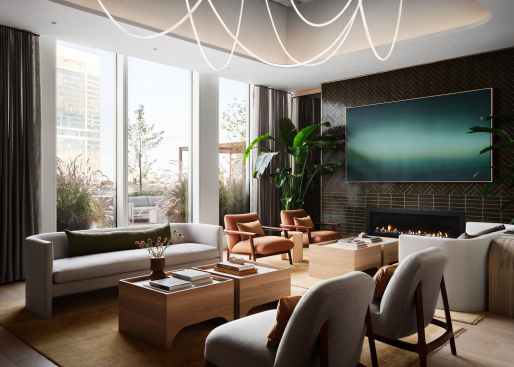
141 Willoughby, Image 01, Brooklyn, NY. Workplace lounge organized around a central hearth with direct access to an adjacent terrace, establishing a spatial anchor for informal gathering. Architecture and Interior Design, FF+E and Art Curation by Fogarty Finger; Photography: David Mitchell.
The contemporary office no longer operates on a single rhythm. It pulses.
Mornings are quieter, fragmented. Midday compresses into moments of intensity. Evenings blur into social time. Hybrid work has reshaped the predictable cadence of the office that office buildings were designed around.
Amenity spaces are now expected to absorb that instability.
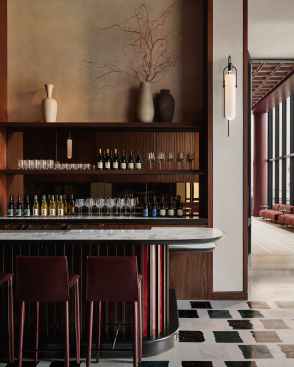
1290 Avenue of the Americas, Image 01, New York, NY Bar area articulated through wood millwork and calibrated lighting, reinforcing its role as a primary workplace amenity. Interior Design, FF+E and Art Curation by Fogarty Finger; Photography: David Mitchell.
A café is no longer a café. At 9 a.m., it is a workspace. At noon, it becomes a meeting room. By late afternoon, it shifts again—into something closer to a bar. The same square footage is performing multiple roles across a single day.
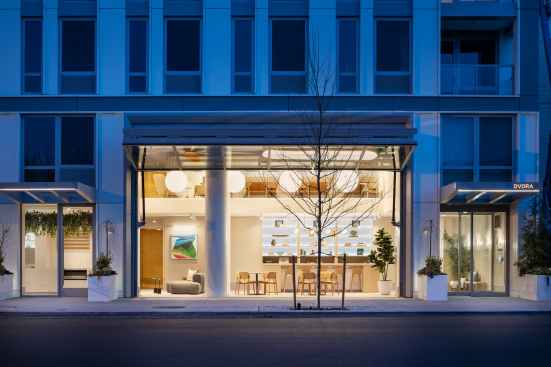
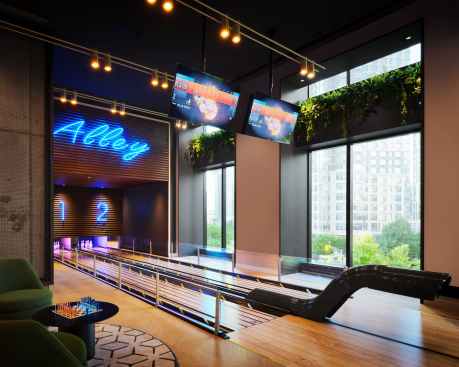
DVORA, Jersey City, NJ Indoor/outdoor recreation space introducing informal programming within the amenity level of a ground-up residential building. Architecture, Interior Design, FF+E and Art Curation by Fogarty Finger; Photography: Mike VanTassell.
Design that cannot accommodate that shift is already obsolete.
Flexibility, however, is not just a matter of movable furniture. It requires a more subtle calibration: lighting that changes tone over time, acoustics that allow for both isolation and overlap, and spatial cues that give people permission to use a space differently without needing instructions.
The best amenity environments don’t dictate behavior. They anticipate it.
Experience Is Now the Product
In a saturated office market, design alone is no longer enough. There are many ‘beautiful’ buildings, but beauty alone is no longer enough.
What differentiates them is not form—it is memory.
In one Midtown building, a concierge greeted me by name and, recalling a previous conversation, recommended a new latte in the lobby café—on the house. It was a small gesture, but it transformed the experience of the building. It introduced recognition, and with it, a sense of belonging.
That is the new competitive edge.
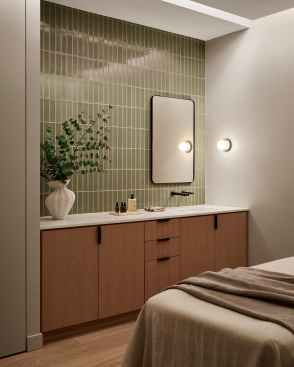
1290 Avenue of the Americas, Image 51, New York, NY View of wellness center's treatment rooms completed by geometric tile and oak millwork to create a soothing environs. Interior Design, FF+E and Art Curation by Fogarty Finger; Photography: David Mitchell.
The most effective amenities are often invisible: a frictionless booking system for a wellness room, a staff member who understands how you like a meeting room set up, a barista who remembers your order. These are not design features in the traditional sense, but they are increasingly what tenants are paying for.
Architecture is no longer just delivering space. It is delivering service.
Designing for Real Life
The most revealing moment in any project comes after completion, when people begin to make spaces their own.
A quiet lounge becomes a brainstorming zone. A circulation corner turns into a gathering point. Furniture migrates. Boundaries dissolve.
The instinct is often to correct this behavior—to reinforce the intended use. But the most successful spaces tend to allow for a broader range of use.
The most successful amenity spaces are designed with the expectation that they will be
reinterpreted. They are resilient, not precious. Materials can withstand constant change.
Infrastructure supports reconfiguration. Spaces invite people to make them their own.
Control has given way to adaptability.
RESIDENTIAL: THE HOTELIZATION OF DAILY LIFE
Buildings That Never Turn Off
Residential amenities have undergone a similar transformation—but with even higher
expectations.
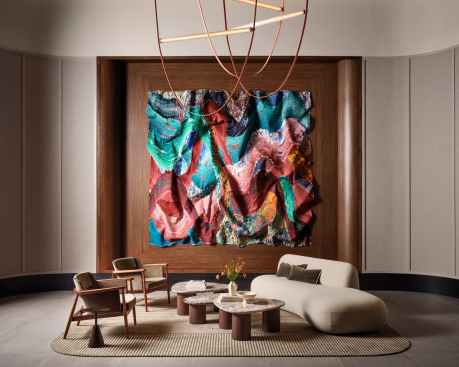
Linea, Charlotte, NC Open lounge with varied seating arrangements and a custom art installation, activating the residential lobby as a shared social space. Interior Design, FF+E and Art Curation by Fogarty Finger; Photography: David Mitchell.
Many multifamily buildings now operate less like housing and more like boutique hotels. The distinction is not aesthetic; it is operational.
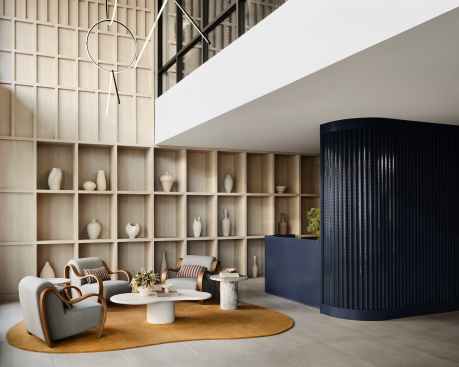
Amenities—once secondary—are now the most important spaces in a building. As work and life blur, architecture is shifting from static design to dynamic, service-driven environments centered on experience. Project: Surfhouse, Asbury Park, NJ. Reception area defined by custom millwork, integrated display shelving, and sculptural light fixtures, establishing a composed arrival sequence within the ground-up rental property. Interior Design, FF+E and Art Curation by Fogarty Finger; Photography: David Mitchell.
Lounges, coworking spaces, fitness areas, and terraces are no longer occasional-use perks. They are active from early morning to late evening. They must perform continuously.
With that level of use, design alone is insufficient. Programming and service become central.
In one Atlanta building, a concierge with a background at the Ritz-Carlton arranged a birthday dinner for a resident with a James Beard Award–winning chef, recreating a meal from a trip to Tokyo. The resident later gave him a bow tie to add to his collection.
This is not just hospitality—it is relationship-building. And increasingly, it is something people expect.
From Amenity to Community Infrastructure
The most effective residential amenities are becoming more tailored to how people actually want to spend their time—often in highly specific, even niche ways.
Amenities—once secondary—are now the most important spaces in a building. As work and life blur, architecture is shifting from static design to dynamic, service-driven environments centered on experience.
Podcast studios. Ceramics rooms. Mahjong lounges. Listening rooms.
These are not novelties. They are signals. They suggest that a building understands not just how people live, but how they want to spend their time—and who they want to be in those moments.
On a recent project, a model unit was furnished entirely with work by local Atlanta artists and designers. The response was immediate. Residents didn’t just admire the pieces—they bought them. The building began hosting artist talks. The amenity space became a cultural platform.
This is where amenity design is heading: away from generic luxury, toward localized identity.
The Rise of “Analog Living”
At the same time, there is a growing resistance to the digital saturation of everyday life.
Residents are increasingly drawn to spaces that remove them from it.
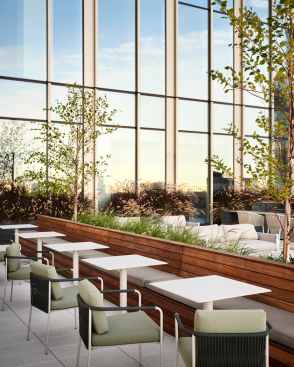
Private Terrace, Image 02, New York, NY Dedicated outdoor private space designed for activity and reflection, sans wifi. Architecture and Interior Design, FF+E and Art Curation by Fogarty Finger; Photography: David Mitchell
Technology-free zones. Meditation rooms. Infrared saunas. Listening lounges.
In one project, a client requested an outdoor area with no Wi-Fi—explicitly designed for reading
and disconnection. In a hyper-connected environment, the absence of technology becomes a luxury in itself.
Amenities are no longer just about activation. They are also about retreat.
Where It All Converges
The distinction between workplace and residential amenity is dissolving.
Offices are adopting the softness, comfort, and social programming of residential environments.
Residential buildings are incorporating spaces for work, productivity, and collaboration.
Both are converging on the same idea: a building is no longer a static container. It is a dynamic
environment that must support a full range of human activity—often within a single day.
The most successful projects understand this.
They are not designed as a collection of spaces, but as a continuous experience—one that evolves, adapts, and, crucially, responds to the people inside it.
When architecture, service, and programming align, amenities stop feeling like additions.
They become the building itself.
Continue the conversation at Elevate this December in Miami.
Join the industry’s top architects, developers, and brokers exploring what’s next in high-rise living at ARCHITECT’s Elevate Conference.