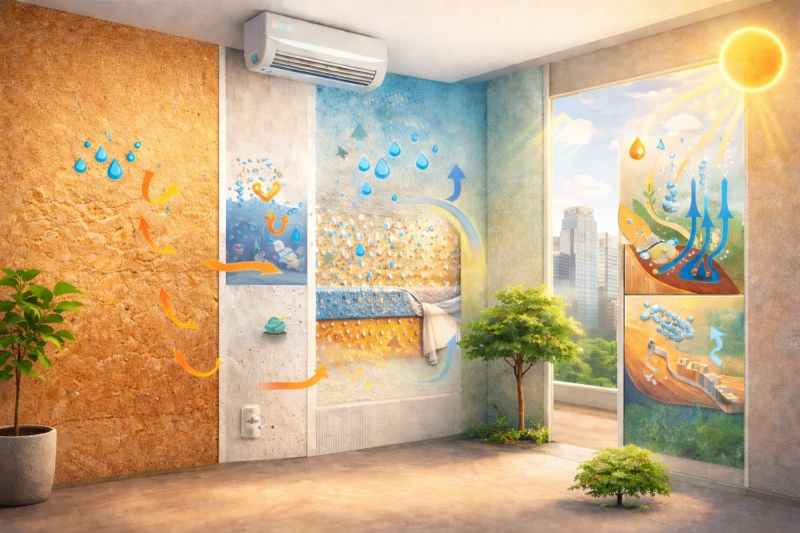
Throughout the preindustrial history of buildings, architectural surfaces were not inert but active participants in regulating climate. Long before the advent of mechanical systems, clay plasters, lime washes, and other capacious finishes absorbed and released moisture, moderated heat, and buffered climatic swings. In this way, premodern surfaces were more resilient than we remember.
The 20th century undermined this approach. HVAC systems and industrial products encouraged buildings to become isolated from the outdoor environment. Facades became largely hermetic and impermeable, making buildings reliant upon mechanical conditioning for occupant health and comfort. Indoor surfaces were stripped of their climate-regulation function.
However, the situation is changing once again. Confronting increasing energy costs, climate volatility, mechanical system limitations, and underappreciated human health needs, architects and materials scientists are revisiting the idea of the architectural surface as a climatic interface.
A new generation of paints, coatings, and thin surface treatments reveals the untapped superpowers of indoor walls and ceilings to modulate temperature and moisture, reducing pressure on HVAC systems and allowing facades to breathe again.
One category of surfacing products reimagines old technology. Cornwall, UK-based Clayworks manufactures clay plasters in a direct lineage from premodern architecture. The finishes are hygroscopic, meaning they absorb excess moisture from the air when the air is humid and release it when the air is dry. The hygroscopic capacity of unfired clay, at 52 kg/m3, is significant in contrast with other interior finishes.
By comparison, gypsum plaster’s capacity is about 10%, at 5.1 kg/m3, while the capacity of typical interior paint is zero. Clayworks’ unfired surfaces have inherent moisture-regulation capabilities, thus helping maintain relative humidity (RH) levels in the optimal range of 40-60%.
Standard paint’s lack of hygroscopic capacity points to an obvious innovation opportunity. Lilypad was developed to meet this need. Like clay plaster, this next-generation paint regulates indoor moisture (it is the only latex-based paint that does so, according to the manufacturer, Adept Materials). The material employs so-called “Vaporwisp” technology that functions like the desiccant packets in vitamin bottles, utilizing both a sponge-like paint layer and a regulating primer layer to attain optimal RH levels.
After application, a single gallon of Lilypad paint can store a soda can’s worth of water, according to the company. The paint’s moisture regulation directly influences thermal comfort as well, since the paint “sweats” during rising temperatures to cool its environment, or buffers the cold by trapping moisture during falling temperatures.
Ongoing research on humidity-moderating surfaces includes zeolite composite coatings. Like the Vaporwisp approach, these microporous minerals are effective at moisture regulation. However, zeolite is an adsorbent, meaning that moisture adheres to its surface rather than being stored within the material.
Unlike traditional regulating surface treatments, zeolite-based systems are tunable, allowing the coating pore size and adsorption capacity to be customized for specific climatic conditions. This surface-as-system approach is particularly useful for mobile partitions, such as those used in disaster relief shelters or in passive design strategies where no HVAC is provided.
Cutting-edge explorations are exemplified by technologies such as nanofibrous moisture pump membranes. These multilayered membranes follow a biomimetic approach to moisture transport, emulating how trees circulate water via transpiration. The composite further emulates trees by featuring an outer photothermal layer that harnesses solar energy to drive water evaporation from the desiccant layer, which stores the moisture.
Like the zeolite coatings above, this material also adopts the functionality of a mechanical system—but in a different way. The nanofibrous membrane (NMF) operates as a moisture pump (similar to a heat pump), transporting water from low-humidity to high-humidity environments via thermo-osmosis. As a result, in sunlight, the material can maintain a comfortable maximum RH of 60%.
Collectively, these innovations represent a technological reconsideration of the architectural surface. Walls are no longer merely dividers but reservoirs of moisture and energy. As mentioned above, this paradigm was common in premodern construction.
However, the resurgence of this strategy has not only revived past material practices but also spurred unprecedented technical achievements. Whether low- or high-tech in their material approach, humidity-regulating coatings demonstrate that architectural surfaces are multifunctional and performative—moderating climate extremes, reducing operating energy costs, and enhancing human health and comfort.