For more than three decades, Hella Jongerius has resisted the easy narratives of contemporary design—efficiency, scalability, perfection—and instead built a body of work rooted in imperfection, tactility, and doubt. Now, a major retrospective at the Vitra Design Museum is making a more provocative claim: that Jongerius may be one of the most quietly subversive designers of her generation.
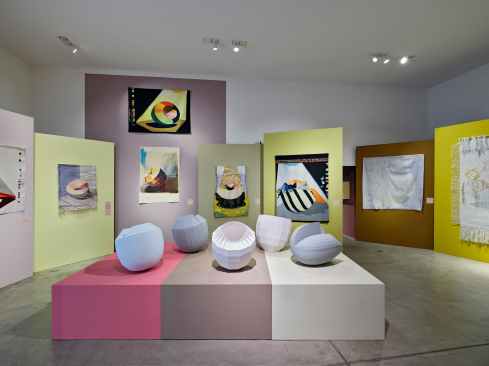
Titled Hella Jongerius: Whispering Things, the exhibition—on view from March 14 to September 6, 2026—positions her work not simply as product design, but as a sustained critique of how and why objects exist at all. It is the first comprehensive retrospective of her career, bringing together more than 400 works, from early experiments to recent sculptural pieces, alongside archival materials, sketches, and films. (More information via the Vitra Design Museum exhibition page.)
But the show’s central provocation is less about what Jongerius has made than what she is asking: “What does it mean to design in a world that already has enough? How can objects embody appreciation and care rather than consumption and waste?”
These questions hover over the exhibition like a quiet indictment of the design industry itself.
Against the Machinery of More
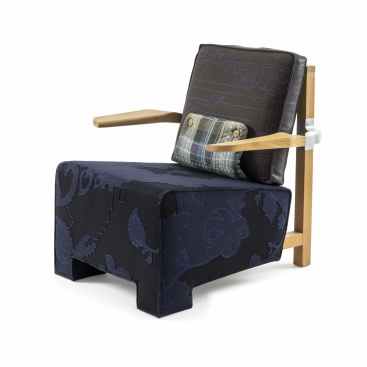
Jongerius emerged in the 1990s as part of the Dutch avant-garde collective Droog Design, a movement that rejected polished modernism in favor of conceptual, often rough-hewn work (see Droog’s archive and early projects).
From the beginning, her practice occupied a liminal space—between craft and industry, between prototype and product, between usefulness and meaning.
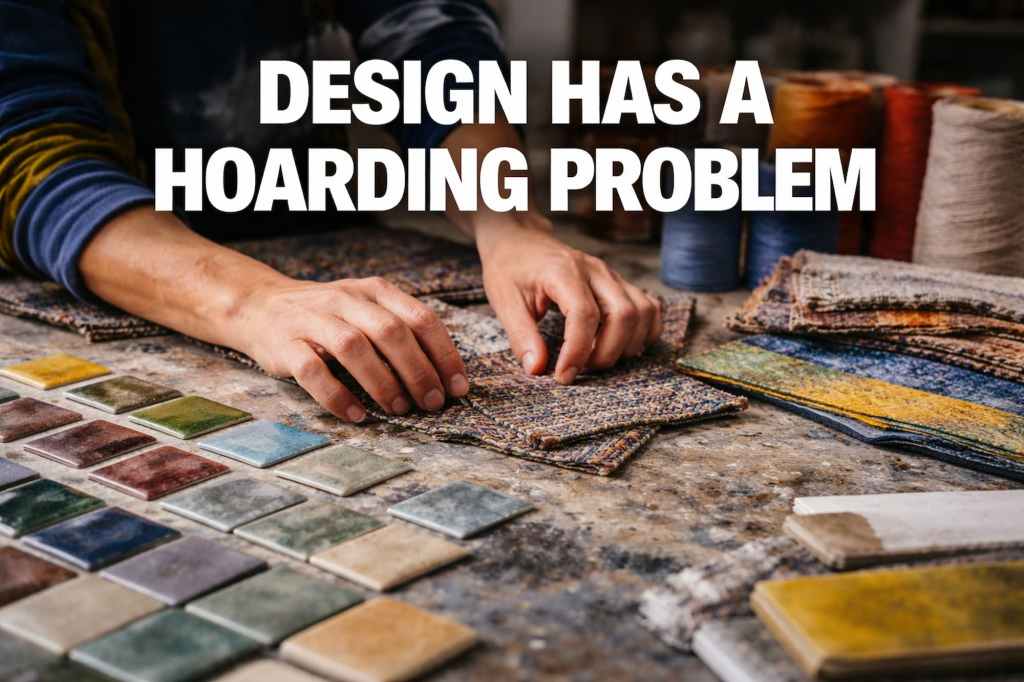
That tension defines the exhibition’s first section, Dirty Hands, which revisits her early years. Here, ceramics, textiles, and furniture are presented alongside a video montage of the designer’s hands at work—an insistence on the physicality of making in an era increasingly defined by digital abstraction.
The message is clear: design, for Jongerius, is not a frictionless process. It is labor, experimentation, and, crucially, imperfection.
A Manifesto Against Design as Usual
If the retrospective frames Jongerius as a critical voice, her own words have made that position unmistakable. In her widely circulated manifesto, Beyond the New—developed with design theorist Louise Schouwenberg—Jongerius issued a direct challenge to the discipline: stop chasing novelty for its own sake (full manifesto available via the Jongeriuslab website and design publications).
Instead, she called for a fundamental reorientation toward durability, material intelligence, and cultural meaning. The manifesto argues that design has become trapped in a cycle of superficial innovation—endless newness without depth—and urges designers to “add quality, not quantity” to the built environment.
Seen through this lens, Whispering Things is not just a retrospective; it is a built argument, a spatial extension of that manifesto’s central claim that design must slow down, look closer, and take responsibility for what it puts into the world.
Inside the Corporate Machine—Without Being Consumed by It
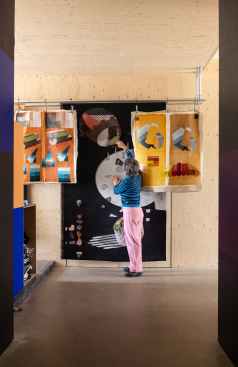
If Jongerius’s early work established her as a critical voice, her later collaborations with global brands complicated that narrative. She has worked with companies including Maharam, IKEA, Nike, Camper, KLM, and Vitra—hardly fringe actors (see product collaborations across brand archives).
Yet the exhibition’s second chapter, Business Class, reframes these partnerships not as compromises but as sites of negotiation. Rather than showcasing polished end products, the gallery foregrounds process: sketches, samples, prototypes, and correspondence.
What emerges is a portrait of a designer who enters industrial systems not to streamline them, but to interrogate them—raising questions about authorship, material integrity, and responsibility.
In this sense, Jongerius’s corporate work becomes something else entirely: a form of embedded critique.
Color as Instability, Not System
The third gallery, Feeling Eye, shifts focus to one of Jongerius’s most sustained investigations: color. But here again, she resists convention.
Instead of treating color as a fixed system—Pantone-perfect and endlessly reproducible—Jongerius approaches it as something relational, unstable, and deeply contingent (see Jongeriuslab color studies and research projects).
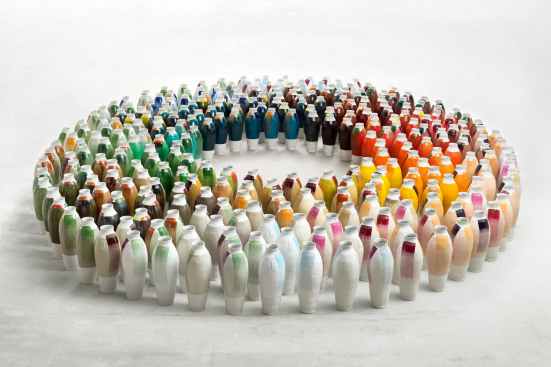
A monumental installation of approximately 300 Coloured Vases anchors the space, alongside experimental textiles and paper studies.
The work suggests that color is not a property of objects but an event—something that shifts with light, context, and perception.
It is a subtle but radical departure from the industrial logic of standardization.
Toward a Post-Human Design Ethic
The exhibition’s final section, Cosmic Mind, expands Jongerius’s inquiry beyond human-centered design. Sculptural works like the Frog Table and the Angry Animals—developed through Jongeriuslab—gesture toward a broader ecological and philosophical framework (see Jongeriuslab project archive).
Here, design becomes speculative, even metaphysical. The Space Amulets, created in the aftermath of the pandemic, introduce a talismanic dimension, while kinetic woven works animate the gallery walls.
The effect is immersive, almost disorienting—a deliberate move away from the clarity and control typically associated with design exhibitions.
Instead, Jongerius invites ambiguity. Objects, in this world, do not simply serve; they speak, resist, and coexist.
A Retrospective That Questions the Retrospective
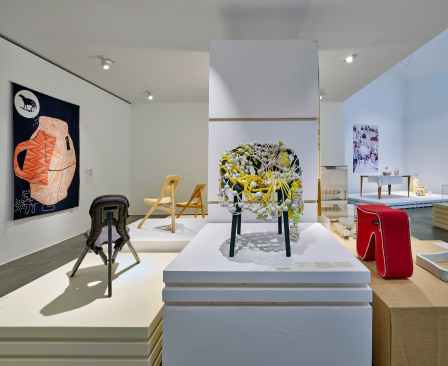
If Whispering Things functions as a survey of Jongerius’s career, it also undermines the very idea of retrospective as celebration. At a moment defined by “conflict, excessiveness and constant distraction,” the exhibition feels less like a victory lap and more like a warning.
Jongerius has long resisted prevailing trends, and her work can be “at times deliberately challenging, breaking with conventions; at the same time, it derives its meaning from a virtuosity in the handling of materials and techniques that is unmatched in contemporary design.”
That tension—between mastery and refusal, between making and questioning—may be what makes her work so resonant now.
Design After Enough
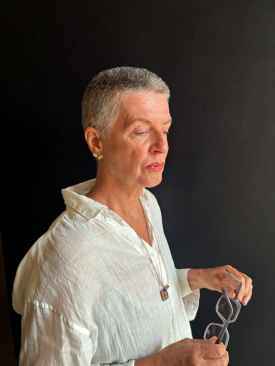
Hella Jongerius.
Ultimately, Hella Jongerius: Whispering Things lands on a question that feels increasingly urgent for architects and designers alike: What is the role of design in a world already saturated with objects?
Jongerius does not offer easy answers. Instead, she proposes a shift in attitude—from production to care, from consumption to attention.
If design has long been about solving problems, her work suggests a different task: learning to listen.
Or, as the exhibition title implies, to hear the quiet, persistent voices of things themselves.