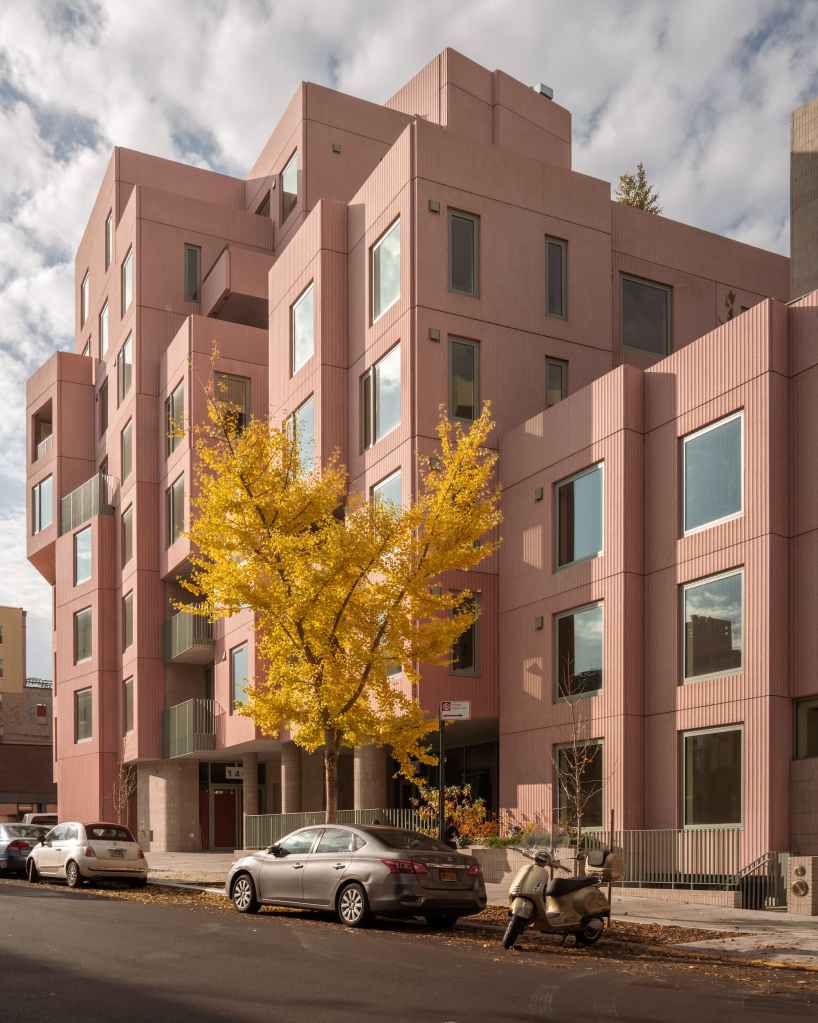
In a city where residential architecture too often defaults to glass repetition or nostalgic mimicry, a new building in Fort Greene is doing something far more deliberate: it is attempting to choreograph not just space, but behavior.
At the corner of Vanderbilt and Myrtle Avenues, 144 Vanderbilt—designed by SO–IL and developed by Tankhouse—has already been framed as a material and formal outlier. But its more ambitious move lies inside, where a dense network of collaborators transforms the building into something closer to a living design platform than a conventional condominium.
This is not staging. It is strategy.
A façade that performs—and sets the terms
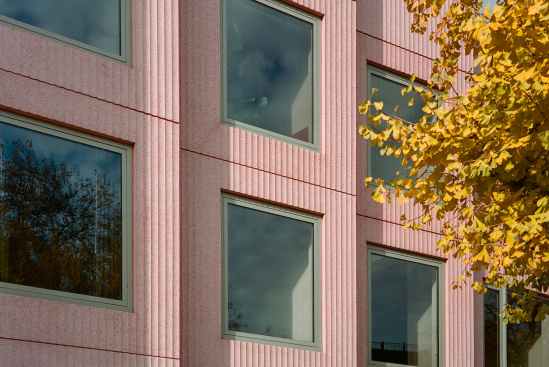
Photo by Valeria Flores.
Wrapped in bespoke pink precast concrete, the building reinterprets Fort Greene’s red-brick context through tone rather than imitation. The scalloped panels—acid-washed and sandblasted to expose aggregate—catch light unevenly, producing a façade that shifts throughout the day.
It is architecture as surface choreography. But it also establishes the project’s underlying premise: that material, perception, and experience are inseparable.
Inside, that logic continues—less through form than through objects, systems, and, increasingly, markets.
Designing the lobby as infrastructure
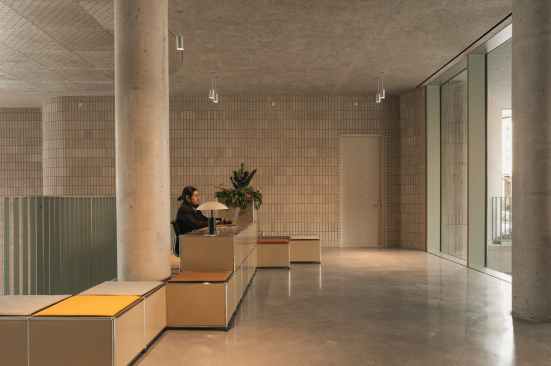
Photo by Valeria Flores.
The most explicit articulation of this approach appears in the lobby, where USM was invited to rethink what a reception desk could be.
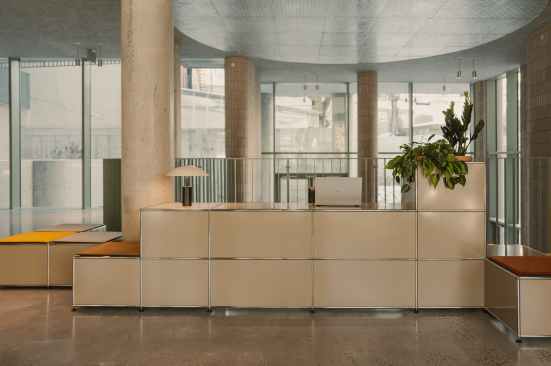
USM Modular furniture. Photo by Valeria Flores.
Rather than inserting a discrete object, USM developed a fully integrated system using its Haller modular framework—finished in a custom USM Beige that subtly echoes the building’s pink-toned exterior. The installation merges reception, seating, storage, planters, and shelving into a single continuous piece.
It is furniture, but also architecture. Infrastructure, but also identity.
The desk organizes how residents move, pause, and interact. It establishes a social center without declaring itself as one. And in doing so, it demonstrates a larger ambition: to dissolve the boundary between building and object.
The domestic showroom—and the normalization of design consumption
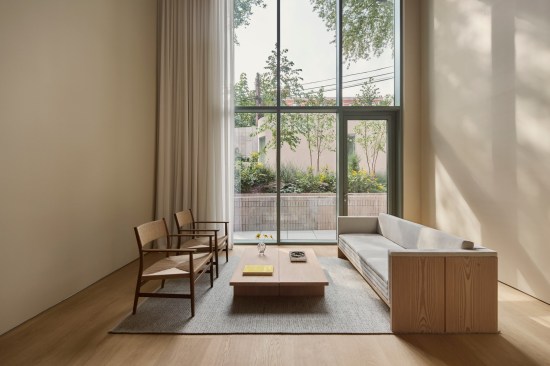
Dinesen Apartment by David Thulstrup. Photo by Eric Petsche.
Inside the townhouse residence, developed with Dinesen and architect David Thulstrup, that ambition becomes more explicit.
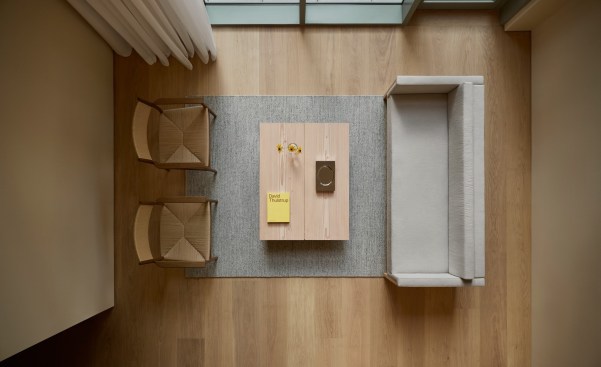
Dinesen Apartment by David Thulstrup. Photo by Eric Petsche.
Wide-plank wood flooring, continuous millwork, and carefully staged furnishings create an interior that functions simultaneously as a home and a showroom. Objects are not just used—they are framed, contextualized, and made legible as design choices.
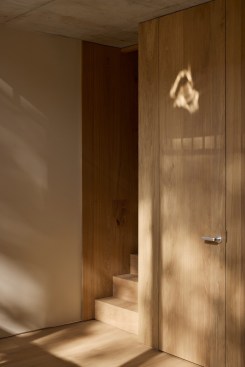
Dinesen Apartment by David Thulstrup. Photo by Eric Petsche.
This is where the building’s underlying thesis begins to emerge: that living in architecture can be an act of curatorial participation.
From curated space to active marketplace
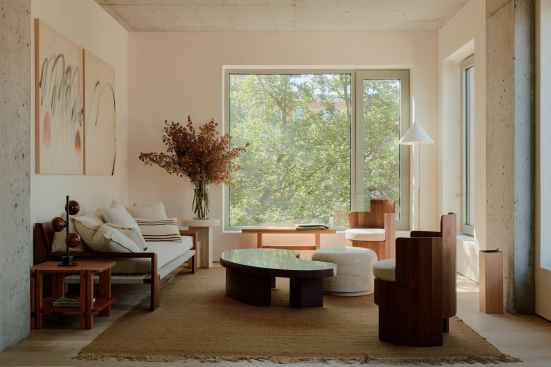
The Residence at 144 Vanderbilt is an Assembly Line showroom, that was designed by General Assembly. Photo courtesy William Jess Laird.
Nowhere is that thesis more fully realized than in the building’s evolving partnership with Assembly Line, the retail arm of General Assembly.
What began as a by-appointment, shoppable gallery embedded within the building has quietly become one of its most consequential features—not because of how it looks, but because of what it does.
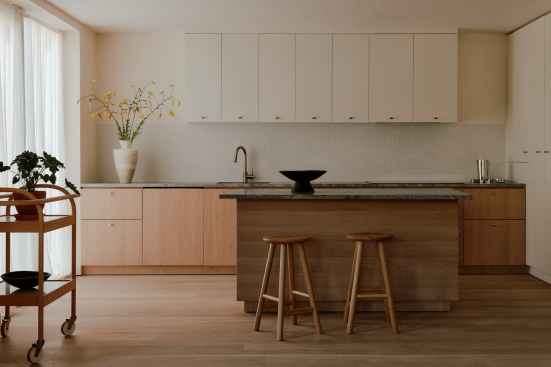
The initial model residence and gallery space featured a tightly curated selection of handcrafted pieces from New York City and Brooklyn-based makers, including Armadillo, Bowen Liu, Fort Standard, Pat Kim, and Sugihara Fine Furniture.
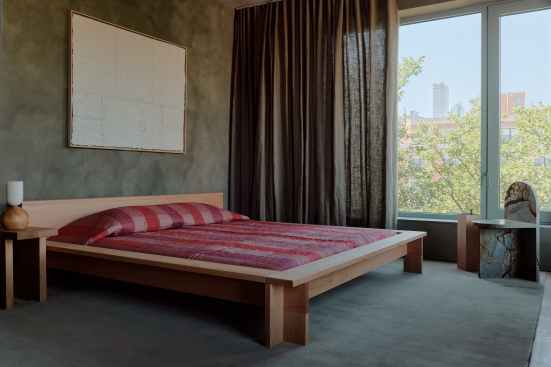
Unlike typical staging—where furniture is presentational and disposable—these pieces were intended to be lived with, purchased, and, crucially, integrated into the residents’ own environments.
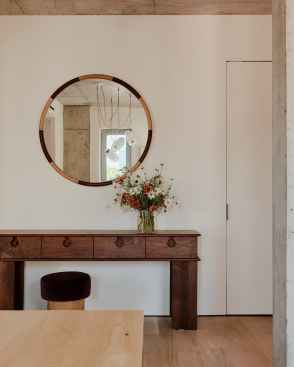
The results are unusually concrete. The results are unusually concrete. Roughly half of the building’s residents have incorporated General Assembly’s Assembly Line pieces into their homes. Several have gone further, commissioning custom work directly from the designers featured in the space.
This is not incidental uptake. It is behavioral design.
The building doesn’t just present objects; it creates the conditions under which residents form relationships with them—first as viewers, then as users, and finally as clients.
Architecture as a generator of demand
That feedback loop is now being formalized. Assembly Line is developing its third shoppable showroom within 144 Vanderbilt, expanding both the roster of designers and the scope of the initiative.
The next iteration will include work from Kalon Studios, In Common With, Steven Bukowski, Yuxuan Huang, and Juntos Projects, among others.
What is emerging is something closer to an embedded design economy—one in which the building itself functions as a platform for production, distribution, and consumption.
For developers, this suggests a new revenue-adjacent model. For designers, it offers direct access to a highly engaged audience. And for residents, it reframes the act of furnishing a home as participation in a curated ecosystem.
Curating work—and how we work
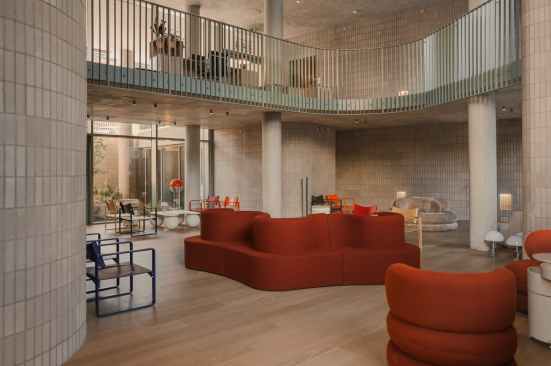
Co-working space with furniure by Verso. Photo by Valeria Flores.
This logic extends into shared spaces as well. The co-working environment, curated by VERSO with pieces from Verpan, resists the neutrality of conventional office design. Instead, it positions work as an aesthetic experience, shaped by color, form, and material presence.
Outdoors, MillerKnoll extends the residential environment through furnishings from Design Within Reach, dissolving the boundary between interior and exterior life.
Across these spaces, a consistent strategy emerges: to eliminate the gap between architecture and the objects that animate it.
A different model for residential architecture
What 144 Vanderbilt ultimately proposes is not just a new formal language, but a new operational one.
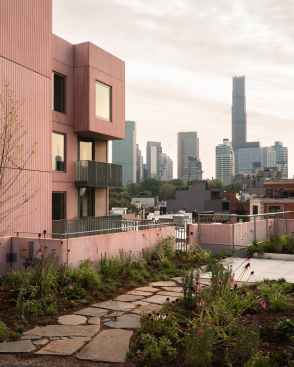
Photo by Valeria Flores.
It suggests that residential buildings can do more than house people—they can shape taste, foster relationships between residents and designers, and even generate economic activity.
In this model, architecture becomes less a finished product and more an active participant in a broader cultural and commercial network.
Architecture that changes behavior
There is a risk, of course, that such a tightly curated environment could feel overly controlled. But 144 Vanderbilt mitigates this through its material looseness and spatial openness—the shifting façade, the porous circulation, the visible life of the building.
What it offers instead is a framework: one that encourages engagement without prescribing it.
And in doing so, it raises a more provocative question for architects and developers alike:
This Building Doesn’t Just House You—It Sells to You.
Continue the conversation at Elevate this December in Miami.
Join the industry’s top architects, developers, and brokers exploring what’s next in high-rise living at ARCHITECT’s Elevate Conference.