On most state capitol campuses, buildings are treated as monuments—fixed, permanent, and resistant to change. In Olympia, Washington, the opposite has just occurred.
The Newhouse Replacement Building, designed by The Miller Hull Partnership as part of the state’s Legislative Campus Modernization initiative, is not simply a new government office building. It is a deliberate rethinking of what civic architecture can be when permanence is no longer assumed, when materials are treated as part of a lifecycle, and when sustainability is measured not just in performance metrics, but in cultural continuity.
Originally constructed in 1934 as a temporary structure, the former Newhouse building endured for nearly 90 years—far beyond its intended lifespan—before mounting life-safety and seismic concerns made replacement unavoidable. The typical response in such cases is demolition, followed by a clean break with the past.
Miller Hull chose a different path.
Building by Unbuilding
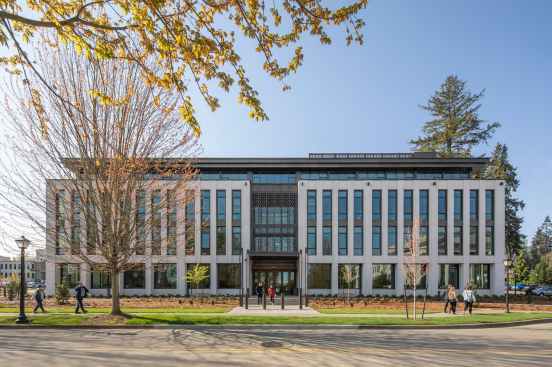
Photo courtesy Lara Swimmer.
Rather than erase the original structure, the design team approached the project as an act of deconstruction—carefully dismantling the old building and salvaging its materials for reuse.
Marble, sandstone, and interior glass panels from the 1934 building were reincorporated into the new structure, embedding fragments of the past within a contemporary civic workplace. Timber from the historic Carlyon and Ayer Press Houses—once home to the Capitol Press Corps—was also salvaged and reintroduced, ensuring that even buildings that could not be physically preserved continue to shape the campus.
The result is not nostalgia. It is continuity.
The Newhouse Replacement Building “redefines the intersection of history and progress on Washington State’s historic Capitol Campus, creating a civic workplace where past meets present, state meets citizenry, and place meets policy.”
That ambition is visible not only in the building’s materials, but in its architectural language. While the structure maintains a dialogue with the campus’s neoclassical context—through its proportions, geometry, and rhythmic façade—it simultaneously introduces a distinctly contemporary sensibility grounded in environmental performance and material innovation.
A New Standard for Civic Sustainability
If the building’s relationship to history is carefully calibrated, its approach to sustainability is unapologetically forward-looking.
LEED Platinum certified, Newhouse is designed to be net-zero ready, anchored by a 90-kilowatt rooftop photovoltaic array that supplies approximately 20 percent of its energy demand. Its all-electric systems and high-performance envelope drive an energy use intensity of just 19—more than a 75 percent reduction compared to baseline expectations.
But the building’s most significant contributions may lie in how these systems are integrated into everyday experience.
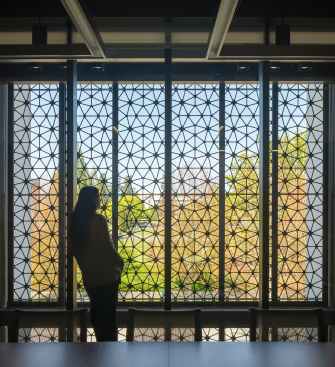
Photo courtesy Lara Swimmer.
Operable windows in every office allow occupants to engage directly with the environment, reintroducing natural ventilation into a building typology that has long prioritized mechanical control. A green roof extends both ecological performance and visual connection, transforming the building’s upper levels into a vantage point for engaging with the surrounding landscape.
Even the supply chain becomes part of the sustainability strategy. Nearly all materials—from exterior cladding to interior finishes—were sourced within Washington State, reinforcing both environmental and economic priorities.
Mass Timber as Policy, Not Just Material
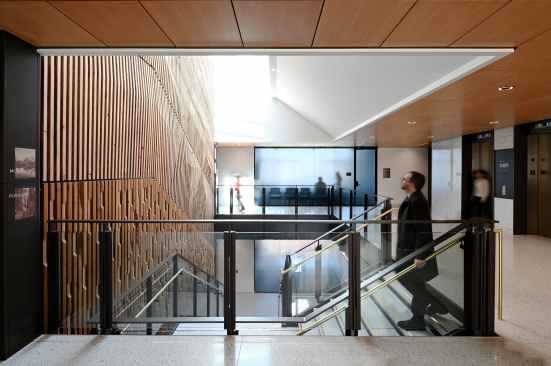
Photo courtesy The Miller Hull Partnership.
In a region defined by its forests, the use of mass timber is both practical and symbolic.
The building prominently features locally sourced Douglas fir, leveraging one of Washington’s most abundant natural resources while advancing a low-carbon construction strategy. But Newhouse goes beyond the now-familiar narrative of timber as a sustainable alternative to steel and concrete.
Its structural system incorporates Acoustic Dowel Laminated Timber (ADLT) floor decks—an innovative assembly that replaces adhesives with precision-milled wood joinery and integrates acoustic insulation directly into the material system.
With this approach, Newhouse becomes the first known building to deploy an ADLT assembly that eliminates “all known chemicals of concern, including substances like formaldehyde commonly found in conventional acoustic insulation.”
The implications extend beyond material selection. The system delivers high acoustic performance while reducing embodied carbon and avoiding harmful substances—suggesting a new baseline for what “healthy” building materials can mean in civic architecture.
Architecture as Civic Infrastructure
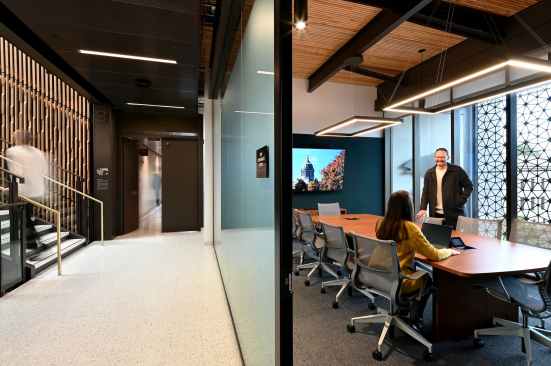
Photo courtesy The Miller Hull Partnership.
For all its technical innovation, the Newhouse Replacement Building is ultimately defined by how it functions as a place of governance.
The four-story structure houses Senate suites, caucus offices, public meeting areas, and educational spaces that support Washington’s legislative Page Program. These students—recognizable by their green blazers—participate directly in the legislative process, and Newhouse is designed to make that experience more visible, accessible, and integrated into the life of the building.
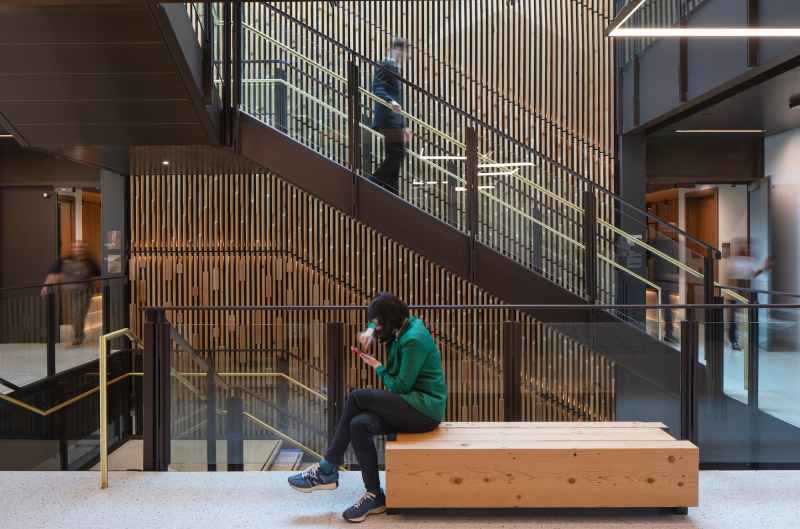
At the center of this program is the “Mixing Chamber,” a four-story skylit stair that serves as both circulation and social infrastructure. More than a passageway, it is a space of encounter—where legislators, staff, students, and the public intersect.
This is architecture as democratic instrument.
Anchoring the space is a four-story art installation constructed from reclaimed Douglas fir, its undulating forms representing Washington’s five primary landscapes: water, the rolling hills of the Palouse, the arid plateau, forests, and mountains. Each panel retains its raw edges, preserving the material’s history while transforming it into a new collective symbol.
As occupants move through the building, the installation becomes a vertical narrative—linking the state’s geography, its resources, and its governance in a single spatial experience.
Rethinking Permanence
What makes the Newhouse Replacement Building remarkable is not any single feature, but the way it reframes the expectations of civic architecture.
It suggests that buildings do not need to be static monuments to endure. They can evolve, adapt, and even be partially dismantled without losing their identity. They can be both historically grounded and materially experimental. They can serve the present while acknowledging the past—and anticipating a future in which resources are finite and adaptability is essential.
In this sense, Newhouse is less a replacement than a transformation.
It takes a building that was never meant to last and turns it into a model for how architecture might persist—not through permanence, but through continuity.
And in doing so, it quietly raises a more provocative question for public architecture in the United States:
What if the most responsible buildings are not the ones that stand forever—but the ones designed to change?