For years, the narrative surrounding artificial intelligence has been simple: the more technology shapes the workplace, the more solitary work becomes. But a sweeping new global study suggests the opposite may be happening.
According to the 2026 Global Workplace Survey released by the Gensler Research Institute, the employees most deeply embedded in AI tools are also the most connected to their teams. Far from isolating workers, artificial intelligence appears to be reshaping the workday in ways that amplify collaboration, learning, and interpersonal engagement.
The findings challenge one of the most persistent assumptions about digital transformation: that automation inevitably diminishes human interaction.
“We often assume that more technology means less connection,” said Janet Pogue McLaurin, Global Director of Workplace Research at Gensler. “But our data tells a different story. The employees most embedded in AI workflows are also the ones most engaged in learning and have better team relationships. That shift signals a new and important role for the workplace.”
The survey—one of the largest studies of workplace behavior ever conducted—collected responses from more than 16,400 office workers across 16 countries. It also builds on a dataset accumulated over two decades, bringing the total number of respondents analyzed by the research institute to nearly 125,000 people worldwide.
What emerges from that longitudinal data is a portrait of a workplace not disappearing under the pressure of technology, but evolving into something more collaborative.
The Rise of the AI Power User
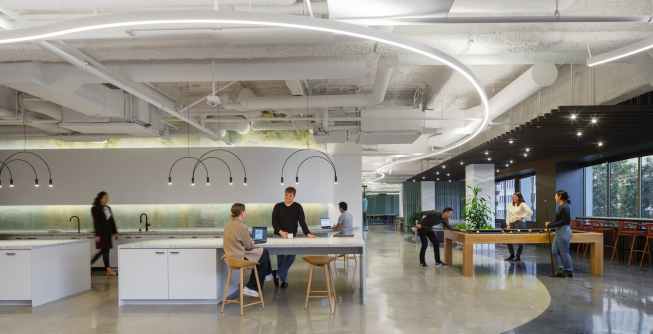
BGO 475 Sansome Amenity Suite, Photo: Jason O’Rear, Courtesy Gensler.
Central to the study is the emergence of a new worker profile: the AI Power User.
About 30 percent of employees surveyed now fall into this category—people who regularly use AI tools in both their professional and personal lives. These workers are not simply early adopters experimenting with new software; they are integrating AI into the rhythms of daily work.
And their work patterns look markedly different.
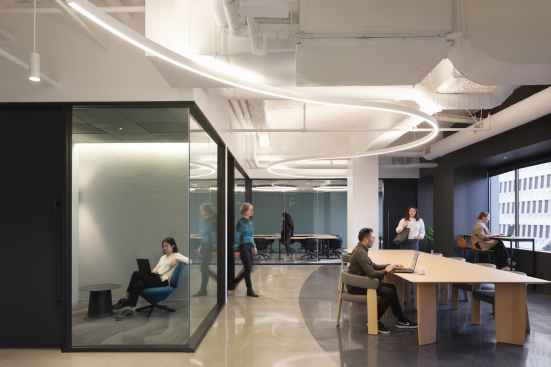
BGO 475 Sansome Amenity Suite, Photo: Jason O’Rear, Courtesy Gensler.
Compared to colleagues who have been slower to adopt AI tools, power users report spending less time working alone—about 37 percent of their workweek, compared to 42 percent for late adopters.
At the same time, they spend more time learning and developing skills, dedicating about 12 percent of their workweek to learning, compared to 8 percent among others.
Social interaction also increases. AI power users report spending 11 percent of their time socializing with colleagues, compared to 9 percent among peers.
In other words, the workers most immersed in advanced technology are not withdrawing into digital silos. They are interacting more—with ideas, with new knowledge, and with each other.
Automation Is Making Room for Human Work
One explanation for the shift is straightforward: AI appears to be offloading certain routine tasks, freeing time for activities that require human judgment and social exchange.

Opella, Photo: Robert Deitchler, Courtesy Gensler.
Rather than replacing people, the technology is reshaping how they allocate attention.
As repetitive tasks shrink, workers gain more space for reflection, mentoring, creative problem-solving, and skill development. The workday becomes less about solitary execution and more about collaboration and learning.
That shift has profound implications for how organizations design both workflows and physical workplaces.
If AI is increasing the importance of human interaction, then environments that support focus, collaboration, and knowledge exchange become even more critical.
The Office Isn’t Dead—It’s Stabilizing
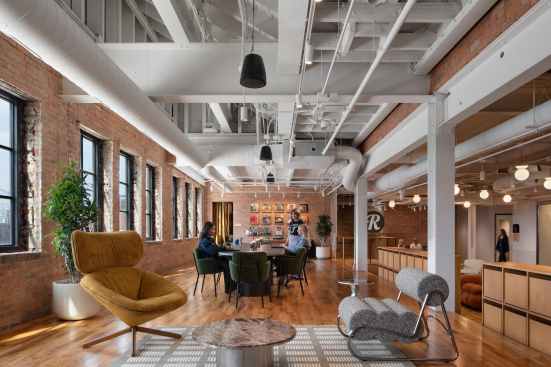
Reverb at The Salt Shed, Photo: Gillian Fry, Courtesy Gensler.
The survey also offers new clarity on another topic that has dominated workplace debates since the pandemic: the fate of the office.
After years of predictions about a permanent shift toward remote work, attendance patterns appear to have stabilized.
Employees now spend about 55 percent of their workweek in the office, according to the survey. Another 18 percent is spent working from home, while 26 percent takes place in other locations, including coworking spaces, client sites, or while traveling.
More striking, however, is what workers say they want.
When asked about their ideal arrangement, respondents reported wanting to spend even more time in the office than they currently do—provided the workplace supports how they actually work.
The finding suggests that demand for physical workplaces remains strong. The question is no longer whether offices will exist, but what kind of environments they must become.
The Workplace Is Falling Behind
If workers want the office, many also feel that today’s offices are not keeping pace with evolving work patterns.
The survey reveals a persistent mismatch between how employees work and the environments designed to support them.
Workers report spending 39 percent of their time working alone and 27 percent collaborating in person. Yet many workplaces struggle to accommodate either activity effectively.
Two-thirds of respondents say they have had to “hack” their workspace to compensate for shortcomings.
The fixes range from improvised ergonomic adjustments to makeshift solutions for temperature control, lighting, or visual privacy. Meeting rooms remain scarce in many offices, while noise continues to disrupt concentration.
In some cases, the adjustments are literal do-it-yourself interventions: one in four employees report creating their own workarounds to make their environment usable.
These problems are not trivial inconveniences. The survey shows that employees working in high-performing environments are far more likely to say their workplace enables their best work, that they feel valued by their organization, and that they intend to stay.
In other words, workplace design directly influences productivity, engagement, and retention.
The Next Office Will Be Built Around AI—and People
The deeper message of the survey may be that AI adoption and workplace strategy can no longer be treated as separate conversations.
Digital tools are transforming how work happens. At the same time, those changes increase the value of environments that support human interaction.
The more work becomes automated, the more the remaining tasks depend on collaboration, mentorship, creativity, and learning—activities that thrive in well-designed spaces.
Organizations that treat AI purely as a technology investment may miss the broader transformation underway.
The companies that succeed, the survey suggests, will be those that redesign the workplace to support both the digital tools employees use and the human relationships those tools are reshaping.
In that sense, the rise of AI power users may signal not the disappearance of the office—but its reinvention.
As McLaurin’s research suggests, the most technologically advanced workers may also be the ones most invested in human connection.
And the future workplace will have to be built accordingly.