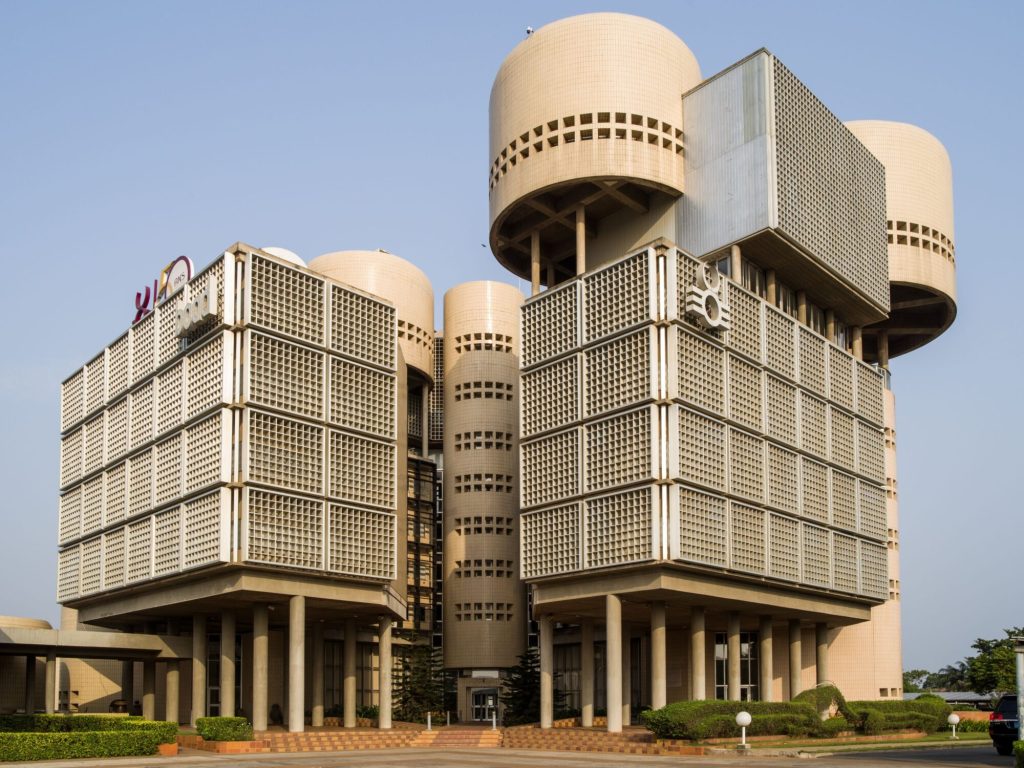
When most histories of modern architecture are written, the story tends to orbit around Europe and North America: Bauhaus experiments in Germany, concrete monuments in France, corporate towers in the United States. But a new exhibition opening this summer at the Museum of Modern Art argues that one of the most politically charged chapters of modern architecture unfolded elsewhere—across the newly independent nations of West Africa.
Architects of Liberation: Modernism in Western Africa, opening July 5, 2026, will be the first major museum exhibition to examine how architecture participated in the political and cultural transformation of the region during the decades surrounding independence. On view through January 2, 2027 in MoMA’s Robert B. Menschel Galleries, the exhibition brings together architecture from Benin, Cameroon, Côte d’Ivoire, Ghana, Nigeria, Senegal, and Togo, framing buildings not simply as aesthetic objects but as instruments of self-determination.
Organized by Martino Stierli, MoMA’s Philip Johnson Chief Curator of Architecture and Design, and guest curator Ikem Stanley Okoye of the University of Delaware, with curatorial associate Mallory Cohen, the exhibition proposes a striking thesis: that modern architecture in West Africa was inseparable from the political ambitions of newly independent states.
“I am thrilled to present Architects of Liberation to our audiences after an intense multi-year research period,” said Stierli. “Our exhibition will shed light on a crucial, under-examined period of African history at mid-century, providing a new perspective on the continent. The stunning works of architecture produced during the independence period are testaments to an extraordinary moment of design innovation and optimism.”
Architecture After Empire
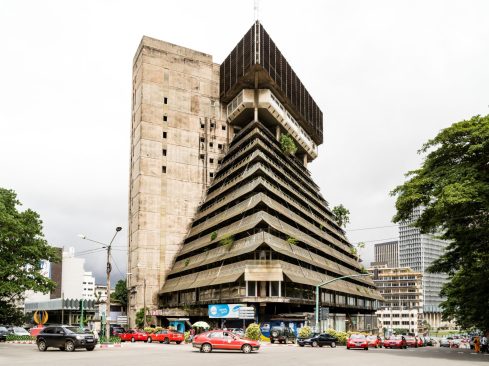
La Pyramide, Abidjan, Côte d’Ivoire. 1968–73. Rinaldo Olivieri (1931–1998). 2025. Photograph: François-Xavier Gbré.
The exhibition situates architecture within a moment of dramatic political transformation.
In 1960—often called the “Year of Africa”—seventeen African nations gained independence from European colonial rule. The new governments that emerged from these movements faced a pressing question: how should a newly sovereign nation represent itself?
Buildings quickly became symbolic tools in answering that question. Ministries, universities, trade fairs, housing estates, and infrastructure projects were commissioned at a remarkable pace, often with the explicit goal of representing national identity, technological progress, and political autonomy.
Architecture therefore became intertwined with broader intellectual movements such as Pan-Africanism and Africanization, which sought to reshape political structures, cultural institutions, and public life after colonialism.
Rather than rejecting modernism outright—an architectural language closely associated with European colonial administration—many architects across the region adapted and transformed it. Concrete structures were redesigned for tropical climates. Monumental civic buildings drew from local spatial traditions. Infrastructure projects were conceived as symbols of modernization and unity.
The exhibition uses the term western Africa loosely to describe the coastal region stretching from Senegal to the eastern reaches of the Gulf of Guinea, emphasizing shared concerns among countries navigating the early decades of independence.
A Forgotten Architectural Boom
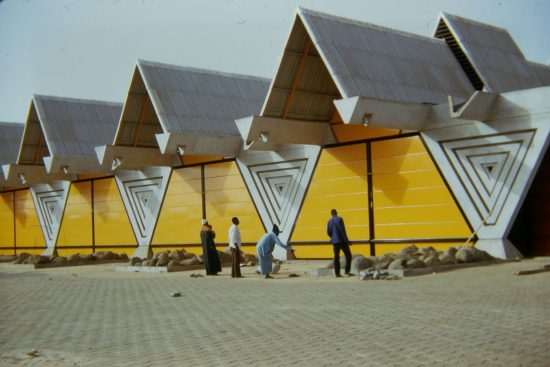
Centre International du Commerce Extérieur du Sénégal (CICES), Dakar, Senegal. 1971–74. Jean-François Lamoureux (b. 1943) and Jean Louis Marin (b. 1943). 1974. Photograph: Michel Fegyveres.
The curators argue that the independence era produced one of the most intense periods of architectural experimentation in the region’s history.
To tell that story, Architects of Liberation assembles approximately 450 objects, including architectural drawings, models, archival photographs, films, and commissioned images, drawn from more than 50 lenders across 17 countries.
The exhibition is the result of four years of research conducted across the region. According to MoMA, the majority of the objects have never been publicly exhibited, and many of the architects included have rarely appeared in exhibitions or scholarly publications.
The exhibition is organized around several thematic entry points—cityscapes, education, and housing—each anchored by projects that reveal how architecture was used to express the aspirations of newly independent nations.
Among the projects featured in the exhibition is the Africa Pavilion at the Accra Trade Fair in Ghana. Designed by Victor Adegbite, Jacek Chyrosz, and Stanisław Rymaszewski and developed by the Ghana National Construction Corporation between 1962 and 1967, the circular pavilion symbolized national unity during the early years of Ghana’s independence.
Another landmark is The Pyramide in Abidjan, Côte d’Ivoire. Designed by Italian architect Rinaldo Olivieri and completed in 1973, the stepped concrete tower dramatically reshaped the skyline of Abidjan, projecting the city’s ambitions as a modern African metropolis.
In Senegal, the CICES trade-fair campus designed by Jean-François Lamoureux and Jean Louis Marin reflected the ideas of President Léopold Senghor, who promoted what he called “asymmetrical parallelism,” an architectural approach that introduced diverse, non-repeating elements to create dynamic harmony.
The exhibition also highlights infrastructure projects such as the Gare de Bessengue train station in Cameroon, designed by Jacques Nsangue Akwa and Emilien Douala Bell, as well as educational projects like the University of Ife in Nigeria, whose master plan was designed by Israeli architect Arieh Sharon.
The First Generation of African Architects
While many international architects were active in the region during this period, the exhibition pays particular attention to the first generation of professionally trained African architects.
Figures such as John Owusu Addo, Cheikh Ngom, Demas Nwoko, and Vic Adegbite played crucial roles in translating global architectural ideas into forms that responded to local climates, cultural traditions, and political aspirations.
Their work demonstrates that the architecture of independence was not merely imported modernism but a hybrid language shaped by regional conditions and national ambitions.
At the same time, the exhibition acknowledges the complex international networks that shaped architecture in the region. Architects from Yugoslavia, Italy, France, and elsewhere—including Zoran Bojović, Henri Chomette, and Rinaldo Olivieri—contributed to projects across West Africa, reflecting Cold War alliances and international development programs.
The resulting architecture was therefore both deeply local and intensely global.
Rewriting the History of Modern Architecture
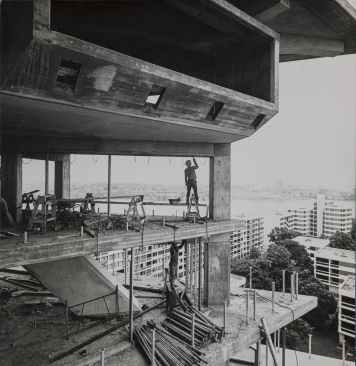
a Pyramide, Abidjan, Côte d’Ivoire. 1968–73. Rinaldo Olivieri (1931–1998). External view. c. 1973. Photograph: Rinaldo Olivieri. Rinaldo Olivieri Archives, Verona.
For decades, much of this architectural history remained marginal within dominant narratives of modernism.
Buildings deteriorated, archives remained scattered, and scholarship often overlooked the region’s architectural production.
Architects of Liberation attempts to correct that imbalance by presenting the independence era as a central chapter in the global history of modern architecture.
The exhibition will include newly commissioned architectural models, films, and photographs, including a photographic portfolio by François-Xavier Gbré. A substantial catalogue edited by Stierli and Okoye accompanies the exhibition, with contributions from scholars including Adekunle Adeyemo, Guillermo S. Arsuaga, Antawan I. Byrd, Johan Lagae, Prita Meier, Łukasz Stanek, and others.
The book spans 224 pages and includes 175 color illustrations.
Architecture as Political Imagination
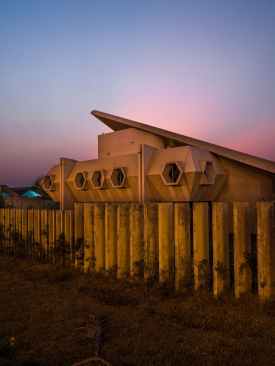
Lycée Mamie Adjoua auditorium, Yamoussoukro, Côte d’Ivoire. Completed c. 1978. Jean Léon (1937–2002). 2025. Photograph: François-Xavier Gbré.
Seen together, the projects in Architects of Liberation reveal how architecture became part of the imaginative project of nation-building.
In the decades following independence, governments across West Africa commissioned buildings not only to house institutions but to represent new futures—futures defined by autonomy, technological ambition, and cultural confidence.
Some of these buildings remain civic landmarks today. Others stand partially abandoned, relics of ambitious development visions that never fully materialized.
But collectively they reveal something essential: that architecture was not merely a backdrop to political transformation in post-colonial Africa.
It was one of its most powerful instruments.