Increasing knowledge of our planetary boundaries, most of which human society has now breached, is elucidating the limits we must impose in the built environment to maintain a one-planet existence. Danish architect Kasper Guldager is a champion of the transition from today’s wasteful building practices to measurably sustainable ones.
After years of traditional architectural practice, Guldager has broadened his focus, becoming a developer, strategist, and systems thinker focused on helping the building industry confront its ecological limits. This transition was influenced by the sobering realization that new construction alone cannot deliver one-planet living.
This insight led him to establish transformer.build, a company devoted to large-scale adaptive reuse as a necessary pathway to absolute—as opposed to relative—sustainability. As Guldager explains, construction has a new currency—its footprint. And once you start measuring it against planetary limits, you can’t “unsee” it.
In our conversation, Guldager discusses provocative concepts such as planetary budgets, per-capita space limits, and why architects must think less about uniqueness and more about scalable transformation systems.
Brownell: You’ve long prioritized sustainability and respect for planetary boundaries. What led you to start transformer.build?
Guldager: I’ve worked with sustainability throughout my career. Five years ago, I shifted from being an architect to becoming a client and developer. I co-founded a company called Home.Earth with a mission to build new housing with the lowest possible carbon footprint and a strong social foundation.
But about a year ago, I had a kind of lightning moment. Even though we were delivering some of the lowest-carbon new buildings in Denmark, I realized something troubling. With the materials and technologies available today, new construction cannot stay within planetary boundaries. Not at scale.
There’s scientific research showing that—even assuming technological improvements—we would need to reduce new construction by roughly 80% and focus primarily on transforming existing buildings if we want to stay within the planet’s capacity. That insight changed everything. If we want to build within planetary limits, transformation must become the norm. So I founded transformer.build.
BB: How do you translate planetary boundaries into measurable targets for buildings?
KG: The key is allocation. We start with global carbon budgets aligned with the 1.5°C Paris Agreement target. Then we break those down into national budgets, sector budgets, and, finally, square-meter and per-person budgets.
This work is described in my book Doughnut for Urban Development, developed with researchers from the Stockholm Resilience Centre and the Doughnut Economics Action Lab. We use allocation principles based on sufficiency and equal per capita distribution. This is what I call absolute sustainability.
Most sustainability work is relative—reduce emissions by 20%, 30%, 50%. But relative reductions can still overshoot planetary limits. In Denmark, we now have mandatory lifecycle assessment (LCA) caps for new buildings over 1,000 square meters. That’s good progress. But even under the current cap, a building can still exceed planetary boundaries by a factor of ten. So, regulation alone is not enough. We need science-based limits.
BB: Are you measuring all nine planetary boundaries?
KG: We focus primarily on two core boundaries: climate change and biodiversity loss. These are foundational Earth systems. If you align with these two, the others largely follow.
For carbon, we aim for an embodied and operational target of 2.5 kilograms CO₂ per square meter per year. That’s aligned with a one-planet scenario. But it’s not only about carbon intensity per square meter. It’s also about space per person.
BB: That’s the controversial part, isn’t it? Limiting space per person?
KG: When I began this work, I asked: What is the per-person square-meter budget if we want to live within one planet? No one had clearly defined it. We now work with 25 square meters (about 270 square feet) per person as a benchmark. That means four people might share 100 square meters (about 1,000 square feet).
If someone lives alone in 10,000 square feet, that can’t be one-planet living—even if the building is efficient. This isn’t about policing lifestyles. It’s about recognizing that planetary capacity is finite. Space is a resource.
Interestingly, in Denmark, we recognize 37 different living patterns—not just the nuclear family model. Transformation projects allow us to respond to that diversity. Shared living, intergenerational housing, collective models—these can deliver a high quality of life with lower resource use. You might live smaller privately, but larger collectively.
BB: Does adaptive reuse give you more flexibility within the carbon budget?
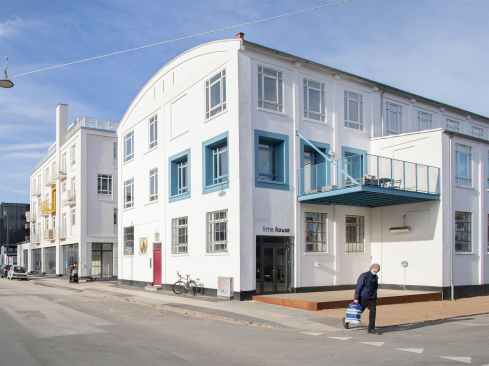
KG: Yes. Reuse gives you a real chance to meet planetary targets because you avoid most embodied carbon from new structures. New construction—even very efficient new construction—almost always overshoots.
So we strip existing buildings down, retain structure, and introduce “Lego bricks”—repeatable components for floors, facades, insulation, partitions, and building services. These components are pre-engineered and code-compliant, enabling quick deployment across projects. We’re not reinventing each building from scratch. We’re industrializing transformation.
BB: You talk about turning passive assets into active ones. Please elaborate.
KG: Many cities have vacant or underused commercial buildings—especially 1970s concrete structures. They sit there as passive assets. At the same time, cities like Copenhagen have housing shortages. So why demolish and build new when you can activate what already exists?
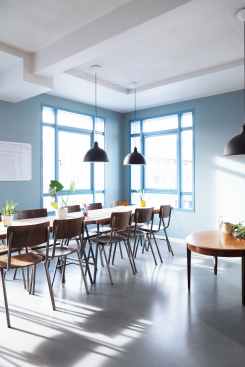
Transformation unlocks value—financially and environmentally. A vacant office building converted to housing becomes both economically productive and socially beneficial.
BB: Indeed. It may surprise most people that vacant buildings still consume resources. They carry a footprint without serving people. So, activation reduces that inefficiency. However, I wonder about economic viability. Is transformer.build economically competitive?
KG: It’s not always cheaper than building new. That’s one of the challenges. Sometimes you need additional value levers: converting office to residential, adding one or two floors if the structure allows, freeing building rights on adjacent plots. Politically, there’s also momentum.
In Denmark, demolition is increasingly discouraged—not only for heritage reasons but for climate reasons. But I’m not waiting for regulation. I see a market opportunity. Institutional capital—pension funds and foundations—is showing strong interest. There is alignment happening between capital and climate.
BB: Have you incorporated environmental externalities into your financial models? These externalities would show that new construction is, in fact, more expensive.
KG: I keep it simple: two bottom lines—one monetary and one planetary. I don’t monetize planetary damage. Instead, I state clearly: this project stays within planetary capacity; others do not. It’s a moral budget. That said, transformation can be good business. We begin with low-hanging fruit—projects where financial and planetary goals align. Then we demonstrate viability and scale.
BB: This work is inherently quantitative, but you’re a designer. How does creativity operate within these tight constraints?
KG: Existing buildings are never neutral. They come with character—deep floor plates, high ceilings, rough materials, and historic elements. These constraints are opportunities. Also, the contemporary housing market often still reflects a 1960s nuclear-family model.
But society is far more diverse. Transformation allows us to match real living patterns with real spaces. Designing within planetary boundaries is not restrictive—it’s generative. It demands ingenuity.
BB: And true transformation requires scale. Is transformer.build scalable?
KG: That’s the goal. We use three development models depending on risk structure: the first is the Classic developer model, in which we assemble investors and carry development risk. The second is the Constituted client model: a building owner finances the transformation, and we manage development. The third is the Delegated model: we act on behalf of housing associations or institutions.
But the real scalability lies in the system. We maintain long-term strategic partnerships with architects, engineers, contractors, suppliers, and banks. We don’t retender everything each time. This creates iterative learning, faster insights, transparent pricing, and shared incentives.
BB: Interesting. Traditional competitive bidding aims for the lowest cost. But integrated teams often deliver higher value over time.
Speaking of teams, what skills should architects develop to work in this space?
KG: Systems thinking. Architects often want each project to be unique. But planetary limits require repeatable systems. We must design within frameworks—not as isolated artistic gestures. That doesn’t reduce creativity. It shifts it.
BB: Will the success of this transition depend more on regulation or consumer demand?
KG: I see a gap in the market. Consumers are ready. Buildings are available. Capital is aligning. The first projects will move slowly. But once we prove the model, acceleration will follow.
We are facing both a climate crisis and a housing crisis. Transformation addresses both. I often say: I’m transforming the world one building at a time. But the ambition is systemic change.