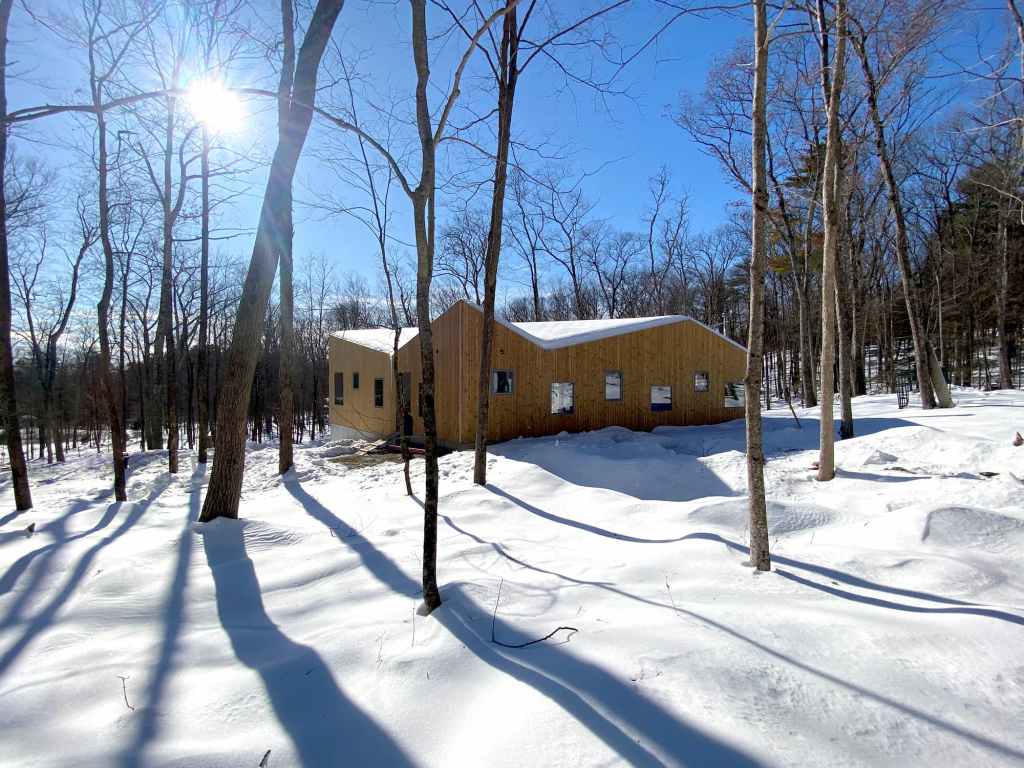
By the time you arrive in Glenford, New York—past Woodstock’s familiar orbit and into a quieter, more wooded register of the Hudson Valley—the usual distinctions between architecture, design, art, and landscape begin to blur. That collapse of categories is precisely the point of Sense of Place, a new collective exhibition staged not in a white box but inside a working house: Ohayo Mountain House, a newly completed private residence by Amin Tadj Studio.
Presented this spring (April 11-May 31) through a partnership between Available Items and Amin Tadj Studio, Sense of Place is not an exhibition in the conventional sense. There are no neutral walls, no didactic labels competing for attention, no implied hierarchy between art object and lived environment. Instead, nineteen contemporary designers and artists—many of whom live and work in the region—are embedded directly into the architecture itself. Their work unfolds across rooms, thresholds, courtyards, and forest edges, asking a deceptively simple question: what happens when design is encountered as part of daily life rather than as spectacle?
A House That Refuses to Be a Backdrop
Ohayo Mountain House is more than a container for the exhibition; it is its conceptual engine. Set on just over two acres of wooded land, the single-story, three-bedroom residence wraps around an interior court, its plan choreographing constant visual and physical engagement with the outdoors. Light enters from multiple directions. Views are layered and partial. Nature is not framed so much as allowed to intrude.
The most striking gesture is overhead: an undulating roof whose complex geometry reads less like a stylistic flourish than a topographic echo of the Catskills themselves. Structurally ambitious yet visually continuous, it transforms the house into a single, flowing gesture—one that resists the compartmentalization typical of both domestic architecture and exhibition design.
Built as a model of eco-friendly luxury, the house incorporates triple-glazed windows, a thermally modified wood façade, a hyper-efficient wood-burning fireplace, EV charging infrastructure, and high-performance systems that bring it close to Passive House standards. Sustainability here is not aestheticized; it is embedded, infrastructural, quietly insistent.
Amin Tadj describes the project as an homage to the Hudson Valley’s vernacular architecture—extended, rather than replicated, for the present. That extension is crucial. Rather than romanticizing the region’s history, Ohayo Mountain House treats it as an active lineage, one that can absorb contemporary fabrication techniques, environmental ethics, and new modes of inhabitation without losing its grounding.
The Hudson Valley, Reconsidered
The Hudson Valley has long served as a proving ground for American ideas about landscape, culture, and retreat—from the painters of the Hudson River School to the experimental communes, art institutions, and music festivals that followed. In recent years, it has also become a fertile zone for contemporary design, particularly practices operating at the intersection of craft, architecture, and small-scale production.
Sense of Place positions itself squarely within that lineage, but with a notable shift in emphasis. This is not a show about nostalgia or pastoral escape. Instead, it treats the region as a living laboratory—one in which material experimentation, ethical production, and domestic intimacy converge.
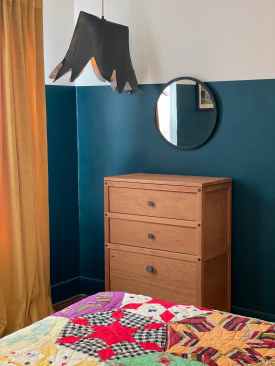
Works by artists and designers such as Francesca DiMattio, Katie Stout, Joshua Vogel, Kieran Kinsella, and LikeMindedObjects are staged in vignettes throughout the house and property. Furniture sits where furniture would actually be used. Sculptures inhabit transitional spaces. Lighting responds to the rhythms of day and night rather than the fixed conditions of a gallery.
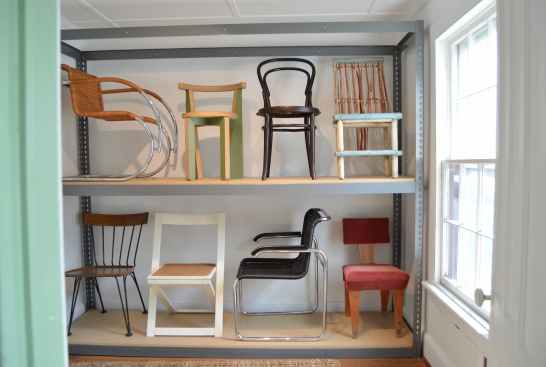
The curatorial logic is experiential rather than taxonomic. Pieces are bound together not by medium or market category but by a shared commitment to the hand: visible labor, material intelligence, playful inversions of form and function. Traditional materials are pushed into unfamiliar territory. Decorative languages bleed into sculptural ones. Craft becomes conceptual without losing its bodily immediacy.
Living With the Work
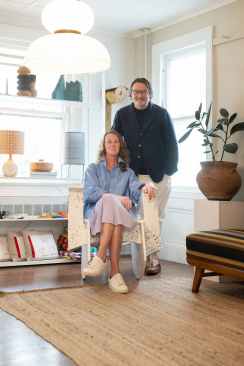
Co-founders of Available Items, Kristin Coleman and Chad Philips. Photo by Jarusha Brown.
For collectors and visitors alike, the residential setting changes the stakes. As Chad Phillips, co-founder of Available Items, notes, encountering design within a house rather than a showroom brings it into “meaningful context.” The question is no longer whether an object is striking or collectible, but whether it can coexist—emotionally, spatially, ethically—with everyday life.
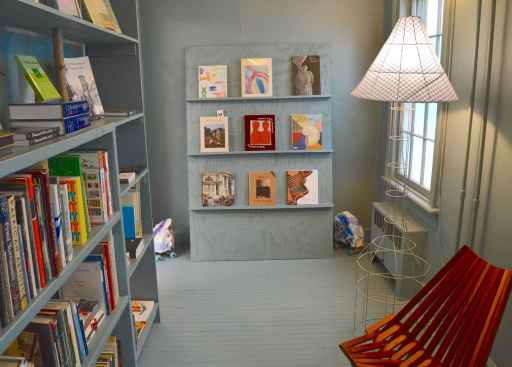
That shift feels particularly urgent at a moment when design culture is increasingly polarized between hyper-commercial spectacle and insular critical discourse. Sense of Place offers a third path: one rooted in lived experience, slow looking, and dialogue between disciplines.
The participating artists and designers span a wide range of approaches, from woodworkers and metal fabricators to ceramicists, fiber artists, and interdisciplinary studios. Yet the exhibition resists eclecticism for its own sake. Instead, it builds a quiet argument about regional practice—not as a limitation, but as a source of depth.
This is design shaped by proximity: to materials, to collaborators, to landscape, to history. It is work that understands place not as a brandable aesthetic but as an active condition—something that presses back, complicates intentions, and ultimately enriches form.
An Exhibition That Unfolds Over Time
Open to the public from April 11 through May 31, Sense of Place will be activated by events and programming throughout its run, further reinforcing its emphasis on conversation and community. The house, like the exhibition itself, is not meant to be consumed in a single pass. It rewards return visits, changing light, shifting weather, and extended attention.
In choosing to stage an exhibition inside a private residence—one that is itself a deeply considered architectural project—Available Items and Amin Tadj Studio are making a subtle but pointed critique of how design is typically presented and consumed. Here, architecture does not recede to let objects shine, nor do objects overwhelm their setting. Instead, each conditions the other.
The result is less a show than a proposition: that the future of contemporary design may lie not in ever-more dramatic displays, but in quieter, more integrated environments where making, living, and place are inseparable.
In Glenford, that proposition feels not only plausible, but already underway.