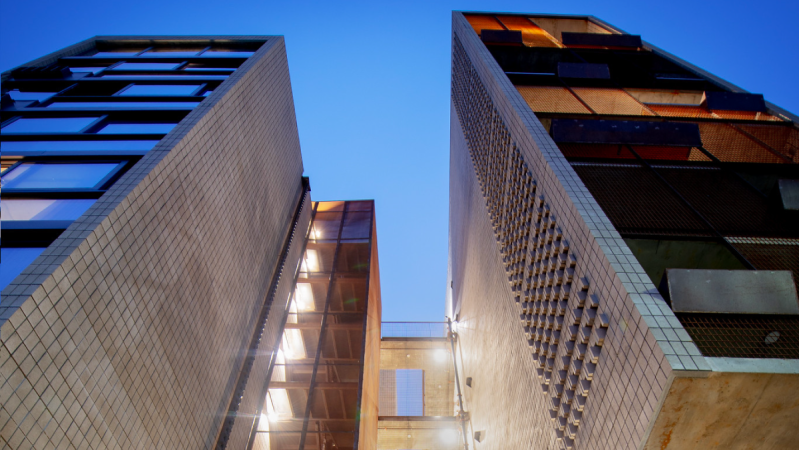
Concrete masonry units (CMU) are one of the most thoroughly studied building materials in construction. Over the last several years, the industry has advanced that rigor by quantifying embodied carbon and carbon sequestration as part of broader decarbonization goals. A key finding has emerged from this work: Embodied carbon performance varies greatly across concrete products.
To support whole-building life cycle assessment (LCA), an industry-average Environmental Product Declaration (EPD) for concrete masonry was introduced in 2024. This EPD provides Global Warming Potential (GWP) and other environmental impact values for seven standard CMU categories, giving architects reliable inputs for whole-building LCA and meaningful carbon accounting across a project’s lifespan.
“Our industry has dedicated significant resources to quantifying the embodied carbon of CMU through rigorous research,” says Nick Lang, vice president of engineering, masonry, at Concrete Masonry & Hardscapes Association (CMHA). “Updated EPD data provides a more current basis for comparing concrete masonry performance in today’s construction context.”
Architects have begun to factor CMU’s carbon profile into broader material evaluations. Lance O’Donnell of o2 Architecture notes that CMU’s carbon behavior is part of what makes it a “future-ready material,” supporting sustainability without compromise.
Low Embodied Carbon Contributors
- Efficient dry-cast manufacturing.
Concrete masonry units are produced through a dry-cast process that uses less water and cement than other types of concrete. Because cement is the largest contributor to embodied carbon, this efficiency directly lowers the carbon footprint of each unit.
- Natural carbon sequestration.
CMU undergoes carbonation, a process through which atmospheric CO₂ is absorbed over time. The interconnected internal void structure allows air and carbon to penetrate more deeply than in many other concrete products. Sequestration occurring within the first 28 days is included in the industry-average EPD’s A1–A3 Global Warming Potential calculations. Additional sequestration measured two years into the use phase is reported separately and can be incorporated into whole-building LCAs under the B1 module.
- Less material by design.
CMU’s hollow core structure reduces the volume of concrete in wall assemblies, further lowering embodied carbon without sacrificing structural capacity. To fully capture these benefits (manufacturing efficiency, sequestration, and reduced material volume), designers must evaluate entire assemblies rather than individual components.
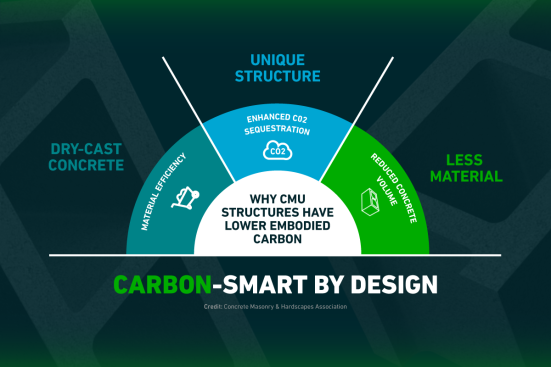
Credit: Concrete Masonry & Hardscapes Association (CMHA)
Sustainability Is More Than a Number
Embodied carbon is only part of the sustainability story. Responsible buildings also account for operational emissions and long-term durability. CMU contributes across all three.
Its high thermal mass helps moderate interior temperatures, shifting heating and cooling loads away from peak demand and reducing operational energy over a building’s life. CMU also provides inherent resilience. Built to code minimums, masonry structures withstand fire, wind and impact without added systems, helping avoid the embodied carbon impacts of early replacement.
Design Flexibility Without Compromise
CMU is often associated with gray structural block known for durability, high thermal mass and noncombustibility. Architectural CMU has all the same attributes, so it can serve as the structure of an assembly. However, it’s also available in multiple finishes, such as split-face, smooth-face, ground or burnished, and polished units. It can also be used as a nonstructural anchored veneer, providing a range of design options.
Projects like Le Parc in San Diego demonstrate how CMU supports both aesthetic ambition and performance. Project architect Dominique Houriet describes how CMU enables design simplicity where “the building bones are also the outer skin,” allowing concrete block to serve as both structure and finish while reducing material layers and associated resource use.
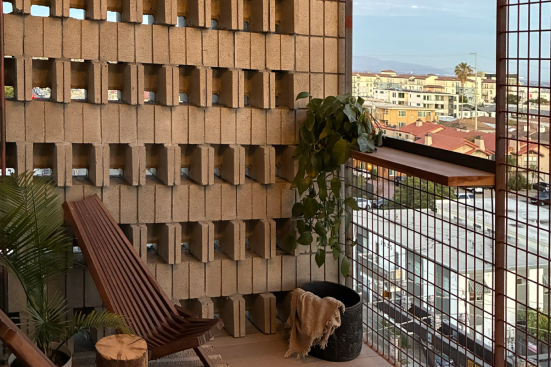
Le Parc, North Park Apartments, San Diego, CA. Photo Credit: [oo-d-a] studio. Photos by Dominque Houriet
A project at Mount Wachusett Community College further illustrates this combination of split- and ground-face (or burnished) CMU.
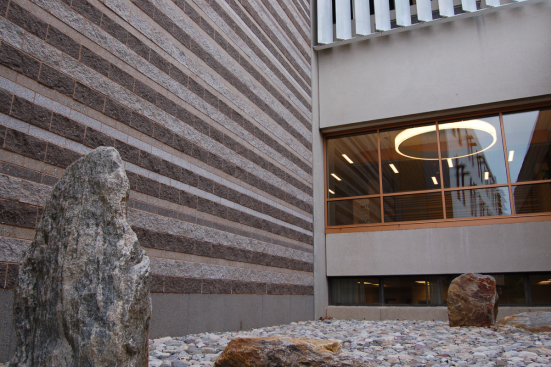
Mount Wachusett Community College, Gardner, MA
Low Embodied Carbon With Added Benefits
As architects pursue verifiable low-carbon solutions, concrete masonry offers a combination of low embodied carbon, measurable sequestration, operational efficiency from thermal mass, and inherent resilience within a single material system.
Concrete Masonry Design Resources
Architects looking to explore concrete masonry further can access free support in two ways:
- Visit the Block Learning Hub for free on-demand, CE-accredited courses, including a dedicated series on embodied carbon.
- Contact the Block Design Collective for complimentary technical design assistance from early concepts through detailing, supported by licensed professionals nationwide throughout the design process.