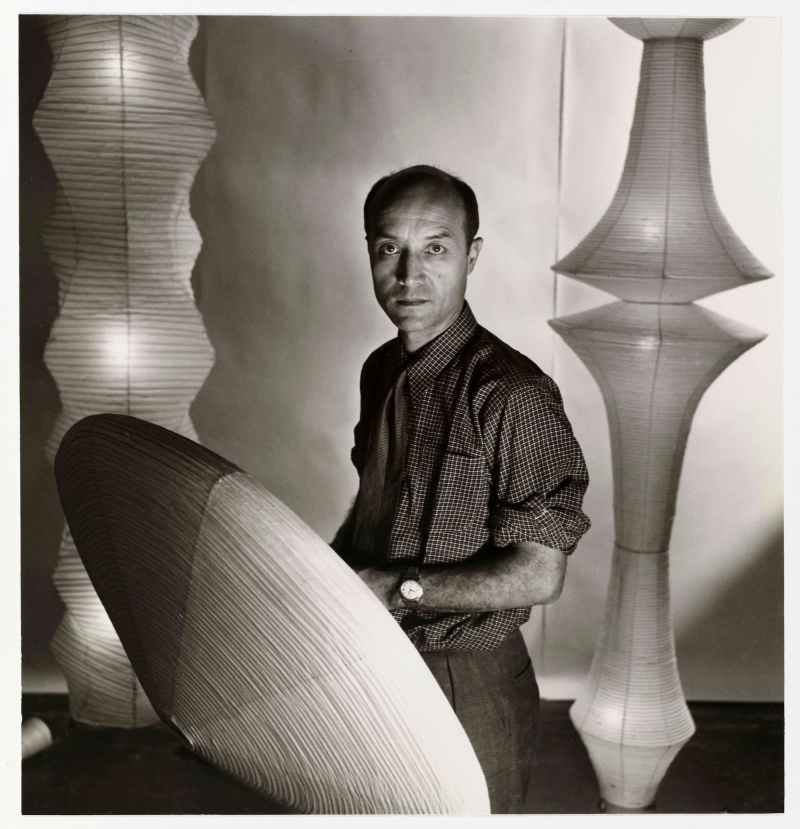
For decades, museums largely took him at his word. Noguchi was canonized as a sculptor—one of the twentieth century’s greats—while his furniture, lighting, playgrounds, stage sets, and landscapes were quietly relegated to the margins: celebrated, widely used, endlessly reproduced, yet rarely treated as intellectually central to his practice.
That omission is what makes Isamu Noguchi: “I am not a designer”—opening April 10, 2026, at the High Museum of Art—one of the most consequential design exhibitions in a generation. It is not merely a retrospective. It is a reckoning.
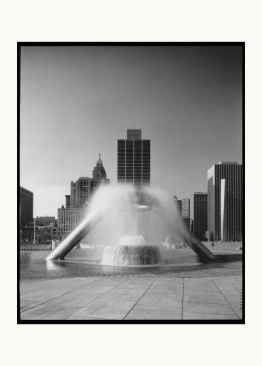
Designed by Isamu Noguchi (American, 1904–1988) with Shoji Sadao (American, 1927–2019), Horace E. Dodge Fountain, Philip A. Hart Plaza, Detroit, 1971–1979. The Noguchi Museum Archives, 02126. © 2026 The Isamu Noguchi Foundation and Garden Museum, New York / Artists Rights Society (ARS), New York.
Organized by the High and touring nationally, the exhibition is the first comprehensive design survey of Noguchi’s work in nearly 25 years—and the most expansive ever attempted. Featuring nearly 200 objects, including many never before exhibited, the show reframes Noguchi not as a sculptor who occasionally designed, but as a figure who collapsed sculpture, architecture, landscape, and industry into a single civic project.
If modern design today speaks fluently about interdisciplinarity, collaboration, social purpose, and public life, it is because Noguchi articulated those ideas decades earlier—often in forms that museums were ill-equipped to recognize as serious.
A Designer Shaped by Displacement
Born in Los Angeles in 1904 to a Japanese poet father and an American writer mother, Noguchi lived between cultures, continents, and identities. He spent formative years in Japan and the United States, a bicultural upbringing that deeply shaped his understanding of space, material, and belonging.
That sense of in-between-ness would become a defining force in his work. Noguchi never accepted the neat divisions between fine art and applied art, object and environment, aesthetics and use. Sculpture, for him, was not an isolated artifact—it was a way of organizing life.
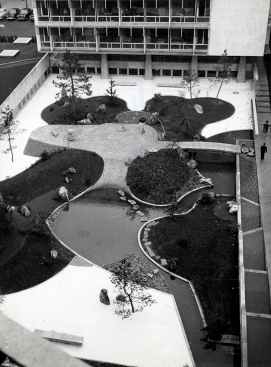
Designed by Isamu Noguchi (American, 1904–1988), Gardens for UNESCO, Paris, 1956–1958. The Noguchi Museum Archives, 150822. © 2026 The Isamu Noguchi Foundation and Garden Museum, New York / Artists Rights Society (ARS), New York.
Over the course of his career, he produced plazas, playgrounds, gardens, memorials, theatrical sets, furniture, and lighting that refused to stay within disciplinary boundaries. His Akari lanterns glow in homes around the world. His furniture designs for Herman Miller and Knoll remain canonical. His landscapes and civic works continue to structure public experience long after his death in 1988.
Yet the institutional narrative lagged behind the reality of his influence.
Atlanta’s Noguchi Legacy—and Why It Matters
Few American cities are as quietly bound to Noguchi’s civic vision as Atlanta. In 1976, the High Museum sponsored what became his only playground realized in the United States during his lifetime: Playscapes, located in Piedmont Park just minutes from the museum.
“The High has a long and unique history with Noguchi, having sponsored what became his only playground built in the United States during his lifetime: ‘Playscapes,’ which opened in 1976,” said the High’s Director Rand Suffolk. “Located in Atlanta’s Piedmont Park, just a few minutes’ walk from the museum, that project has been beloved by the city’s residents over the past 50 years.”
For Suffolk, the exhibition is not an abstract scholarly exercise but a civic return. “This touring exhibition is an incredible opportunity to bring so many of his rare and important works together and to share them with Atlantans, who have directly benefited from his community-oriented design for decades.”
That emphasis—design as lived experience rather than collectible object—runs through the exhibition’s curatorial logic.
Rewriting Design History, One Object at a Time
Co-curated by Monica Obniski, the High’s Curator of Decorative Arts and Design, and independent curator and sculpture scholar Marin R. Sullivan, the exhibition is intentionally interdisciplinary, mirroring Noguchi’s own way of working.
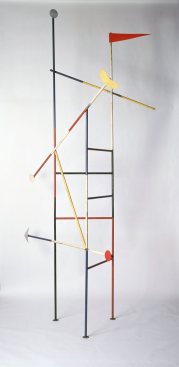
Designed by Isamu Noguchi (American, 1904–1988), Jungle Gym from Stephen Acrobat, 1947, steel, plastic, and paint, The Isamu Noguchi Foundation and Garden Museum, New York. Photo by Kevin Noble / The Noguchi Museum Archives, 00189. © 2026 The Isamu Noguchi Foundation and Garden Museum, New York / Artists Rights Society (ARS), New York.
“This exhibition seeks to reposition his design practice, sometimes considered ancillary to his ‘real’ work, to reinforce that it was not merely a backdrop for his sculpture,” the curators explain. Instead, the show treats design as a generative engine—one that shaped Noguchi’s thinking at every scale, from tabletop to city.
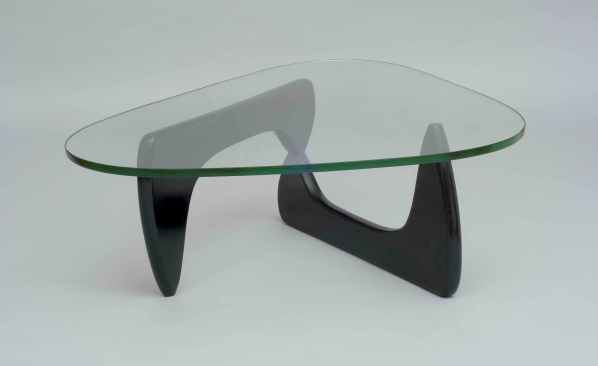
Designed by Isamu Noguchi (American, 1904–1988), manufactured by Herman Miller Furniture Company (Zeeland, Michigan, established 1923), Coffee Table (IN-50), designed 1944, this example made ca. 1947–1953, ebonized birch, glass, and aluminum, High Museum of Art, Atlanta, gift of Fredna and Ricardo Cottingham, 1998.34 a-b. © 2026 The Isamu Noguchi Foundation and Garden Museum, New York / Artists Rights Society (ARS), New York.
“Today we think about design as expansively as Noguchi thought about sculpture during his lifetime—or put another way, what Noguchi broadly classified as sculpture is something far closer to what we now understand as design,” Obniski said. “By exploring Noguchi’s work holistically, but intentionally from a design perspective, this exhibition offers a revisionist history that more fully accounts for the diversity of his projects and the crucial role collaboration played across this practice.”
Sullivan adds: “Noguchi’s significant contributions to 20th-century sculpture have long been heralded. This exhibition, however, not only expands our understanding of how important design was to Noguchi throughout his career but also demonstrates how generative and interconnected the two disciplines were to his practice as a whole.”
From Playgrounds to Paper Lanterns
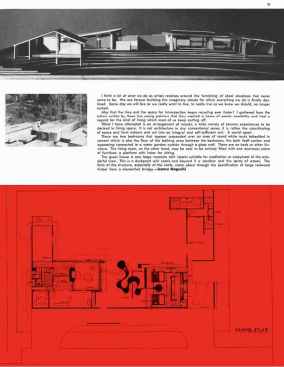
“House by Isamu Noguchi and Kazumi Adachi,” with photos by Vlad Balabanov, in Arts & Architecture 72, no. 11 (November 1955): 26–27. © 2007–2025 David F. Travers (assigned to Travers Family Trusts). Used with permission. © 2026 The Isamu Noguchi Foundation and Garden Museum, New York / Artists Rights Society (ARS), New York.
Organized thematically, the exhibition opens with foundational works that span the arc of Noguchi’s career, from the radical 1933 proposal Play Mountain—a utopian vision to transform an entire New York City block into an abstract playground—to the late stone sculpture Wounded Rock (1981), a meditation on nature, trauma, and time.
The High recently acquired the original Play Mountain plaster model, which has not been publicly shown since the 1930s—a reminder of how long some of Noguchi’s most visionary ideas remained unrealized or underexamined.
Subsequent sections explore reproducibility (Making Multiples), architecture and inhabitable space (Elements of Architecture), and the social impact of landscape and public work (Shaping Spaces). Highlights include:
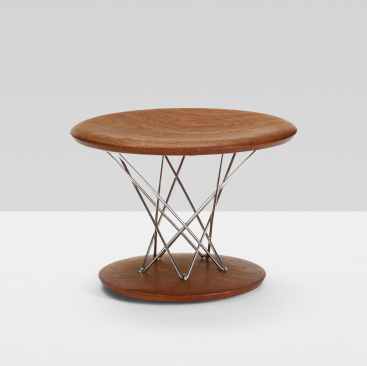
Designed by Isamu Noguchi (American, 1904–1988), manufactured by Knoll Inc. (New York, New York, established 1938), Small Rocking Stool (model 85-T), designed 1954– 1955, made 1956–1957, birch and chrome-plated steel, collection of Robert Munch. Image courtesy of Rago / Wright. © 2026 The Isamu Noguchi Foundation and Garden Museum, New York / Artists Rights Society (ARS), New York.
- Furniture designs for Knoll and Herman Miller, including the iconic IN-50 coffee table
- Experimental industrial objects like Radio Nurse
- Collaborations with figures such as R. Buckminster Fuller and Kenzō Tange
- A rarely seen reconstruction of the stage set for Martha Graham’s Seraphic Dialogue (1955)
- An immersive field of illuminated Akari lanterns
- Interactive play sculptures that foreground touch, movement, and participation
The exhibition closes with a film by the architecture studio Spirit of Space, documenting three of Noguchi’s most important gardens and public spaces—projects that resist documentation precisely because they are meant to be inhabited, not merely viewed.
Why This Exhibition Lands Now
At a moment when architecture and design are urgently reexamining their social responsibilities—rethinking public space, inclusivity, climate, and civic life—Noguchi’s work feels uncannily contemporary.
He was designing playgrounds when modernism was still obsessed with monuments. He was thinking about participation when museums privileged distance. He was dissolving disciplinary boundaries decades before interdisciplinarity became a buzzword.
In insisting that he was not a designer, Noguchi was perhaps resisting a category that, in his time, diminished the seriousness of applied work. Ironically, it is only now—when design has reclaimed its cultural and political agency—that his declaration can be understood as both a provocation and a challenge.
This exhibition answers it directly.Isamu Noguchi: “I am not a designer”
April 10–August 2, 2026
High Museum of Art, Atlanta
Touring to the Peabody Essex Museum (Fall 2026) and the Memorial Art Gallery of the University of Rochester (Spring 2027)