At the beginning of the twentieth century, French architect Tony Garnier offered a vision of the modern city that would create a profound impact on urban planning. In response to the conflicting demands between different types of urban occupation, the Une Cité Industrielle graphic treatise proposed a new model of the metropolis organized around functional differentiation and public health. The plan separated industry and technical infrastructure from housing, civic life, and cultural destinations, utilizing green space as a protective buffer between the distinct realms.
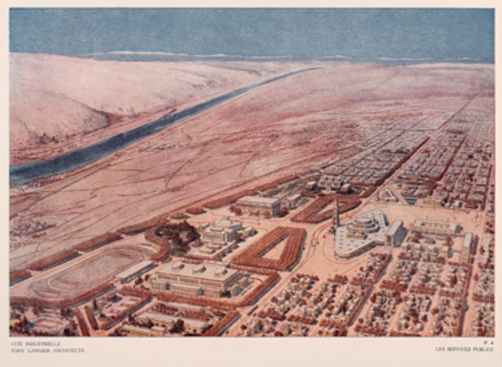
Tony Garnier's Cite Industrielle.
Garnier had good reason to propose this separation. In an epoch defined by coal smoke, industrial hazards, and untreated waste, this disassociation was a logical way to protect human health and well-being. Parks assumed a critical role as restorative escapes located outside the centers of production.
Meanwhile, utility infrastructure such as waste facilities and power plants was relegated to the urban periphery to minimize their physical presence. This segregating worldview became a fundamental driver in twentieth-century urban planning and zoning, reinforcing the pervasive assumption that infrastructure and public life are inherently incompatible.
For most of the past hundred years, the Cité Industrielle model proved remarkably enduring. As cities grew and became more industrialized, urban infrastructure expanded while becoming more opaque. Containment, efficiency, and security governed the construction of utilities, which were designed for functionality on the margins and not public visibility or access.
And yet, the technological and environmental conditions that inspired Garnier’s model of segregation have gradually changed. Much of today’s infrastructure is no longer synonymous with smoke, odor, or contamination. Advances in emissions controls, enclosure systems, and digital monitoring have significantly improved environmental conditions for energy generation, waste processing, and water treatment.
The relative cleanliness and containment of contemporary facilities thwarts the long-held perception that they cannot coexist with public space. Urban environments are under mounting pressure to maximize the value of limited land while aging twentieth-century infrastructure becomes obsolete. These circumstances suggest that infrastructural isolation is not only unnecessary but also a missed opportunity.
As seen in an increasing number of recent works, urban utility infrastructure is no longer perceived as a necessary evil—something that cities merely tolerate and try to hide—but as a cultural attractor for public enjoyment.
This paradigm shift inverts Garnier’s organizational logic, revealing new possibilities for cities’ operational machinery. Once expected only to perform technically, infrastructure is now increasingly under pressure to contribute tangibly to civic life.
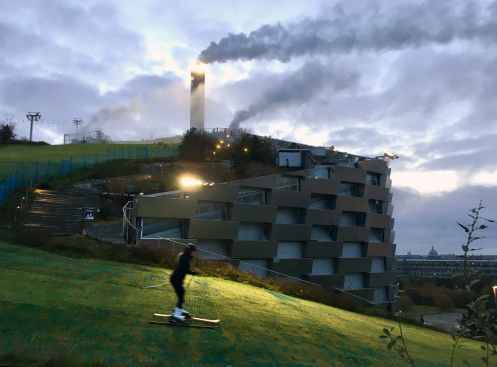
BIG's Amager Bakke in Copenhagen.
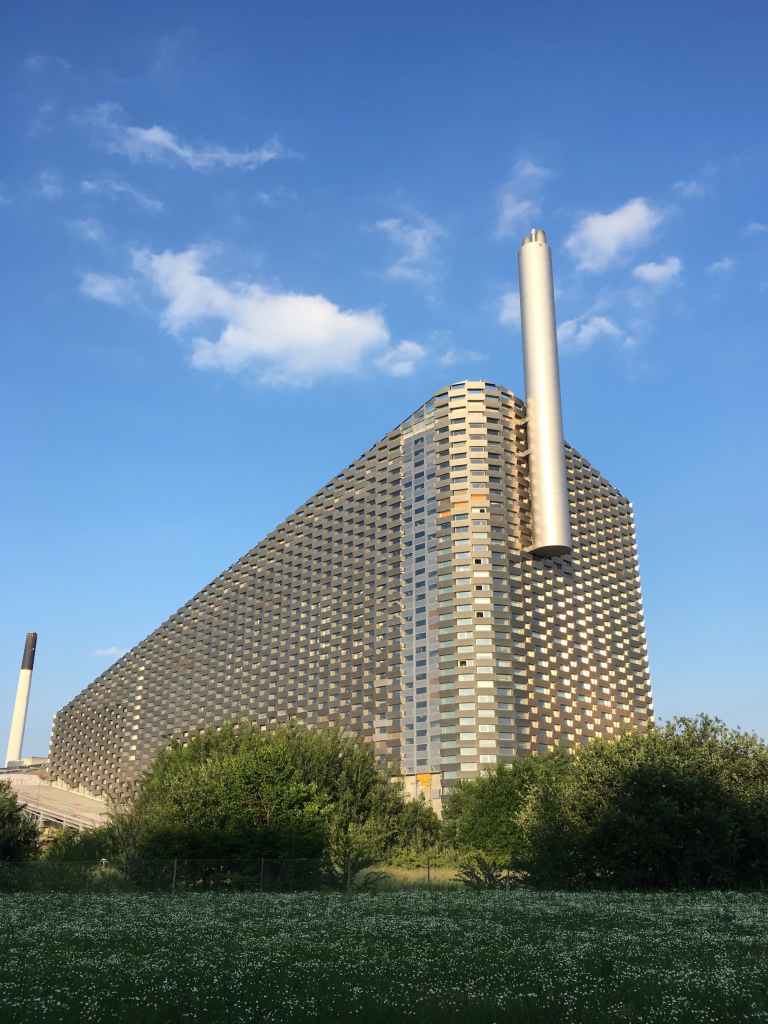
The most familiar example of this phenomenon is BIG’s Amager Bakke (CopenHill), a waste-to-energy plant in Copenhagen that the architect envisioned as an artificial mountain boasting a ski slope, climbing wall, and hiking paths. This recreational landscape offers a significant public benefit, particularly within the dense urban environment of Copenhagen.
Athough the waste-to-energy processes are safely contained, the architect devised clever ways to reveal the plant’s industrial functionality with a celebratory smokestack that forms a new civic landmark.
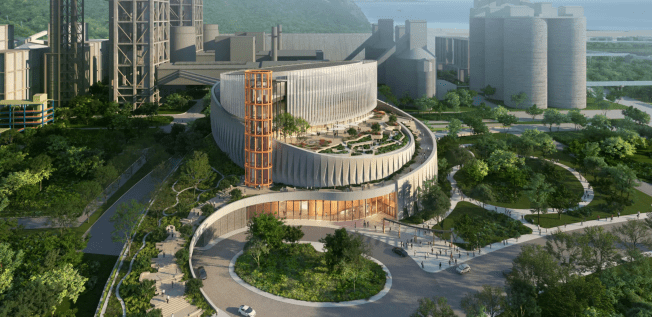
KPF’s TCC Daka Renewable Resource Recycling Center in Taiwan.
A similar approach is evident in KPF’s TCC Daka Renewable Resource Recycling Center in Taiwan. Envisioned as a mixed-use facility in a public park, the project features meandering pathways that spiral upward into landscaped terraces overlooking the nearby ocean.
Commissioned by the Taiwan Cement Company, the recycling center incorporates public-facing programs—including a botanical garden, cafe, and exhibition space—within a spiraling armature of concrete and steel. This design approach suggests a reciprocal ethic between infrastructure and the citizenry it serves, offering civic value to the individuals participating in the circular systems of urban consumption.
Water infrastructure is particularly fertile ground for this reimagined vision. DLANDstudio Architecture + Landscape Architecture’s Gowanus Canal Sponge Park is a lush rain garden that integrates stormwater filtration into the streetscape along the canal’s banks.
On a site marked by a legacy of intensive pollution in the 19th and 20th centuries, the 1,800-square-foot park performs critical ecological remediation in a publicly accessible and educational way. In this way, the project reveals environmental pollution control as a legible, accessible, and interactive experience.
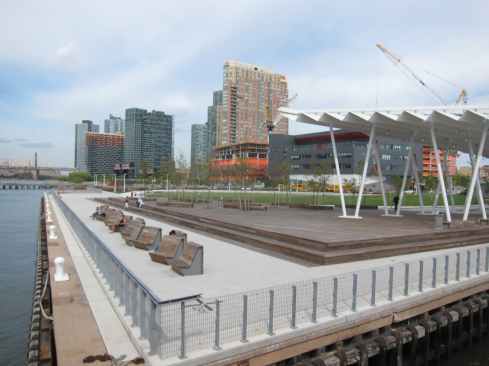
Weiss/Manfredi’s Hunter’s Point South Waterfront Park.
Weiss/Manfredi’s nearby Hunter’s Point South Waterfront Park pairs similar functions of riverfront restoration and civic benefit. The substantial park development features 30 acres of once-industrial waterfront that has been transformed into an accessible, multifunctional greenscape. This model project successfully blurs the infrastructure of climate adaptation with public recreation space, revealing its flood protection functionality only during extreme weather events.
As these works demonstrate, cities are beginning to reject the long-held assumption that urban infrastructure must be separated from civic life. Instead, the idea of inhabited infrastructure, or technical support systems that simultaneously contribute to urban identity and public enjoyment, is supplanting the notion of brute functional segregation.
Not only do these projects add measurable value to a limited land area, satisfying technical and civic needs simultaneously, but they also foster public trust. As utility technologies evolve and urban infrastructure becomes more complex, architecture that invites access and transparency can demystify these critical yet under-appreciated systems, reinforcing their role in supporting collective well-being.