For much of Miami Beach’s history, architecture has announced itself loudly—through silhouettes, setbacks, and skyline gestures aimed at the horizon. At Ocean Terrace, however, the most consequential design work happens inside.
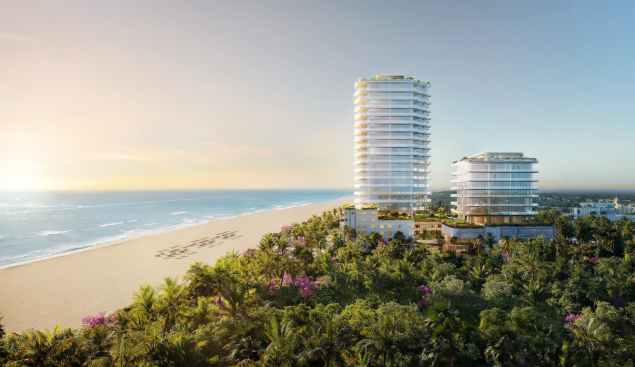
The Park View.
Set on a nearly full-block site adjacent to an oceanfront park, Ocean Terrace stitches together several historic structures and façades with two new residential towers, forming a mixed-use enclave that feels less like a single building and more like a resort village rediscovered. The overall architecture is by Revuelta Architecture International, but the project’s identity—its atmosphere, material intelligence, and sense of place—has been entrusted to Robert A.M. Stern Architects (RAMSA), whose role is deliberately and decisively focused on interiors and outdoor FF&E.
That distinction matters. Ocean Terrace is not about imposing a new object on Miami Beach, but about orchestrating an experience—one that moves fluidly from lobby to garden, from private residence to shared amenity, from historical reference to contemporary ease.
Interiors as Urban Memory
RAMSA’s work spans four distinct components of the project: a condominium tower, a condo-hotel tower, a hotel and dining building, and a wellness and private club facility. Across all of them, the firm draws from a wide historical bandwidth—Art Deco and Miami Modern, mid-century Brazilian modernism, and French modernist traditions—without collapsing into nostalgia.
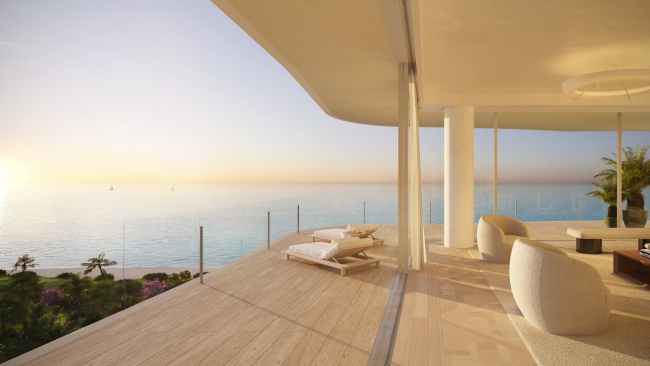
Indoor-Outdoor Great Room, designed by RAMSA.
“We’ve blended the rich interior design traditions of 20th-century Miami Beach, drawing inspiration from Art Deco and Miami Modern to imagine a new 21st-century sensibility. Ocean Terrace honors the history of Miami Beach and marks a new design era for the city’s evolving spirit,” says Paul L. Whalen, Partner at RAMSA.
Rather than treating history as a style to be revived, the interiors treat it as a vocabulary to be recomposed. Influences from the 1930s through the 1960s are layered—sometimes symmetrically, sometimes playfully—into spaces that feel simultaneously grounded and unforced.
“Miami Beach is a city with an international brand: a semi-tropical resort city where culture, style, and architecture intersect,” Whalen adds. “We channeled these qualities into Ocean Terrace’s interiors with a playful blend of creative excitement and relaxed beachfront living.”
The Lobby as Threshold—and Stage
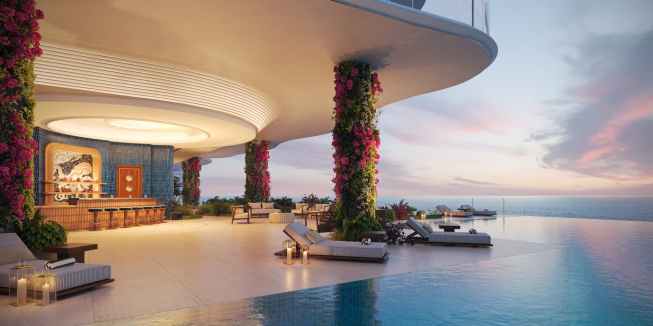
The Pool Bar.
The residential lobby announces this approach immediately. Symmetrical and double-height, it borrows from Baroque planning, Art Deco ornament, and modern classicism, yet avoids monumentality for its own sake. Decorative entry door screens, a pediment with a shell motif, and custom brass sconces animate the threshold, while a dark marble reception desk—flanked like a piece of jewelry—anchors the room.
Travertine flooring meets butt-jointed wood paneling reminiscent of mid-century Brazilian interiors, overlaid with colonettes and a thin entablature. The sequence culminates in a grand arch framing the lush tropical landscape beyond, visually tying the interior to Raymond Jungles’ adjacent Ocean Terrace Park.
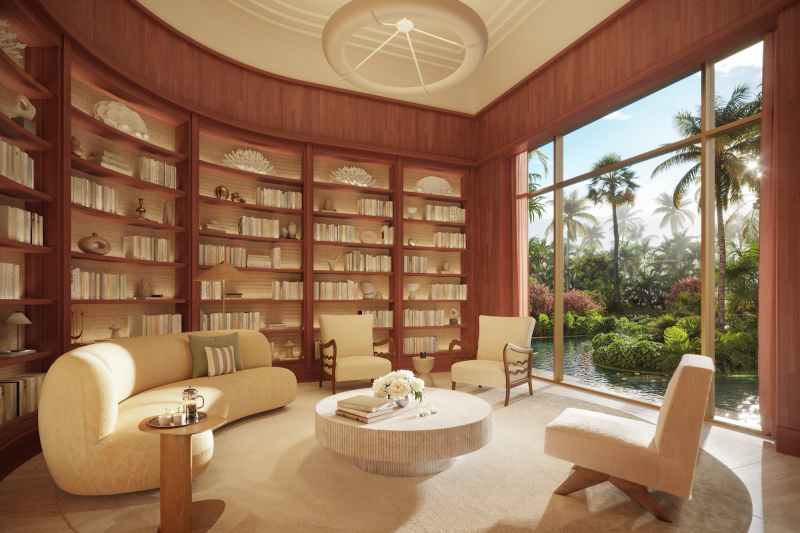
The effect is deliberate and theatrical, but never rigid. The lobby opens seamlessly into a semi-circular library and a tea room—both conceived as social extensions rather than ancillary spaces. Rattan-clad bookshelves, mid-century–inspired seating, and views toward the gardens reinforce the sense that this is a place meant to be occupied, not passed through.
Amenities as a Way of Living
Above the lobby, the amenities unfold like a curated cruise ship—an intentional nod to Miami Beach’s ocean liner fantasies. A gym with yacht-inspired curves and wood planks overlooks both courtyard and ocean. A children’s room introduces whimsy through mural and landscape-like textures. The games room and lounge are designed as either discrete or interconnected spaces, opening onto an outdoor terrace that extends leisure beyond the building envelope.
The pool bar, capped by a dramatic round ceiling and wrapped in blue ceramic tile, is both destination and hinge—oriented toward pool and ocean alike. A custom mosaic mural anchors the bar, while the curved, terra cotta–clad counter encourages lingering rather than turnover.
“We wanted the lobbies, restaurants and hospitality spaces to evoke a feeling of theatrical fantasy,” Whalen has said. “We drew inspiration from luxurious cruise ships, ocean liners, and art deco style to blend grandeur with intimacy and create a memorable experience.”
Residences Framed by the Horizon
In the residential towers, the design pivots from theatrical to precise. RAMSA-designed floor plans ensure that all living rooms and primary bedrooms face the ocean, while maintaining classic proportions and layouts that are rigorously planned yet easy to furnish.
“We took the cosmopolitan sophistication of New York City apartments and reinterpreted it in a beachfront resort context,” says Michael D. Jones, Partner at RAMSA. “The floorplans, rigorous while open and connected, offer a sense of open expanse along with intimacy, elegance, and a sharp attention to detail.”
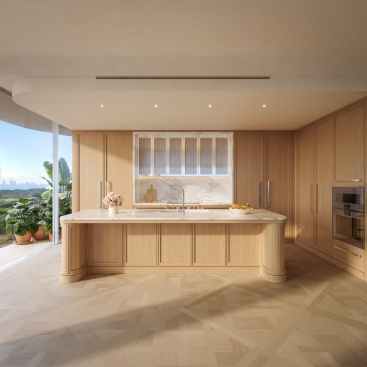
The Kitchen.
Materiality does much of the work. Parquet de Versailles oak flooring appears throughout primary spaces—great rooms, foyers, bedrooms, and powder rooms—paired with modern architectural detailing. Kitchens are sleek and discreet, with hidden appliances and clean lines, while primary bathrooms combine white travertine with wavy veining and dark wood drawers that transform vanities into furniture-like objects.
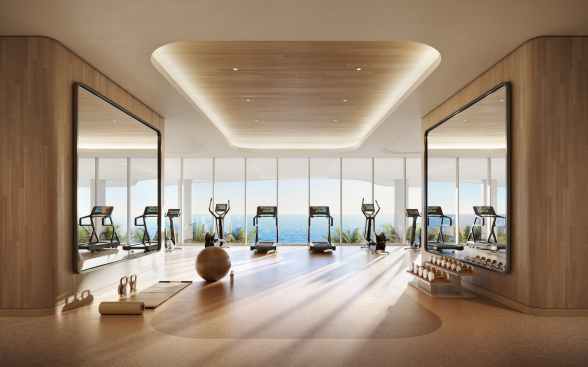
Indoor Gym.
“The interior spaces celebrate elegance and ease, with French parquet floors partnered with modernist curves and glass,” Jones adds. “These elements create spaces that are both refined and playful, blending classicism with mid-century modernism to create a new Miami Beach style.”
Penthouses elevate the experience further, with private elevators leading to rooftop pool decks, outdoor kitchens, and entertaining spaces that extend the domestic interior into the sky.
A Village, Not a Statement
What ultimately distinguishes Ocean Terrace is restraint. In a city often defined by architectural spectacle, the project’s ambition lies in its interior coherence—its ability to create a private, gracious enclave that feels deeply rooted in Miami Beach’s layered history without being beholden to it.
“Our firm is known for designing buildings, but we were excited to focus our efforts at Ocean Terrace on the interior spaces, which are essential in creating an authentically Miami Beach lifestyle,” Whalen notes.
At Ocean Terrace, architecture does not end at the façade. It begins at the threshold, unfolds through material and proportion, and settles into daily life—quietly, confidently, and with the kind of permanence that comes not from novelty, but from care.