Architects obsess about how any new tools they add to the kit with which they design and represent their work will fundamentally alter what they produce. I think that is because we have a natural tendency to focus on what we know, which is our own process, rather than asking what we are doing, for whom, and why. The current toy of choice is of course AI. It is the latest advance in how we humans reimagine and reshape our world to confront us and thus a design tool.
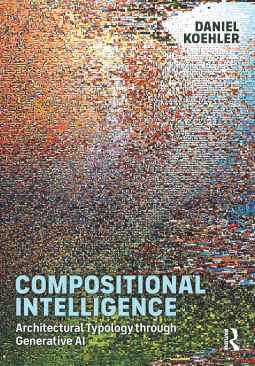
Compositional Intelligence by Daniel Koehler (Routledge).
One recent book, Daniel Koehler’s Compositional Intelligence: Architectural Intelligence through Generative AI, speculates with some conviction and intriguing suggestions about what AI means not only for the process of design, but for architecture itself.
Koehler starts his argument with great optimism and promise: “These [generative AI] models suggest novel ways of conceiving open-ended urban environments; their capacity to generate synthetic ‘latent spaces’ resonates with architecture’s engagement with multiplicity and complexity. How might this interplay transform traditional notions of building types, thresholds, or the basic grammar of city-making?
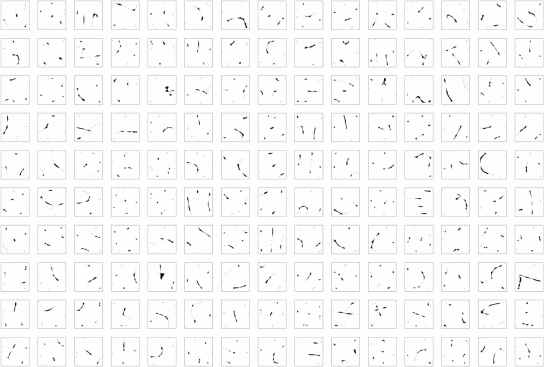
The Geometry of Features Large-scale AI models learn by organizing knowledge spatially. Each square in this visualization represents a cross-section through a neural network layer, showing which nodes activate for specific learned concepts—not unlike how a floor plan represents a spatial cut through a building. Where architectural notation has historically served as a technology of reduction, compressing complex intentions into comprehensible drawings, these models operate inversely: they expand knowledge into high-dimensional spatial arrangements. The model's geometry is its knowledge—there is no separate thought process behind these mathematical relationships. This offers architects a compelling analogy: just as these models compute through spatial allocation and weighted distances, buildings organize social, economic, and environmental relationships through physical form.
This book contends that AI’s inductive logics can help architect [sic] plural perspectives across scales –from individual buildings to the material and cultural networks they inhabit—while preserving the critical agency architects have historically wielded.”
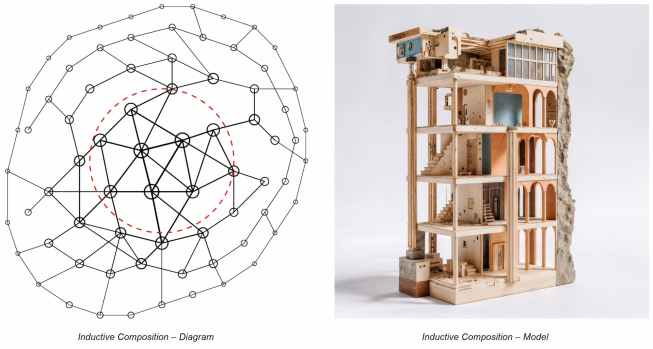
From Deduction to Induction The traditional tools of architectural design—sketches, parti diagrams, and typological references—embody deductive reasoning: they start with general principles and deduce specific forms. Large-scale models introduce something fundamentally different: inductive reasoning that learns from complex observations to discover new patterns. For architects, this represents a paradigm shift. Rather than imposing predetermined schemas onto design problems, inductive methods allow spatial relationships to emerge from data itself. The architect's role evolves from sole creator of form to facilitator of spatial knowledge—synthesizing and interpreting the collective intelligence embedded in the models they now work with. Prompting through text, images, or other media becomes a new form of compositional notation, one that must be navigated rather than prescribed.
Koehler claims that these possibilities do not come out of nowhere or bring something alien to the field but rather are deeply rooted in architecture that seeks to be open-ended and speculative. He focuses his analysis on familiar elements such as type, which he believes now becomes “…no longer a stable form to be replicated but a dynamic interface –a threshold where patterns of data, material forces, and social values interact.”
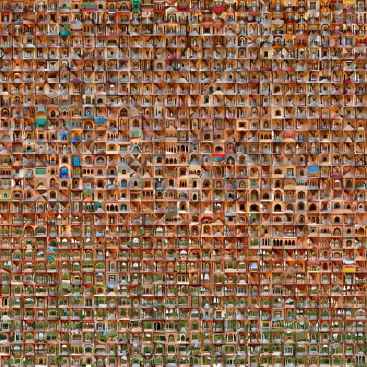
Navigating High-Dimensional Space This UMAP visualization flattens the high-dimensional representations of an AI model into a navigable two-dimensional map, revealing how the model sees relationships between building characteristics. Points that cluster together share learned features; distances represent conceptual similarity. Unlike traditional typological classifications that sort buildings into discrete categories, these embeddings operate through continuous gradients of overlapping relationships. For architects, this represents a new kind of compositional intelligence: the ability to work with analogies and correlations too complex for human cognition alone. Relationships that once seemed impossible to negotiate—weathering patterns and maintenance rhythms, acoustic atmosphere and structural depth, informal economies and threshold conditions, rainwater choreography and public gathering, festival adaptability and everyday domesticity—can now coexist within the same representational space, enabling designers to discover unexpected correlations and compose between multiple value systems simultaneously.
Large Language Models (LLMs), those programs that scarf the internet for huge amounts of data, “parallel the way architects manipulate physical space to organize social, economic, and environmental relationships.” He believes that “…[LLMs’] facility in synthesizing consensus from multifaceted, and even conflicting, data sources corresponds to an architectural environment where myriad building parts or institutions can coexist without collapsing into fragmentation.”
They do so, however, in a manner that does bring a great deal of knowledge and ways of operating that are alien to architecture as it is practiced today into the discipline. Take that notion of type: “Rather than adhering to fixed typologies –like the basilica, courtyard, slab, block, or tower—the inductive type operates at the intersection of multiple value systems, mediating between the different dimensions.”
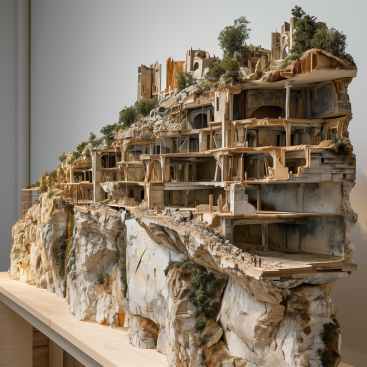
Synthetic Architecture Buildings can become truly synthetic: not in the sense of artificial, but composed through the interplay of multiple intelligences—human, material, environmental, and informational. This image suggests what it might mean to design with life-cycles in mind, to integrate local crafts and responsive material flows, to understand multi-generational occupation patterns, or to embed productive landscapes within urban fabric. Rather than singular forms authored by individual designers, such buildings emerge from superposition—overlapping layers where structural, programmatic, and ecological features coexist and reconfigure in response to changing conditions. The architect shifts from form-giver to curator of probabilistic possibilities, orchestrating features rather than fixing forms.
As a result, he says, architecture becomes more like curating information than coming up with forms that are limited by what a single architect knows. The architect uses the LLM to turbo-boost their hunting and gathering of precedents and models. In so doing so, designers also free themselves from prejudices built into what they know, creating open-ended fields in which the prevalence of forms, images, or ideas held by laypeople and professionals alike weights outcomes.
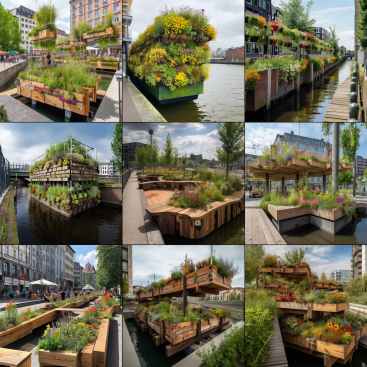
Buildings as Network Nodes When buildings become active participants in larger systems. This image suggests architecture conceived as network infrastructure: buildings as carbon sinks rather than carbon sources, as productive nodes in urban ecologies rather than isolated objects. From an inductive perspective, buildings function like nodes in a neural network—their value emerging not from discrete functions but from the density and distribution of their relationships. Such an architecture no longer represents closed entities but becomes an open-ended process, perpetually ready to incorporate fresh demands and unforeseen possibilities. The city itself transforms from a collection of programmed containers into a computational field where multiple logics—ecological, economic, cultural—can overlap, recombine, and evolve.
The use of that data, however, does need the architect. To use it they must, Koehler says, use inductive, rather than deductive reasoning, which changes how architects design: “This shift towards inductive reasoning transforms the architectural workflow from a linear sequence (sketch to realization) into a circular, iterative process of open interventions. The architect’s role evolves into that of an advocate for the built environment, leveraging their expertise in how physical form shapes socio-cultural spaces. Authorship shifts from the act of ‘inventing’ to the responsibility of ‘filtering,’ ‘weighting,’ and curating outcomes.”
That is true not just for the process, but the outcome as well. Koehler believes that the result will be just as open, fluid, and flexible. That is because it is not just, like the process of design currently, based on one person’s memory, but on collective and perhaps unconscious knowledge, and responds in real time to choices people make. Thus, architecture will, if I understand him correctly, not necessary inhere in buildings, but in continually evolving environments or structures.
If something like a building comes out of this process of curation, intuition, and coalescence, it must be adaptable: “When a building is no longer merely a machine for living but a node in a computational network, its spatial configuration is valued not for its fixed program but for its capacity for indeterminacy –its potential to accommodate multiple, even conflicting, rationales and to facilitate unforeseen interactions and uses.”
This seems to me to be a version of a late modern dream of endlessly adaptable and open architecture that Constant, the cartoonists at Archigram, or the Italian neo-utopias of Superstudio might have imagined. It continues the modernism faith in technology to create a better, more fluid future.
In a twist that reminded me of the way that theoreticians in the 1970s theorized noise as good while scientists were simultaneously trying to eliminate it and invented noise cancellation, Koehler argued that the difference now comes from the “hallucinations” that are a byproduct of the LLM’s iterative imagination.
He believes that they reflect a “collective unconscious: …[they] produce entirely new content based on learned patterns and relationships;… [their] mathematical framework allows for the capture and manipulation of intricate relationships and patterns that go beyond human intuition, enabling a more comprehensive and nuanced understanding of architectural knowledge.” He calls this a “synthesis of collective knowledge”: “The output is from countless observations, effectively synthesizing the internet’s vast repository of images to create a form of societal representation.”
In the end, I am still not sure what this societal representation is. Koehler is ambitious: “When features –structural, environmental, or programmatic—are conceived as overlapping ‘dimensions’ within a shared architectural space, each dimension remains capable of reorganizing in response to new constraints or contexts.
In other words, a single design gesture can fulfill multiple intentions or articulate multiple meanings, with their relative ‘weights’ adjustable over time. Far from diluting interpretability, this overlapping enables polysemantic or multi-valent design elements, in which multiple demands –structural performance, thermal regulation, cultural expression—coexist within the same spatial matrix.”
That does not sound like a building, and sometimes it seems as if Koehler does want to give up on what we might think of the making of structures that stand and last altogether: “Just as a neural network calibrates each node’s connection weight through millions of training iterations, architecture could be trained via extensive simulation across multiple scales.
At the molecular level, building elements would be optimized for specific structural or climatic properties. At the building scale, spatial layouts would support parallel, shifting uses. At the urban scale architectural relationships would strategically enhance local networks and supply chains.” He also speculates that we might be able to grow buildings.
What Koehler shows, in the illustrations leavened through this dense argument, are his own and his students’ experiments with collection, curation, and what you might call guided hallucination that produces, more than anything else, versions of familiar types that have been transformed into something uncanny.
Whether this is enough remains to be seen. I completely agree with Koehler that we are long overdue for a shift from the idea that the master architect can impose their will on people’s lives in the forms of buildings to a notion of the architect who uses their skill and knowledge to open up, rearrange, and make better –however you define that according to your ethical, moral, political, or aesthetic principals—the world they have inherited. That they should do so in a way that is open-ended, flexible, multivalent, and with the least investment of carbon resources possible seems beyond question.
Koehler promises us that LLMs and generative AI in general can make such architecture possible. Beyond the question of the immense carbon expenditure involved in the creation of those LLMs and their use, I have not yet seen the proof in the until now half-baked and hallucinatory pudding.
The views and conclusions from this author are not necessarily those of ARCHITECT magazine.
Read more: The latest from columnist Aaron Betsky includes reviews of: Frank Gerhy | Robert A.M. Stern | Lars Lerup | Princeton Art Museum | Victor Legorreta | Mexico City Underwater | On Vitruvius | On Olive Development | Calder Gardens | White House and Classical Architecture | Louis Kahn’s Esherick House | Ma Yansong’s Fenix Museum | The Cult of Emptiness | An Icon in Waiting | Osaka Expo | Teamlab | the Venice Biennale of Architecture | On Michael Graves | On Censorship or Caution? | Uniformity in Architecture | Book on Frank Israel | Legacy of Ric Scofidio| Fredrik Jonsson and Liam Young | DSR’s New Book | the Stupinigi Palace | Living in a Diagram | Bruce Goff | Biopartners 5 |Handshake Urbanism | the MONA | Elon Musk’s Space X | AMAA | DIGSAU | Art Biennales | B+ | William Morris’s Red House | Dhaka | Marlon Blackwell’s new mixed-use development | Eric Höweler’s social media posts,| Peter Braithwaite’s architecture in Nova Scotia,| Powerhouse Arts, | the Mercer Museum, | and MoMA’s Ed Ruscha exhibition.
Keep the conversation going—sign up to our newsletter for exclusive content and updates. Sign up for free.