Five slim steel columns support the flat path that forms one gra…
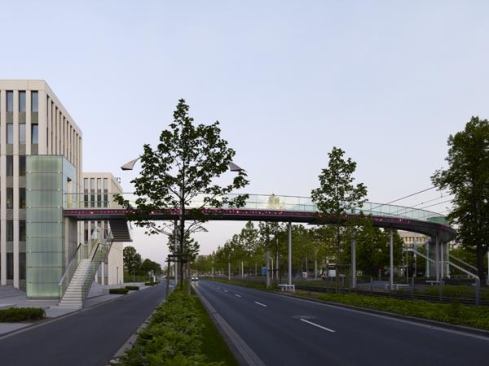
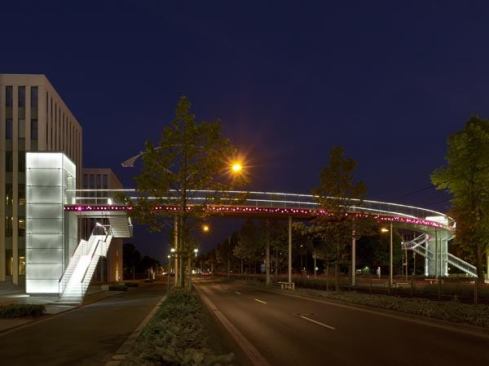
Five slim steel columns support the flat path that forms one grand curve across the traffic pathway.
Lukas Roth
Elevator shafts on each end of the bridge support the slender cu…
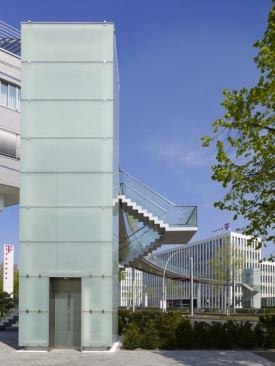
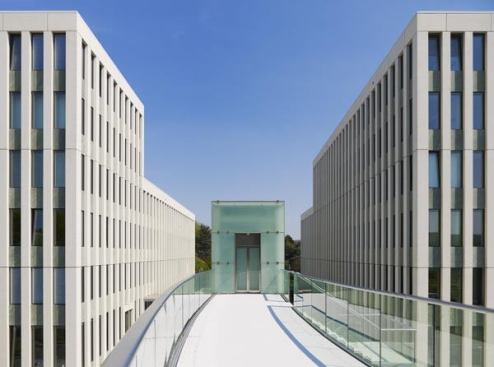
Elevator shafts on each end of the bridge support the slender curved path and connect the buildings of the Deutsche Telekom campus.
Pedestrians can now safely cross the busy street via the newly b…
Pedestrians can now safely cross the busy street via the newly built pedestrian bridge.
Lukas Roth
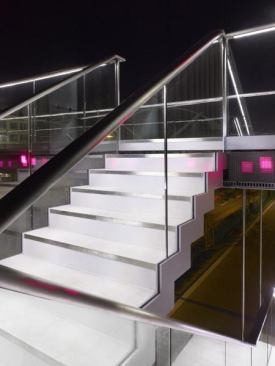
At night the LED handrails provide a uniform light from the stai…
At night the LED handrails provide a uniform light from the stairs to the walkway.
Lukas Roth
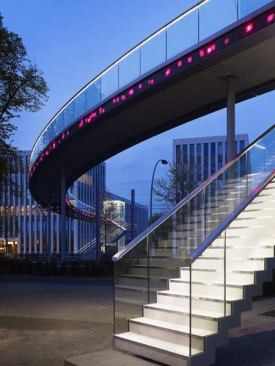
At dusk, the abstract animations that run along the bridge’s e…
At dusk, the abstract animations that run along the bridge’s edges start to become more apparent.
Lukas Roth
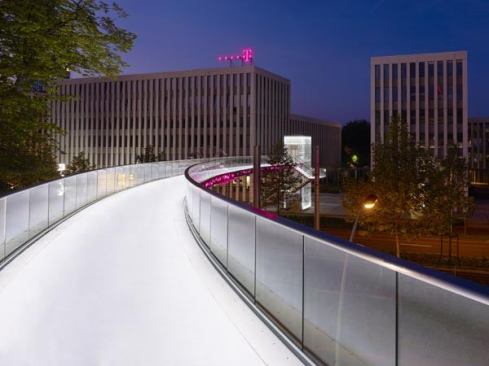
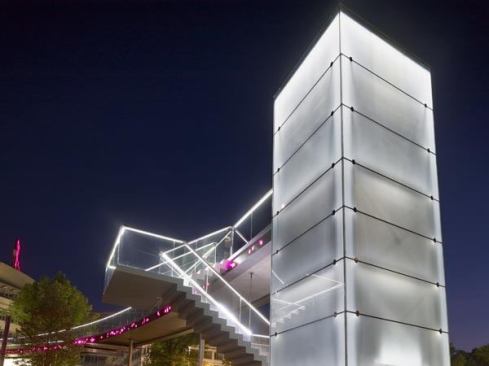
The brightly lit walkway emerges against the nighttime sky and c…
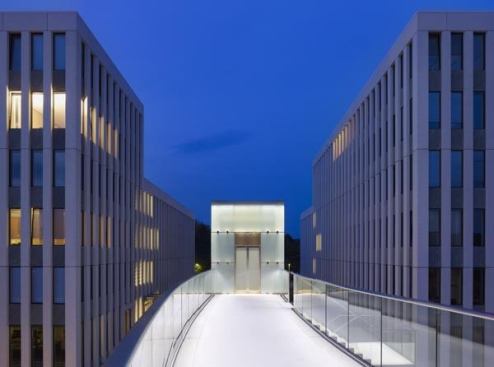
The brightly lit walkway emerges against the nighttime sky and creates an illuminated visual link between the buildings of the Deutsche Telekom campus.
Lukas Roth
A detail of the illuminated staircase and the recessed LED video…
A detail of the illuminated staircase and the recessed LED video display.
Lukas Roth
Artistic content of any kind can be shown on the video displays …
Artistic content of any kind can be shown on the video displays on both sides of the bridge.
Lukas Roth
The opal glass cladding of the elevator towers is backlit with l…
The opal glass cladding of the elevator towers is backlit with linear LED arrays.
Lukas Roth
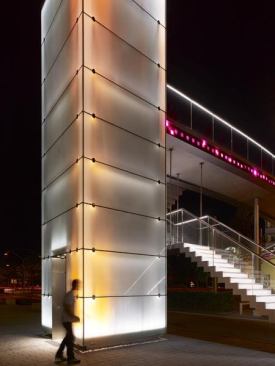
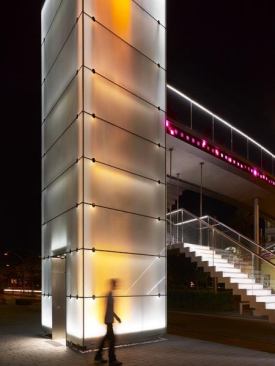
Double pulse lasers detect the position and movement of passers-…
Double pulse lasers detect the position and movement of passers-by, prompting the control software to switch on and off individual amber-colored LED luminaires.
Lukas Roth
Passers-by can playfully interact with the towers transforming t…
Passers-by can playfully interact with the towers transforming the static light towers into a dynamic light installation.
To connect its group headquarters’ office buildings, separated by one of the busiest streets in Bonn, Germany, Deutsche Telekom knew it needed to construct a bridge to facilitate pedestrian crossing. So the telecom giant looked to architecture firm Schlaich Bergermann und Partner and lighting design firm Licht Kunst Licht to design something that would be functional, but also create a piece of urban architecture.
The bridge’s design responds to the site. Supported by five slim steel columns, it gently curves a span of approximately 243 feet as it crosses over four traffic lanes and two tram tracks. A suspended stair and a 36-foot-tall elevator tower anchors each end of the bridge. Linear LED profiles with a narrow beam distribution—to prevent glare from the traffic below— are integrated into the underside of all the handrails with a neutral white light. By day the light is undetectable, but at night the bridge unfolds, like an illuminated ribbon floating above the roadway.
Along the sides of the bridge is a custom string of LED video displays that play a series of light matrix patterns. The high luminous density of 7,000 cd/m2 is visible throughout the day, but at night the light is dimmed to 30 percent to calibrate to the nighttime surrounds.
Continuing the artistic thread, neutral white LEDs are mounted at the top and bottom edges of the elevator towers to create a diffuse glow against the opal glass cladding. At night an interactive feature is triggered, and the light changes from white to amber as it detects a person walking by. People can change the direction of the light by altering their movement. Featuring a lighting solution that is at once practical and artistic, the Telekom Bridge is meant to be a transitional space, but its luminous qualities make it a destination point in its own right.
Jury Comments: An elegant and focused lighting solution. • The interactive lighting feature on the elevator towers and the scrolling lighting matrix across the bridge transform this project from something ordinary into something noteworthy.
Elizabeth Donoff is Editor-at-Large of Architectural Lighting (AL). She served as Editor-in-Chief from 2006 to 2017. She joined the editorial team in 2003 and is a leading voice in the lighting community speaking at industry events such as Lightfair and the International Association of Lighting Designers Annual Enlighten Conference, and has twice served as a judge for the Illuminating Engineering Society New York City Section’s (IESNYC) Lumen Award program. In 2009, she received the Brilliance Award from the IESNYC for dedicated service and contribution to the New York City lighting community. Over the past 11 years, under her editorial direction, Architectural Lighting has received a number of prestigious B2B journalism awards. In 2017, Architectural Lighting was a Top Ten Finalist for Magazine of the Year from the American Society of Business Publication Editors' AZBEE Awards. In 2016, Donoff received the Jesse H. Neal Award for her Editor’s Comments in the category of Best Commentary/Blog, and in 2015, AL received a Jesse H. Neal Award for Best Media Brand (Overall Editorial Excellence).Prior to her entry into design journalism, Donoff worked in New York City architectural offices including FXFowle where she was part of the project teams for the Reuters Building at Three Times Square and the New York Times Headquarters. She is a graduate of Bates College in Lewiston, Me., and she earned her Master of Architecture degree from the School of Architecture at Washington University in St. Louis.