Skylines
crowded with rectilinear glass-and-steel towers and hillsides dotted with planar, day-lit
homes are beacons of Modernist influence. The genre’s practice of using conventional
materials to realize efficient, approachable design—fabricated then at a scale fueled by 20th-century industry—hasn’t faded. Instead, the appetite for streamlined construction has only grown, along with the number mediums through which it can be acquired.
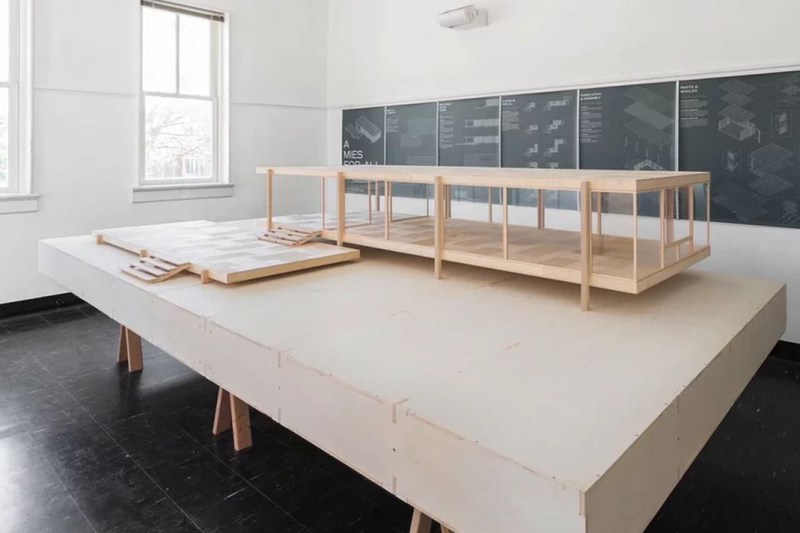
There’s the open market, where period commercial and residential properties can be found in stages of disrepair or ballooning in value. There’s the standby building-in-the-style-of. And, soon, there could be DIY kits for original Modernist designs. Collaborative venture A Mies for All (AMFA), a project of Dutch firm One Architecture and Lexington, Ky.–based design and research studio Filson and Rohrbacher, is attempting to revive the tenet of Modernism that calls for efficacious design for the masses. Starting with Mies van der Rohe’s Farnsworth House, the firms have proposed modular, full-scale replicas that can be built anywhere in the world using local labor—no Miesian expertise necessary.
Whether
this is the mass availability Mies envisioned or the mass production that’s currently fueling
a knock-off culture in furniture and object design—or a twist on both—will be the subject of a
round-table discussion this Wednesday, Sept. 2, at Hôtel Droog, in Amsterdam.
The gallery talk closes the AMFA exhibition “A Mies for All: On Democratic Architecture,”
which explores the firms’ proposal, and will cover technology, open-source design, and the art of ripping off famous works of art and architecture. Participants include French artist Pierre Bismuth, who wrote
the screenplay for the film Eternal
Sunshine of the Spotless Mind; Anne Filson, co-founder at Filson and
Rohrbacher; Matthijs Bouw, founding principal at One Architecture; Ed van
Hinte, chairman of Lightness Studios,
in the Netherlands; and Dutch journalist Bernard Hulsman.
For more information, visit: hoteldroog.com/events/